
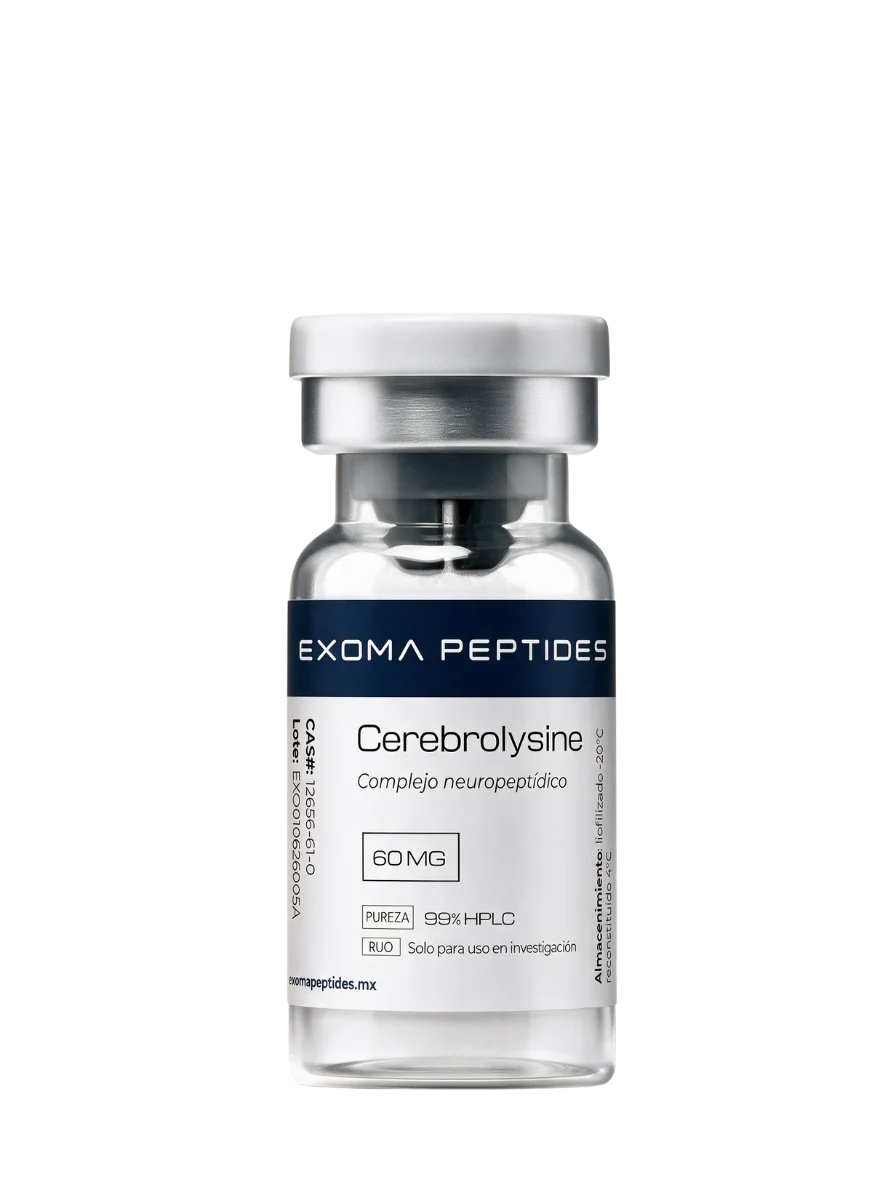
Cerebrolysin
Cerebrolysin — reagent for research use (RUO).
Technical data
- INN name
- Cerebrolysin
- Development code
- FPF-1070
- CAS
- 12656-61-0
Sizes and prices: 60 mg $1,450 MXN ($24 MXN per mg).
Buy Cerebrolysine in Mexico: order online with nationwide shipping in 1-4 business days depending on zone and tracking number. Prices in Mexican pesos. Material for research use only.
Cerebrolysin is known internationally as Cerebrolysin (English INN name). Buy Cerebrolysin in Mexico / comprar Cerebrolysin en México: reagent for research use (RUO) and nationwide shipping.
Cerebrolysine is also searched as: FPF-1070, Cerebrolisina.
Identity and composition
Cerebrolysin (Cerebrolysin, 60 mg) is a neuropeptide preparation: a standardized enzymatic hydrolysate of purified porcine brain proteins, composed of biologically active low-molecular-weight peptides (<10 kDa) plus free amino acids. It is investigated for its action similar to that of endogenous neurotrophic factors on neuronal protection and repair.
Unlike a single molecule, it cannot be represented by a defined molecular weight, chemical formula, or sequence, because it is a heterogeneous mixture; therefore those fields do not apply and are omitted. The number associated CAS is 12656-61-0. Among its synonyms are cerebroprotein hydrolysate, porcine brain peptide preparation and the code FPF-1070.
Product for research use.
Mechanism of action
In preclinical models (in vitro and in animals) Cerebrolysin has been characterized as a neuropeptide preparation that mimics the action of endogenous neurotrophic factors on the protection and repair of brain tissue (PMID 22514792). The mechanistic literature attributes its effects to neurotrophic-type signaling, antiapoptotic activity, reduction of oxidative stress, promotion of neurogenesis (for example in the dentate gyrus and the subventricular zone) and reinforcement of synaptic plasticity.
A review article describes that it decreases beta-amyloid deposition and tau phosphorylation by modulating the activity of GSK-3beta and CDK5 (PMID 22514792). In in vitro and in vivo work it has also been observed that reduces microglial activation, proposed as a neuroprotective and immunomodulatory mechanism (PMID 10961440).
It should be clarified that the presence of intact proteins such as BDNF, NGF, GDNF, or CNTF appears in secondary sources, but is not confirmed in the reviewed mechanistic reviews; the neurotrophic action is better described as factor-mimetic, not as a supply of those intact factors.
Pharmacokinetics
No pharmacokinetic profile or reliable half-life was found in the reviewed sources. As it is a mixture of peptides and amino acids administered by the parenteral route (IV/IM), there is no single half-life value that can be reported from this evidence. Any specific figure would fall outside what is verifiable, so it is deliberately omitted.
Scientific evidence
Cerebrolysin has been studied clinically for decades, mainly outside the United States, where it is not an FDA-approved drug. There are randomized controlled trials and meta-analyses in acute ischemic stroke, as well as double-blind placebo-controlled trials by the intravenous route in Alzheimer-type dementia (PMID 8159781) and in vascular dementia; it has also been investigated preliminarily in traumatic brain injury and spinal cord injury (PMID 22514792).
La the quality of the evidence is mixed and a good part remains characterized as preliminary. In clinical and preclinical studies, its neurotrophic and peptidergic neuromodulatory action has been investigated (PMID 8159781), but the efficacy conclusions are not established and the results should be interpreted with caution. The preliminary evidence suggests lines of research, not promised outcomes.
Research applications
Product for research use.
- Ideal for: in vitro and preclinical research work oriented toward neurotrophic-type signaling, neuroprotection, modulation of microglial activation, neurogenesis, and synaptic plasticity; comparative studies against other neurotrophic approaches.
- Not applicable for: clinical use, self-administration, clinical use, diagnosis or treatment of any condition. It does not replace medical care or approved drugs.
The EXOMA open-store framing is explicit: this material is offered only for research and laboratory-handling purposes by qualified personnel.
Research protocols
In the reviewed clinical research, Cerebrolysin has been administered by parenteral route (intravenous or intramuscular), including double-blind, placebo-controlled intravenous schemes in Alzheimer-type dementia (PMID 8159781).
No verifiable numerical doses in milligrams, durations or frequencies linked to a specific citation are available in this source, so dosing figures are omitted so as not to exceed what is supported. The experimental design (dose, route, duration) must be defined by the researcher in accordance with their protocol and primary literature.
Reconstitution
As a general laboratory handling guide, lyophilized peptide materials are usually reconstituted with bacteriostatic water (sterile water with ~0.9% benzyl alcohol) or, depending on the design, with sterile water for injection. Standard technique: add the diluent letting it run slowly down the wall of the vial, without injecting the stream directly onto the powder, and swirl gently the vial without shaking to avoid damaging the peptides, until a clear solution is obtained.
The specific presentation determines the procedure: if the material is received already in solution, it does not require reconstitution. Always handle with aseptic technique.
Stability and storage
As a standard of laboratory handling, a peptide material lyophilized is more stable and is usually stored refrigerated (2–8 °C) o frozen for prolonged storage, protected from light and humidity. Once reconstituted, the solution is less stable: it is advisable to keep it refrigerated, use it within a short period and avoid repeated freeze-thaw cycles.
Always follow the conditions indicated on the batch and supplier label, which take precedence over this general guide.
Safety profile
Among the adverse effects associated with injection, the following have been documented nausea, dizziness, headache and sweating. According to prescribing precaution summaries, it has been reported that not recommended in people with epilepsy, kidney disease, or hypersensitivity to its components.
It should be emphasized that Cerebrolysin is not an approved drug in the United States and that this profile is described for informational and laboratory-handling purposes, not as guidance for use in people. As it is a product for research, it must be handled with the appropriate protective equipment and biosafety protocols.
Comparative context
Unlike single-molecule nootropics or individual recombinant neurotrophins (for example, recombinant BDNF or NGF), Cerebrolysin is a heterogeneous peptide/amino acid hydrolysate of porcine origin. Therefore:
- Does not have a defined molecular weight, formula, or sequence.
- Cannot be represented as a single structure in PubChem.
- Its hypothetical advantage over administering individual neurotrophins would be the small size of its peptides, which would facilitate crossing the blood-brain barrier; this is posited as a mechanistic hypothesis, not as an established fact.
In summary, it is distinguished by being a standardized mixture with factor-mimetic action, in contrast to agents of a single chemical composition.
History and development
Cerebrolysin was developed as a standardized preparation of peptides derived from porcine brain obtained by enzymatic (proteolytic) hydrolysis, also known by the development code FPF-1070 and as cerebroprotein hydrolysate. It has been studied clinically for decades, especially outside the United States, where it does not have FDA approval. Its research primarily spans the field of neuroscience, with trials in Alzheimer-type dementia, vascular dementia, and ischemic stroke, and preliminary exploration in traumatic brain injury and spinal cord injury.
FAQ
What is Cerebrolysin and what is it researched for?
It is a neuropeptide preparation: a standardized enzymatic hydrolysate of porcine brain proteins, with peptides <10 kDa and free amino acids. In preclinical and clinical research, its neurotrophic-type and neuroprotective action has been studied, primarily in the field of neuroscience. It is a product for research use; not for clinical use.
Does Cerebrolysin have a defined chemical formula or molecular weight?
No. Being a heterogeneous mixture of peptides and amino acids, it does not have a unique molecular weight, formula, or sequence, and cannot be represented as a single structure in PubChem. The associated CAS number is 12656-61-0.
Is it approved by the FDA?
No. Cerebrolysine is not an FDA-approved drug in the United States. It has been studied clinically for decades mainly outside that country, with mixed and largely preliminary evidence.
What is its proposed mechanism of action?
In preclinical models it is credited with neurotrophic-type signaling, antiapoptotic activity, reduction of oxidative stress and microglial activation, promotion of neurogenesis and synaptic plasticity. A review describes a decrease in beta-amyloid and in tau phosphorylation via GSK-3beta and CDK5 (PMID 22514792).
How is it stored and reconstituted?
As a general laboratory guide, the lyophilized material is stored refrigerated or frozen, protected from light and humidity; once reconstituted with bacteriostatic water, it is kept refrigerated and used within a short time, avoiding freeze-thaw cycles. Always follow the batch label.
What adverse effects have been documented?
Nausea, dizziness, headache and sweating associated with the injection have been reported. According to summaries of precautions, it is not recommended in people with epilepsy, kidney disease or hypersensitivity to its components. It is a product for research, not for use in people.
Customer reviews
Average rating: 4.8 out of 5, based on 6 customer ratings.
Sergio Z. — 5/5
Very satisfied with the Cerebrolysin. The package arrived sealed and with excellent thermal protection.
Romina C. — 5/5
Super protected glass vials; none arrived fractured.
Claudia R. — 5/5
I was afraid the Cerebrolysine would be damaged along the way by the heat, but it arrived super well protected and in excellent condition. Very professional.
David L. — 4/5
A unique product you won't find with other suppliers. Good quality and documentation.
Jorge L. — 5/5
I wrote to them on WhatsApp with some questions and they answered quickly. The product is good, as I expected
Scientific references (4)
Peer-reviewed literature on Cerebrolysin, with its PubMed identifier where available:
- Cerebrolysin and Recovery After Stroke (CARS): A Randomized, Placebo-Controlled, Double-Blind, Multicenter Trial (Muresanu, et al. · Stroke · 2016) PMID 26564102.
- A 28-week, double-blind, placebo-controlled study with Cerebrolysin in patients with mild to moderate Alzheimer's disease (Ruether, et al. · International Clinical Psychopharmacology · 2001) PMID 11552768.
- Cerebrolysin in mild-to-moderate Alzheimer's disease: a meta-analysis of randomized controlled clinical trials (Gauthier, et al. · Dementia and Geriatric Cognitive Disorders · 2015) PMID 25832905.
- Safety and efficacy of Cerebrolysin in early post-stroke recovery: a meta-analysis of nine randomized clinical trials (Bornstein, et al. · Neurological Sciences · 2018) PMID 29248999.
Full scientific profile: Brain Peptide Complex in the compendium — mechanism of action, studies and technical data sheet.
See the full category catalog: Cognitive.