
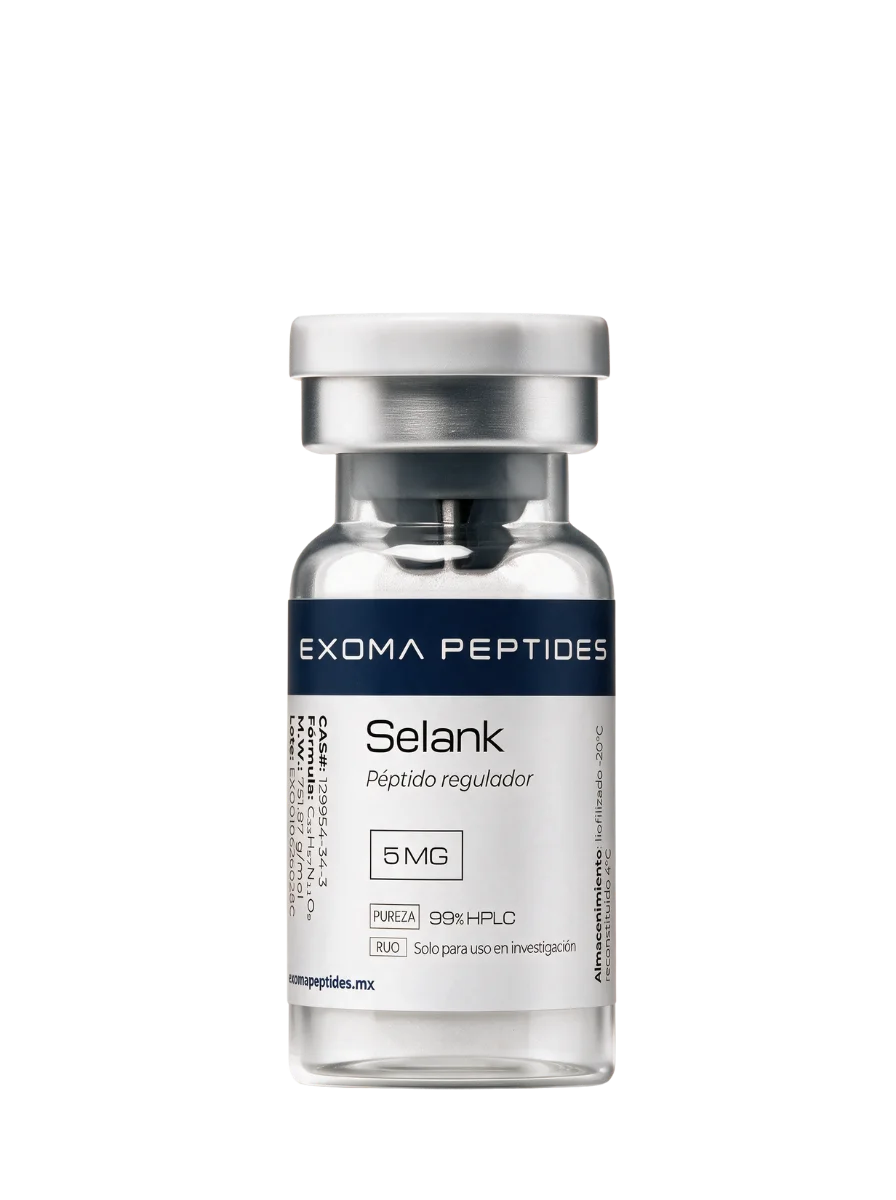
Selank
Selank — research reagent (RUO). HPLC purity 99.6 % with COA per batch.
Technical data
- CAS
- 129954-34-3
- Molecular formula
- C33H57N11O9
- Molecular weight
- 751.88 g/mol
Sizes and prices: 5 mg $599 MXN ($120 MXN per mg) · 10 mg $890 MXN ($89 MXN per mg) · 30 mg $1,999 MXN ($67 MXN per mg).
Buy Selank in Mexico: order online with nationwide shipping in 1-4 business days depending on zone and tracking number. Prices in Mexican pesos. Material for research use only.
Selank is also searched as: TKPRPGP, TP-7, tuftsina-PGP.
Identity and composition
Selank is a synthetic heptapeptide of sequence Thr-Lys-Pro-Arg-Pro-Gly-Pro (CAS 129954-34-3; molecular formula C33H57N11O9), developed in Russia by the Institute of Molecular Biology of the Academy of Sciences in collaboration with the Institute of Pharmacology. It was designed as a structural analogue of tuftsin, an endogenous tetrapeptide derived from immunoglobulin G with immunomodulatory and neurotropic activity. To the tuftsin fragment was added the C-terminal tail Pro-Gly-Pro, a modification that confers notably greater resistance to degradation by plasma peptidases, thus prolonging its functional life relative to the native peptide. This class of anxiolytic nootropic peptides has been the subject of extensive research for its ability to modulate limbic circuits without the classic sedative effects. Those seeking to buy Selank Mexico for pharmacological research lines receive it as a lyophilized reference material intended exclusively for research (RUO). Its compact molecular profile and improved enzymatic stability make it an attractive tool for studies of experimental anxiety, neuroplasticity and regulation of the stress response in controlled preclinical models.
Mechanism of action
The mechanism of Selank is multimodal and converges on the GABAergic system and serotonergic signaling. In experimental models, the peptide modulates the inhibitory neurotransmission mediated by GABA, producing an anxiolytic effect without the sedation, muscle relaxation, or potential for dependence characteristic of benzodiazepines. In parallel it influences the serotonergic pathway, adjusting serotonin metabolism in limbic structures associated with emotional regulation. Selank increases the expression of BDNF (brain-derived neurotrophic factor), a central mediator of synaptic plasticity and neuroprotection, and raises the levels of enkephalins by inhibiting enkephalinase, the enzyme that degrades these endogenous opioid peptides, prolonging their modulatory action. At the immunological level it regulates the expression of proinflammatory cytokines such as IL-6 and modifies the production of interferon, reflecting its functional kinship with tuftsin. This combination of actions on GABA, serotonin, neurotrophic factors, and immune mediators explains its interest as a nootropic anxiolytic peptide in chronic stress research. All of these findings come from preclinical models and the material is offered for research (RUO).
Pharmacokinetics
As a low-molecular-weight peptide, Selank exhibits pharmacokinetics conditioned by its amino-acid nature: it is susceptible to the action of peptidases, although the Pro-Gly-Pro tail incorporated into its design substantially slows that degradation compared with native tuftsin. In research protocols the intranasal route has been widely explored, exploited for its ability to facilitate the access of peptide molecules to the central nervous system by crossing the blood-brain barrier more efficiently than other routes, as well as parenteral administration in animal models. Studies describe a relatively rapid onset of action and effects that persist beyond the detectable presence of the intact peptide in circulation, a phenomenon attributed to the cascade of neurochemical events it triggers, including the induction of BDNF and enkephalins. Its distribution, metabolism by peptide hydrolysis and elimination follow the general patterns of oligopeptides. These parameters are documented for the purpose of experimental characterization; the product is supplied as a research reagent (RUO) and its handling corresponds to laboratory settings.
Scientific evidence
The evidence on Selank comes mostly from Russian preclinical research and from exploratory clinical studies conducted in its country of origin, where it has been studied in the context of generalized anxiety disorders. Animal models consistently document anxiolytic-type effects in standardized behavioral tests, together with improvements in learning and memory parameters attributable to its nootropic action and to the induction of BDNF. Molecular-level research has described changes in the gene expression of limbic structures, in the balance of proinflammatory cytokines such as IL-6 and in the activity of the enkephalin system mediated by inhibition of enkephalinase. Its influence on serotonergic metabolism and on oxidative stress markers in models of experimental chronic stress has also been characterized. Although the international peer-reviewed body of literature is more limited than that of conventional drugs, the overall dataset offers a coherent pharmacological basis for continued research. This material is intended exclusively for research (RUO) and does not constitute a claim of therapeutic efficacy in humans.
Research applications
In the research domain, Selank concentrates its interest in three major lines. The first is experimental generalized anxiety: numerous behavioral models use it to study anxiolytic mechanisms alternative to benzodiazepines, given that it reduces anxiety markers without inducing sedation or tolerance. The second is the study of experimental chronic stress and its neurochemical consequences, where its capacity to normalize the balance of neurotransmitters, raise BDNF and counteract alterations induced by sustained stress in limbic structures is analyzed. The third is immune modulation, a direct inheritance from its kinship with tuftsin, explored through the regulation of proinflammatory cytokines such as IL-6 and the production of interferon. Added to these is its role as a nootropic anxiolytic peptide in research on memory, learning and neuroplasticity. For laboratories evaluating Selank price and availability, the 5 mg vial constitutes a practical reference format. All of these applications are framed strictly within research use (RUO), in cellular and animal models under controlled laboratory conditions.
Research protocols
Research protocols with Selank define experimental variables such as the working concentration, the frequency of administration, and the route used, always within preclinical designs. From a 5 mg lyophilized vial, researchers establish a stock solution by reconstitution with bacteriostatic water and calculate aliquots according to the target concentration of the assay; for example, reconstituting with 1 mL generates a solution of approximately 5 mg/mL, while 2 mL produce close to 2.5 mg/mL, facilitating finer dosing in small models. The preclinical literature has explored both acute administrations to observe immediate anxiolytic effects and repeated schemes to study sustained neurochemical adaptations, including the intranasal route for its efficient access to the central nervous system. The absence of tolerance and dependence described in models makes it possible to design prolonged-exposure protocols that are difficult to replicate with classical anxiolytics. Traceability, lot recording, and reproducibility are pillars of rigorous work. These parameters are indicative for research (RUO) and must be adjusted to the specific experimental design of each laboratory and to its internal quality controls.
Reconstitution
Reconstitution of Selank starts from the lyophilized 5 mg vial and uses bacteriostatic water as the reference diluent in laboratory work. Adding 1 mL of bacteriostatic water yields a solution of approximately 5 mg/mL, a concentration suitable when the goal is to minimize the administration volume in the experimental model; alternatively, using 2 mL yields a solution close to 2.5 mg/mL, useful when the design requires larger volumes or more granular dosing. The diluent should be directed against the inner wall of the vial, letting it run gently down over the lyophilized pellet rather than projecting it directly onto it, since peptides are sensitive to vigorous mechanical agitation. After addition, it is recommended to swirl the vial gently, without shaking or forming foam, until a clear, homogeneous solution is obtained. It is advisable to label the vial with the resulting concentration and the reconstitution date to ensure reagent traceability. Careful calculation of the aliquots ensures reproducibility across replicates. This procedure corresponds to the preparation of a research-use-only (RUO) material handled with aseptic technique in the laboratory setting.
Stability and storage
The stability of Selank depends directly on its physical state and on the storage conditions. In its lyophilized form, the peptide is notably stable and should be kept at -20 °C, a condition under which it maintains its structural integrity for extended periods and is protected against moisture and thermal degradation. Once reconstituted with bacteriostatic water, the solution is more labile and should be refrigerated between 2 and 8 °C, remaining in good condition for a maximum of 30 days; beyond that threshold, the activity of the peptide may be compromised by progressive hydrolysis. The Pro-Gly-Pro tail incorporated into its design improves enzymatic resistance compared with native tuftsin, but does not exempt it from respecting the cold chain. It is advisable to avoid repeated freeze-thaw cycles, which favor degradation and loss of potency, so the preparation of single-use aliquots is a recommended practice. Protection from direct light and recording the reconstitution date complete the good practices. These recommendations apply to the handling of a research reagent (RUO).
Safety profile
In the preclinical literature, Selank stands out for a favorable tolerability profile within the experimental contexts studied. Unlike benzodiazepines, the models do not describe significant sedation, muscle relaxation, impaired coordination, or the development of tolerance or dependence with repeated administration, features that drive much of the scientific interest in this nootropic anxiolytic peptide. Nor have the withdrawal syndromes associated with discontinuation of classic anxiolytics been documented. Its kinship with tuftsin and its immunomodulatory action are investigated as potentially favorable properties rather than as sources of toxicity within the ranges studied. Nonetheless, all safety characterization comes from cellular and animal models, so it cannot be extrapolated to humans nor interpreted as a guarantee of safety. Responsible handling requires aseptic technique, personal protective equipment, concentration control, and rigorous lot recording. Selank is marketed strictly as research-use-only (RUO) material, intended for laboratories and trained personnel operating under biosafety protocols and controls appropriate to their setting.
Comparative context
Selank is usually compared with two reference points. Against benzodiazepines, its main contrast lies in the fact that it exerts anxiolytic effects by modulating the GABAergic and serotonergic systems without producing the sedation, muscle relaxation or the potential for tolerance and dependence that characterize that family; this separation between anxiolytic action and central nervous system depression is precisely what makes it attractive in research on new mechanisms. Its other reference point is Semax, the sibling nootropic peptide that also arose from the Russian pharmacological school: both share origin and research class, but Semax is oriented preferentially toward cognitive functions, neuroprotection and stimulation, whereas Selank emphasizes the anxiety-stress axis and the immune modulation inherited from tuftsin. Compared with other tuftsin analogs, Selank stands out for the enzymatic stability conferred by the Pro-Gly-Pro tail. For laboratories evaluating buying Selank in Mexico and comparing Selank price against other peptides, this positioning clarifies its experimental niche. Any comparison is pharmacological in nature and the material is offered for research (RUO).
History and development
The development of Selank is set within the Russian tradition of research on regulatory peptides. It was created by the Institute of Molecular Biology of the Russian Academy of Sciences together with the Research Institute of Pharmacology, as part of a program aimed at designing synthetic analogs of endogenous peptides with neurotropic and immunomodulatory properties. The starting point was tuftsin, a tetrapeptide derived from immunoglobulin G known for its activity on the immune system and behavior. The researchers retained the active fragment and added the C-terminal sequence Pro-Gly-Pro to overcome the main limitation of native tuftsin: its rapid degradation by peptidases. The result was a stable heptapeptide with reproducible anxiolytic action in experimental models, which became a benchmark of the generation of nootropic anxiolytic peptides alongside its sibling Semax. Since then it has been the subject of preclinical and exploratory clinical studies in its country of origin. Today it circulates internationally as a research reagent, and those seeking to buy Selank in Mexico acquire it strictly as research-use-only (RUO) material for scientific purposes.
FAQ
How does Selank differ from benzodiazepines?
Although both share an anxiolytic effect observed in experimental models, the mechanism and profile differ notably. Selank is a heptapeptide that modulates the GABAergic system and serotonergic signaling and induces BDNF and enkephalins, producing a reduction in anxiety without the sedation, muscle relaxation or cognitive impairment typical of benzodiazepines. Furthermore, the preclinical literature does not describe the development of tolerance, dependence or withdrawal syndrome associated with discontinuation of those drugs, which motivates its study as a mechanistic alternative. This information is pharmacological and applies to a research-use-only (RUO) material.
Are Selank and Semax the same?
No. They are distinct peptides, although related by their origin in the Russian pharmacological school and by belonging to the same class of nootropic research peptides. Selank is derived from tuftsin and its sequence is Thr-Lys-Pro-Arg-Pro-Gly-Pro, with emphasis on the modulation of anxiety, stress and the immune response. Semax is derived from a fragment of ACTH and is oriented preferentially toward cognitive functions, neuroprotection and stimulation. They share the stabilization strategy with added residues, but they have different structure, predominant mechanism and experimental applications. Both are offered exclusively for research (RUO).
How is the 5 mg Selank vial reconstituted?
The 5 mg lyophilized vial is reconstituted with bacteriostatic water. Adding 1 mL yields a solution of approximately 5 mg/mL, while 2 mL produce close to 2.5 mg/mL, a useful option for finer dosing in the experimental model. The diluent should be allowed to run gently down the wall of the vial onto the pellet, without projecting it forcefully, and then the vial should be swirled gently without shaking or forming foam until a clear solution is obtained. It is advisable to label the concentration and the date. This is a laboratory procedure for a reagent intended for research (RUO).
How is Selank stored to preserve its stability?
In its lyophilized form, Selank should be stored at -20 °C, a condition under which it remains stable for prolonged periods. Once reconstituted with bacteriostatic water, the solution should be refrigerated between 2 and 8 °C and used within a maximum of 30 days. It is recommended to avoid repeated freeze-thaw cycles, to prepare single-use aliquots, and to protect the material from direct light. The Pro-Gly-Pro tail improves its enzymatic resistance, but respecting the cold chain remains essential. These instructions correspond to the handling of a material for research (RUO).
What is the mechanism of action of Selank?
Selank acts in a multimodal manner. It modulates the GABAergic system to produce an anxiolytic effect without sedation and adjusts serotonergic signaling in limbic structures. It increases the expression of BDNF, key to synaptic plasticity, and raises enkephalins by inhibiting enkephalinase, the enzyme that degrades them. At the immune level it regulates proinflammatory cytokines such as IL-6 and modifies interferon production, reflecting its kinship with tuftsin. This combination explains its interest as a nootropic anxiolytic peptide. All findings come from preclinical models and the product is intended for research (RUO).
Where to buy Selank in Mexico and what format does it come in?
At EXOMA, Selank is offered as a reference material for research (RUO) in a 5 mg lyophilized vial presentation, a practical format for preparing stock solutions and aliquots in the laboratory. Those looking to buy Selank in Mexico and comparing Selank prices will find in this vial a standard unit for designing preclinical protocols of anxiety, stress, and immune modulation. The product comes with clear storage and reconstitution conditions to preserve its stability. Its sale is directed exclusively toward scientific research purposes in laboratory settings.
Customer reviews
Average rating: 5.0 out of 5, based on 18 customer ratings.
Paulina G. — 5/5
Very happy with my purchase of Selank. The package arrived earlier than expected.
Valeria S. — 5/5
I had my doubts but the quality is evident from the packaging. Very attentive customer service.
Héctor E. — 5/5
I bought Selank and everything perfect. They kept me informed of the tracking number at all times.
Héctor E. — 5/5
Very satisfied with the Selank. Very fast shipping.
Ivanna T. — 5/5
They helped me a lot via WhatsApp on a Sunday afternoon.
Diana M. — 5/5
Excellent complement to Semax. Very good quality.
Paloma K. — 5/5
Everything well packed, vials intact and clean.
Perla H. — 5/5
No pain or irritation when used. Zero surprises.
Querube A. — 5/5
Super friendly and professional support. Great purchase.
Quenia M. — 5/5
No uncomfortable side effects, very clean.
Quetzal V. — 5/5
Very attentive to my questions about dilution.
Héctor E. — 5/5
Very satisfied with the Selank. They kept me informed about the tracking the whole time.
Quintín B. — 5/5
Very comfortable to use and no discomfort afterward.
Mario M. — 5/5
Very satisfied with the cost-benefit ratio, I will definitely order again.
Mónica P. — 5/5
I have used several lots and the quality is always the same. Very reliable.
Diana S. — 5/5
The Selank arrived super well protected and right on time. Very professional.
Andrés M. — 5/5
The Selank has the purity I need for my research. Complete documentation and discreet shipping.
Certificate of analysis per batch
Selank lots with certificate of analysis published in the COA catalog:
- Lot EXO010626028A — 30 mg, issued 2026-05-28
- Lot EXO010626028C — 5 mg, issued 2026-05-29
Scientific references (8)
Peer-reviewed literature on Selank, with its PubMed identifier when available:
- Efficacy and possible mechanisms of action of a new peptide anxiolytic selank in the therapy of generalized anxiety disorder and neurasthenia (Seredenin SB, et al. · Zhurnal Nevrologii i Psikhiatrii im. S.S. Korsakova · 2008) — Estudio de efectos ansiolíticos de Selank sin sedación. PMID 18454096.
- Peptide-based Anxiolytics: The Molecular Aspects of Heptapeptide Selank Biological Activity (Vyunova, et al. · Protein & Peptide Letters · 2018) PMID 30255741.
- Efficacy of peptide anxiolytic selank during modeling of withdrawal syndrome in rats with stable alcoholic motivation (Kolik, et al. · Bulletin of Experimental Biology and Medicine · 2014) PMID 24913576.
- Peptide Selank Enhances the Effect of Diazepam in Reducing Anxiety in Unpredictable Chronic Mild Stress Conditions in Rats (Kasian, et al. · Behavioural Neurology · 2017)
- [Optimization of the treatment of anxiety disorders with selank]. (Medvedev VE, et al. · Zh Nevrol Psikhiatr Im S S Korsakova · 2015) PMID 26356395.
- [A comparison of the anxiolytic effect and tolerability of selank and phenazepam in the treatment of anxiety disorders]. (Medvedev VE, et al. · Zh Nevrol Psikhiatr Im S S Korsakova · 2014) PMID 25176261.
- Functional Connectomic Approach to Studying Selank and Semax Effects. (Panikratova YR, et al. · Dokl Biol Sci · 2020) PMID 32342318.
- Selank, Peptide Analogue of Tuftsin, Protects Against Ethanol-Induced Memory Impairment by Regulating of BDNF Content in the Hippocampus and Prefrontal Cortex in Rats. (Kolik LG, et al. · Bull Exp Biol Med · 2019) PMID 31625062.
Full scientific profile: Selank in the compendium — mechanism of action, studies and technical data sheet.
See the full category catalog: Cognitive.
Otras presentaciones de Selank
Guides and articles about Selank
Lecturas del blog de EXOMA que la editorial asoció a este compuesto: