
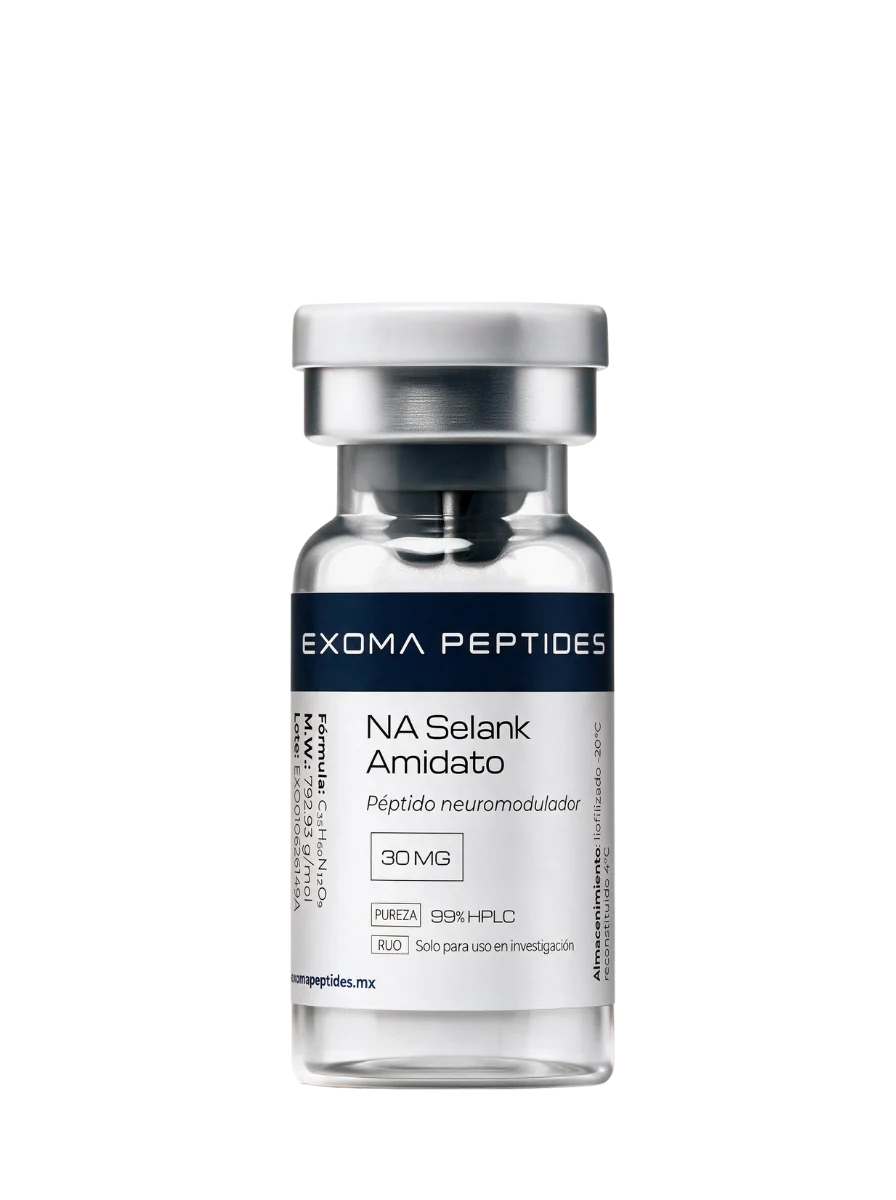
NA Selank Amidate
NA Selank Amidate — research reagent (RUO). COA per batch available.
Technical data
- INN name
- N-Acetyl Selank Amidate
- Molecular formula
- C35H60N12O9
- Molecular weight
- 792.94 g/mol
Sizes and prices: 30 mg $2,270 MXN ($76 MXN per mg).
Buy NA Selank Amidate in Mexico: order online with nationwide shipping in 1-4 business days depending on zone and tracking number. Prices in Mexican pesos. Material for research use only.
NA Selank Amidate is known internationally as N-Acetyl Selank Amidate (INN name in English). Buy N-Acetyl Selank Amidate in Mexico / buy N-Acetyl Selank Amidate in Mexico: research reagent (RUO) with COA per batch and nationwide shipping.
NA Selank Amidato is also searched as: NA-Selank amidate, Ac-TKPRPGP-NH2.
Identity and composition
NA Selank Amidate (N-Acetyl Selank Amidate) is a synthetic research peptide, a modified analog of the heptapeptide Selank. It is studied mainly as a modulator of the GABAergic system in preclinical models and in a context of anxiolytic research. Product for research use.
Structurally it corresponds to a variant of Selank with N-acetylation at the N-terminal end and C-amidation at the C-terminal end. The confirmed parent sequence of Selank is Thr-Lys-Pro-Arg-Pro-Gly-Pro (TKPRPGP), so the acetylated-amidated form is formally described as Ac-Thr-Lys-Pro-Arg-Pro-Gly-Pro-NH2. The motif Pro-Gly-Pro provides resistance against prolyl endopeptidases.
No specific entry for the N-acetylated/C-amidated analog was found in primary or regulatory sources (PubChem/DrugBank), so no specific CAS, molecular weight or molecular formula are reported here of this variant: those data are not verified for the acetylated-amidated compound and are deliberately omitted. It is also known as N-Acetyl Selank, NA Selank o NASA Selank. Reference presentation: 30 mg.
Mechanism of action
The documented mechanism corresponds to the parenteral Selank; there is no peer-reviewed primary literature specific to the N-acetylated/C-amidated analogue, so the following is described for educational purposes and by extension from the base peptide.
Selank is a synthetic heptapeptide derived from tuftsin (a fragment of the heavy portion of IgG). Its action has been linked to modulation of the GABAergic system. In preclinical studies, intranasal administration of Selank in rat frontal cortex altered the expression of a set of neurotransmission genes, with a strong positive correlation against the changes induced by GABA and increases in the epsilon subunit of the GABA-A receptor (Gabre) (Front Pharmacol 2016; PMID 26924987).
In an in vitro model (IMR-32 cells), Selank alone did not modify gene expression, but it suppressed the changes induced by GABA, which suggests a indirect modulatory effect on GABAergic signaling rather than direct receptor agonism (Front Pharmacol 2017; PMID 28293190). Unlike benzodiazepines, it does not act as a direct agonist of the GABA-A receptor. Additionally, modulation of enkephalins/the endogenous opioid system has been attributed to it (PMID 18454096). The acetyl/amide modification is proposed commercially to increase metabolic stability, but this advantage is not verified in peer-reviewed literature for this analog.
Pharmacokinetics
No published pharmacokinetics was found for the N-acetyl/C-amidated analogue. For the parent Selank, some commercial sources cite a very short plasma half-life and propose that the acetyl/amide modification could prolong it, but a quantitative half-life was not confirmed in a primary source, so no numerical values are reported here.
The preclinical literature describes administration intranasal and mentions a greater metabolic stability of Selank compared to tuftsin thanks to the added amino acids, without providing clearance or t½ values (PMID 26924987). Consequently, any half-life or stability-improvement figure attributed to the amidate variant should be considered an unverified claim.
Scientific evidence
The available evidence is preliminary and corresponds to the parent Selank, not to the acetylated-amidated variant, for which no primary literature was found.
- Preclinical / in vitro: in rodent studies and cell cultures, the modulation of GABAergic neurotransmission has been investigated (PMID 26924987; PMID 28293190).
- Clinical (limited): at least one small trial is available that compared intranasal Selank with a benzodiazepine (medazepam) over approximately 14 days in the context of generalized anxiety disorder and neurasthenia, where an apparently comparable anxiolytic efficacy with additional anti-asthenic effects was observed (PMID 18454096).
This trial is small, of short duration and published in a Russian journal; the remaining mechanistic evidence is preclinical. Taken together, the information on the NA amidate variant is of low confidence and of an exploratory nature.
Research applications
Product for research use.
It may be of interest for research in:
- In vitro and preclinical studies on modulation of GABAergic signaling.
- Comparative work on enzymatic stability between the parental Selank and analogs with terminal modifications (N-acetyl/C-amide).
- Preclinical anxiety-like behavior models, as an extension of the Selank research line.
Not applicable for:
- clinical use, clinical use, diagnostic or therapeutic.
- Extrapolating results from parental Selank to the NA amidate variant as if they were verified.
- Any application requiring confirmed pharmacokinetics or safety of the analog, since these are not available.
Research protocols
No validated milligram dosing protocol is available for the NA amidate variant in the primary literature. The clinical evidence for the parent Selank describes administration intranasal for approximately 14 days in a small trial against a benzodiazepine, but the literature consulted does not provide a dose figure in mg supported by a citation, so no numerical value is reported (PMID 18454096).
In preclinical studies, the route described is likewise intranasal in rodent models (PMID 26924987). Any working scheme must be defined within the researcher's experimental design; no orientative doses are offered as no verified data exist for this analog.
Reconstitution
General standard laboratory guide for lyophilized peptides:
- The 30 mg vial is usually reconstituted with bacteriostatic water (sterile water with approximately 0.9% benzyl alcohol), which allows multiple withdrawals by inhibiting microbial growth.
- Direct the solvent down the wall of the vial, with slow dripping; do not inject directly onto the powder nor shake forcefully. Gently swirl until fully dissolved.
- Adjust the solvent volume according to the working concentration desired for your experimental design.
- For preservative-free preparations, sterile water may be used, considering that it reduces the shelf life once reconstituted.
Intended solely for laboratory handling.
Stability and storage
Standard laboratory handling:
- Lyophilized (powder): is the most stable form. It is best stored protected from light and moisture; refrigeration prolongs its stability and freezing is suitable for prolonged storage.
- Reconstituted (in solution): store refrigerated and use within a short period. The solution form is less stable than the powder.
- Avoid repeated freeze-thaw cycles, which can degrade the peptide; consider dividing into aliquots.
- Label with the reconstitution date and concentration.
These are general handling guidelines; they do not replace the specific conditions defined by the researcher's protocol.
Safety profile
No peer-reviewed safety data specific to the N-acetyl/C-amidated analog were located.
For parental Selank, a small clinical trial reported a favorable profile, without the sedation, cognitive impairment or withdrawal syndrome typically associated with benzodiazepines over a period of approximately 14 days (PMID 18454096). Nevertheless, it is a study small, short in duration and published in a Russian journal, so long-term safety data are limited and should not be extrapolated to the amidated variant.
No formal contraindications or verified toxicological profile are available for this analog. Exclusively for research use; not for clinical use. Handle with appropriate protective equipment in a laboratory setting.
Comparative context
Compared to benzodiazepines (e.g., medazepam, diazepam): in the comparative trial, Selank showed an apparently similar anxiolytic efficacy, but without the characteristic sedation and with additional anti-asthenic effects (PMID 18454096). Mechanistically, it modulates the GABAergic system indirectly rather than acting as a direct agonist of the GABA-A receptor.
Compared to parental Selank: the NA amidate analog differs only by the N-acetylation and C-amidation, proposed to improve enzymatic stability (a supplier claim, not verified in primary literature). All available clinical and mechanistic data come from the base Selank.
Compared to Semax / N-Acetyl Semax: shares the conceptual family of Russian regulatory peptides with analogous terminal modifications, although Semax derives from ACTH and not from tuftsin, so its origin and action profile differ.
History and development
El Selank was developed by the Institute of Molecular Genetics of the Russian Academy of Sciences. It is a synthetic heptapeptide derived from tuftsin, a fragment of the heavy portion of the immunoglobulin IgG, to which amino acids were added that confer greater metabolic stability compared to the natural peptide.
It has been studied mainly in the context of generalized anxiety disorder (GAD) and neurasthenia, and outside Russia it is considered a research compound not approved as a drug. The variant NA Selank Amidate arises as a terminal chemical modification (N-acetyl/C-amide) proposed in commercial sources to increase resistance to aminopeptidases and carboxypeptidases; however, this specific variant does not have its own primary literature documenting its development or characterization.
FAQ
What is NA Selank Amidate and how does it differ from Selank?
It is a research variant of the heptapeptide Selank with N-acetylation at the N-terminus and C-amidation at the C-terminus. The parent sequence is Thr-Lys-Pro-Arg-Pro-Gly-Pro. The terminal modifications are proposed to improve enzymatic stability, although this advantage is not verified in peer-reviewed literature for the analog.
Does NA Selank Amidate have its own clinical studies?
No. All the clinical and preclinical evidence available corresponds to parental Selank, not to the acetylated-amidated variant. The information is considered of low confidence and of an exploratory nature, so it must not be extrapolated directly to this analog.
What is the studied mechanism of action?
In preclinical and in vitro models, Selank has been linked to the indirect modulation of the GABAergic system, without acting as a direct agonist of the GABA-A receptor (PMID 26924987; PMID 28293190). Modulation of enkephalins has also been attributed to it. There is no primary literature specific to the amidate analog.
How is it reconstituted and stored?
The lyophilized vial is usually reconstituted with bacteriostatic water, dripping the solvent down the wall of the vial without shaking vigorously. The powder is best stored refrigerated or frozen; once reconstituted, keep refrigerated, use within a short time and avoid freeze-thaw cycles.
Is the half-life or pharmacokinetics known?
No published pharmacokinetics were located for the analog. For the parent Selank, commercial sources cite a very short half-life, but no quantitative value was confirmed in a primary source, so no half-life figures are reported here.
Can it be used in humans?
No. It is a product for research use; not for clinical use. It has no peer-reviewed safety data specific to the analog nor a verified toxicological profile, and its use is limited to the laboratory.
Certificate of analysis per batch
NA Selank Amidate batch with certificate of analysis published in the COA catalog:
- Lot EXO010626149A — 30 mg, issued 2026-05-30
Scientific references (2)
Peer-reviewed literature on NA Selank Amidate, with its PubMed identifier where available:
- Efficacy and possible mechanisms of action of a new peptide anxiolytic selank in the therapy of generalized anxiety disorder and neurasthenia (Seredenin SB, et al. · Zhurnal Nevrologii i Psikhiatrii im. S.S. Korsakova · 2008) — Estudio de efectos ansiolíticos de Selank sin sedación. PMID 18454096.
- Peptide-based Anxiolytics: The Molecular Aspects of Heptapeptide Selank Biological Activity (Vyunova, et al. · Protein and Peptide Letters · 2018) PMID 30255741.
Full scientific profile: Selank in the compendium — mechanism of action, studies and technical data sheet.
See the full category catalog: Cognitive.