NA Semax Amidate
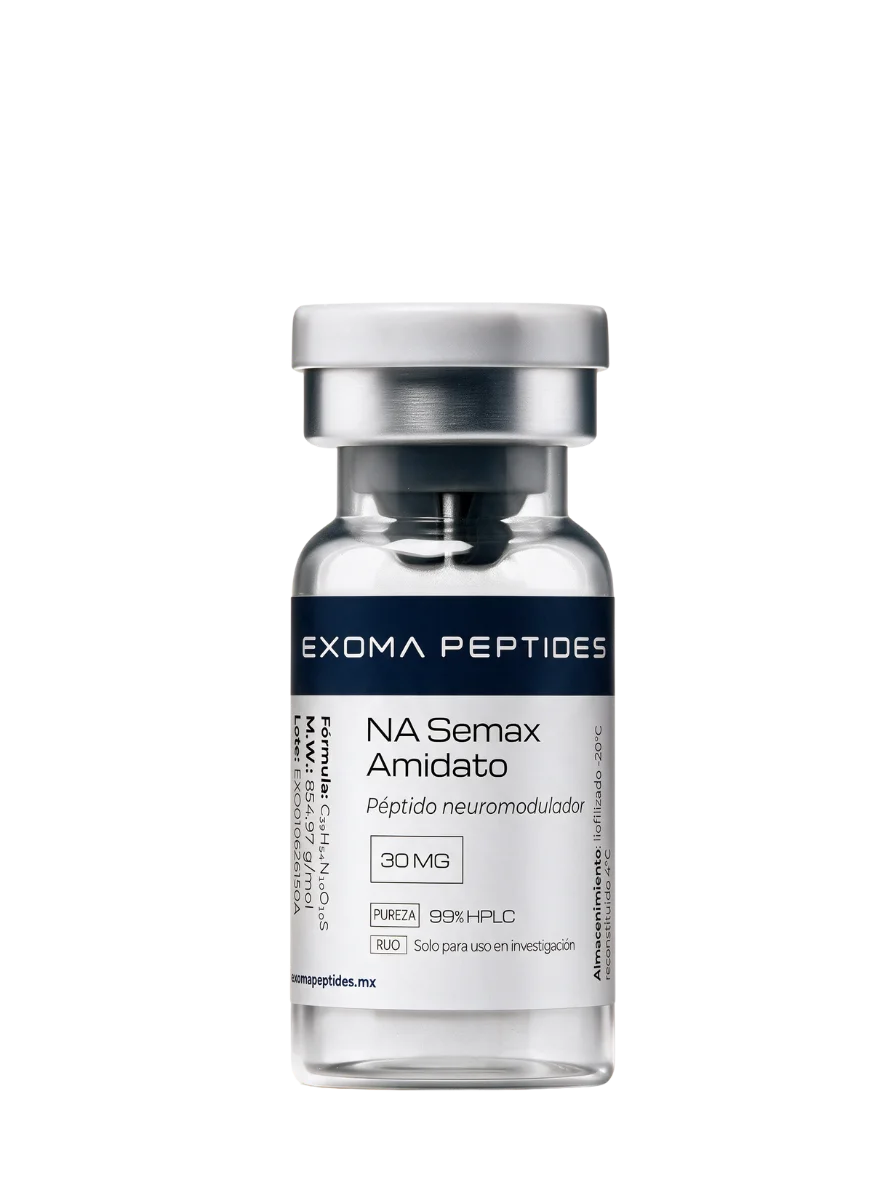
NA Semax Amidate — reagent for research use (RUO). COA per batch available.
Technical data
- INN name
- N-Acetyl Semax Amidate
- CAS
- 2920938-90-3
- Molecular formula
- C39H54N10O10S
- Molecular weight
- 855.0 g/mol
Sizes and prices: 30 mg $2,270 MXN ($76 MXN per mg).
Buy NA Semax Amidate in Mexico: order online with nationwide shipping in 1-4 business days depending on zone and tracking number. Prices in Mexican pesos. Material for research use only.
NA Semax Amidate is known internationally as N-Acetyl Semax Amidate (English INN name). Buy N-Acetyl Semax Amidate in Mexico / comprar N-Acetyl Semax Amidate en México: reagent for research use (RUO) with COA per batch and nationwide shipping.
NA Semax Amidato is also searched as: Ac-MEHFPGP-NH2, N-acetil semax amidato.
Identity and composition
NA Semax Amidate (N-Acetyl Semax Amidate) is a synthetic heptapeptide, a modified analogue of the peptide Semax (itself derived from the ACTH 4-10 fragment). It is studied in the research context for its kinship with peptides of neurotrophic interest. Product for research use.
As for its chemical identity, the compound is registered in PubChem (CID 172638603) with molecular formula C39H54N10O10S and a approximate molecular weight of 855.0 g/mol consistent with that formula. Its sequence corresponds to Ac-Met-Glu-His-Phe-Pro-Gly-Pro-NH2, that is, the heptapeptide Semax (MEHFPGP) with acetylation at the N-terminal end and amidation at the C-terminal end.
The value of CAS is not confirmed in primary reference sources for the amidate, so it is omitted. Among its synonyms include: N-acetyl semax amidate, NA Semax Amidate and Semax N-Acetyl Amidate.
Mechanism of action
It is important to note from the outset that there is no primary peer-reviewed literature on the pharmacology of this specific N-acetylated/amidated analog. The mechanism described below corresponds to the compound parent, Semax, and is extrapolated with caution; it should not be attributed directly to this modified variant.
For Semax, the proposed action is the modulation of neurotrophic factor expression. In in vivo studies in rats, changes have been observed (multidirectional depending on the brain region and time) in the gene expression of BDNF and NGF in hippocampus, frontal cortex, and retina after a single administration (PMID 19662538), as well as regulation of the BDNF/trkB system. Additional studies support the action of Semax on the expression of neurotrophins in rat brain (PMID 17353092).
Unlike full ACTH, Semax does not stimulate the adrenal MC2R receptor. Terminal modifications (acetyl/amide) are usually associated in peptide chemistry with greater resistance to exopeptidases, but that claim for this analog comes only from supplier material and is not verified in primary sources.
Pharmacokinetics
No published pharmacokinetic data were found (half-life, bioavailability) for the NA Semax Amidate analogue in primary sources. The claims of longer half-life or stability compared to native Semax come from supplier material and are not verified, so no numerical values are reported.
From peptide chemistry, N-terminal acetylation and C-terminal amidation usually reduce degradation by amino/carboxypeptidases; however, there are no studies quantifying this effect for the specific compound. Any pharmacokinetic characterization should be considered pending experimental determination.
Scientific evidence
The available evidence for this compound is very limited. NA Semax Amidate appears only as chemical entity in databases (PubChem CID 172638603) and in research supplier catalogs; no clinical trials were identified on ClinicalTrials.gov nor specific preclinical studies for the N-acetylated/amidated analog.
The existing research corresponds to the parent compound Semax, studied mainly in animal models for its action on the expression of neurotrophins (PMID 19662538; PMID 17353092), in addition to some Russian clinical studies on nootropic/neuroprotective properties. Those data should not be attributed directly to this analog. (sterile water with approximately 0.9% benzyl alcohol as preservative), which allows the solution to be kept for several days under refrigeration.
Research applications
Product for research use.
It may be of interest for:
- Physicochemical characterization and identity studies of Semax peptide analogs.
- In vitro or preclinical research exploring peptide analogs of the ACTH 4-10 fragment.
- Comparative stability work between native Semax and its terminally modified forms.
Not applicable for:
- clinical use, therapeutic use, or diagnostic or dietary use of any kind.
- Applications that require an established efficacy or safety profile: this compound does not have clinical or toxicology data own.
- Substitute for an approved medication: has neither FDA nor EMA approval.
Research protocols
No validated dosing protocols are available for NA Semax Amidate, since there are no published preclinical or clinical studies specific to this analog. Therefore, it is not possible to report study doses (in mg) supported by evidence for this variant.
The experimental parameters (concentration, route, frequency) must be defined by the researcher in accordance with the design of their protocol and good laboratory practices, documenting that this is a material for research use only. Any extrapolation from the parent compound Semax should be handled with caution and not as an established guideline.
Reconstitution
As a general laboratory-handling guide, the lyophilized peptide is usually reconstituted with bacteriostatic water (sterile water with approximately 0.9% benzyl alcohol), which helps limit microbial growth in solutions of repeated use. Sterile water for injection may also be used when the protocol requires it.
Suggested general steps:
- Let the vial reach room temperature before opening.
- Add the diluent, letting it run slowly down the wall of the vial, without injecting directly onto the powder.
- Do not shake vigorously; swirl gently until completely dissolved.
- Calculate the diluent volume according to the desired working concentration (for example, for the 30 mg vial, adjust the volume to the target concentration of the protocol).
Stability and storage
As a laboratory handling standard for lyophilized peptides:
- Lyophilized (powder): is the most stable form. It is usually kept refrigerated for short-term use and frozen for long-term storage, protected from light and moisture.
- Reconstituted (in solution): is less stable and must be kept refrigerated, used within a short period, and avoid repeated freeze-thaw cycles, which can degrade the peptide.
It is recommended to label the vial with the date of reconstitution and the concentration. There are no published stability data specific to this analog, so these indications are general handling guidelines, not validated product specifications.
Safety profile
No safety or toxicology data documented in primary sources were found for this specific analog. The compound is labeled for research only and has not been evaluated for clinical use by regulatory agencies; it has no FDA or EMA approval.
As it lacks a characterized safety profile, no contraindications, interactions, or adverse-event rates can be established. It must be handled in accordance with good laboratory practices: use of personal protective equipment, avoiding skin, eye, or inhalation exposure, and restricting its use exclusively to research purposes. Any risk associated with the analog remains undetermined for lack of studies.
Comparative context
NA Semax Amidate is a chemically modified variant of Semax, a heptapeptide derived from the ACTH 4-10 fragment. The stated structural difference from native Semax is the N-terminal acetylation and C-terminal amidation.
In general terms of peptide chemistry, these terminal modifications usually reduce degradation by amino- and carboxypeptidases, which in principle could be associated with greater enzymatic resistance. However, there are no published direct comparative studies that quantify differences in potency or pharmacokinetics between the amidate and native Semax, so any relative advantage remains unverified in primary sources.
Summary of contrasts:
- Native Semax: base heptapeptide, with research (mostly animal and Russian clinical) on neurotrophic action.
- NA Semax Amidate: form with modified termini; documented only as a chemical entity and in supplier catalogs, without pharmacological literature of its own.
History and development
Semax was developed as a synthetic analog of the ACTH 4-10 fragment, designed to retain neurotrophic/nootropic-type properties without adrenal hormonal activity (it does not stimulate the MC2R receptor). Its research has concentrated on animal models and on some Russian clinical studies oriented toward cognition and neuroprotection.
NA Semax Amidate arises as a subsequent modification of that molecule, with N-terminal acetylation and C-terminal amidation, common strategies in peptide chemistry to modulate stability. To date, this analog appears registered as a chemical entity in PubChem (CID 172638603) and is distributed in supplier catalogs as research material (research-use-only), without clinical development or regulatory approval documented.
FAQ
What is NA Semax Amidate and how does it differ from regular Semax?
It is a chemically modified variant of Semax (a heptapeptide derived from ACTH 4-10) with N-terminal acetylation and C-terminal amidation. These modifications are usually associated in peptide chemistry with greater resistance to peptidases, although there are no published direct comparative studies confirming it for this variant.
Are there clinical studies of NA Semax Amidate?
No. No clinical trials or preclinical studies specific to this N-acetylated/amidated analog were identified. The available research corresponds to the parent compound Semax, mainly in animal models, and must not be attributed directly to this variant.
What is the molecular formula and the molecular weight?
According to PubChem (CID 172638603), its molecular formula is C39H54N10O10S, with an approximate molecular weight of 855.0 g/mol consistent with that formula. Its sequence is Ac-Met-Glu-His-Phe-Pro-Gly-Pro-NH2.
How is it reconstituted and stored?
As a general laboratory guide, it is reconstituted with bacteriostatic water added slowly down the wall of the vial, swirling gently until dissolved. The lyophilized powder is stored refrigerated or frozen; once reconstituted, it is kept refrigerated, used soon and freeze-thaw cycles are avoided.
Is it safe for clinical use?
No. It is a product for research use; not for clinical use. There are no documented safety or toxicology data for this analogue and it does not have FDA or EMA approval.
What is the recommended dose?
There are no validated dosing protocols for this analog, since there are no specific published studies. The experimental parameters must be defined by the investigator in accordance with their protocol and good laboratory practices.
Customer reviews
Average rating: 4.3 out of 5, based on 4 customer ratings.
Guillermo G. — 4/5
Good service. The NA Semax Amidate arrived in good condition, although the box came a bit damaged by the rain.
Sebastián N. — 5/5
Very good product, the NA Semax Amidate. It arrived in 2 days and the courier service worked perfectly.
Raúl M. — 4/5
Good NA Semax Amidate. It took 3 business days to reach my home in Monterrey, everything in order and well packed in its little box.
Guillermo G. — 4/5
Good service. The NA Semax Amidate arrived in good condition.
Certificate of analysis per batch
NA Semax Amidate batch with certificate of analysis published in the COA catalog:
- Lot EXO010626150A — 30 mg, issued 2026-05-29
Scientific references (2)
Peer-reviewed literature on NA Semax Amidate, with its PubMed identifier where available:
- Semax and its metabolites have an effect on the dopaminergic system (Dolotov OV, et al. · Neurochemical Research · 2005) — Study on the mechanism of action of Semax in the dopaminergic system. PMID 16362768.
- Effectiveness of semax in acute period of hemispheric ischemic stroke (a clinical and electrophysiological study) (Gusev, et al. · Zhurnal Nevrologii i Psikhiatrii imeni S.S. Korsakova · 1997) PMID 11517472.
Full scientific profile: Semax in the compendium — mechanism of action, studies and technical data sheet.
See the full category catalog: Cognitive.