
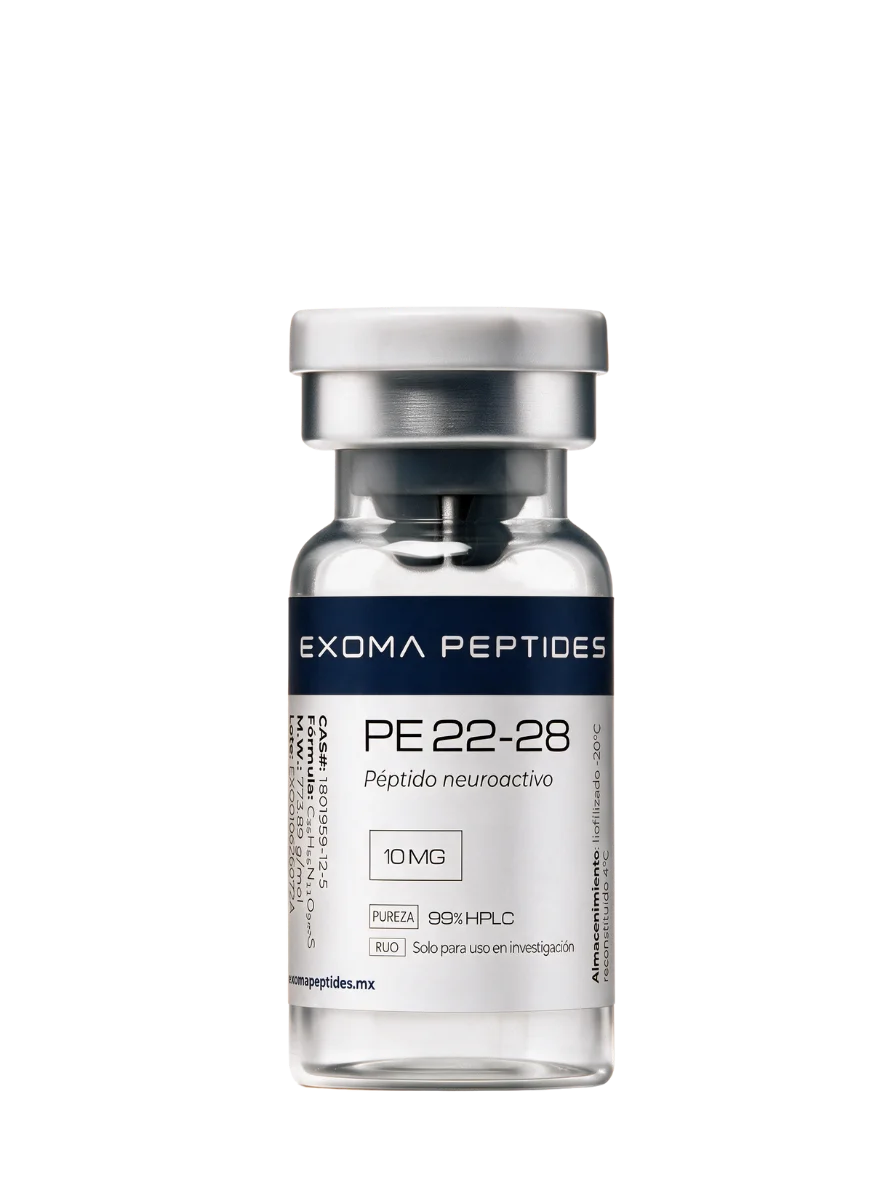
PE 22-28
PE 22-28 — research reagent (RUO).
Technical data
- CAS
- 1801959-12-5
- Molecular formula
- C35H55N11O9
- Molecular weight
- 773.89 g/mol
Sizes and prices: 10 mg $960 MXN ($96 MXN per mg).
Buy PE 22-28 in Mexico: order online with nationwide shipping in 1-4 business days depending on zone and tracking number. Prices in Mexican pesos. Material for research use only.
PE 22-28 is also searched as: Spadin analog.
Identity and composition
PE 22-28 is a synthetic heptapeptide (sequence Gly-Val-Ser-Trp-Gly-Leu-Arg, GVSWGLR) that corresponds to the residue 22-28 fragment of spadin and is studied in preclinical models as a selective inhibitor of the TREK-1 potassium channel. It is offered exclusively as laboratory material.
Product for research use.
As for its reference chemical identity, it has a molecular formula C35H55N11O9 and a molecular weight of 773.9 g/mol, with the sequence GVSWGLR confirmed in PubChem. It is also known by the synonyms Mini-spadin, PE22-28 y Spadin fragment (22-28). No confirmed CAS number is available in the consulted reference databases, so that datum is omitted.
Mechanism of action
PE 22-28 corresponds to fragment 22-28 of the spadin propeptide, an endogenous peptide derived from the propeptide (PE 1-44) that is released during sortilin maturation. Its proposed mechanism is the selective inhibition of the two-pore potassium channel TREK-1 (KCNK2) (Djillani et al., 2017; PMID 28955242).
In preclinical studies, a IC50 of 0.12 nM on TREK-1, approximately 300 times more potent than spadin (IC50 of 40-60 nM). The inhibition of TREK-1 in hippocampal and cortical neurons is the mechanism that research proposes for its antidepressant-like effect observed in animal models (PMID 28955242).
The formula (C35H55N11O9), the molecular weight (773.9 g/mol) and the sequence GVSWGLR are confirmed in PubChem (CID 165437303).
Pharmacokinetics
No such was identified precise plasma half-life (t1/2) in a primary source, so that value is omitted.
What has been reported in in vivo models is a improved duration of action relative to spadin, of up to approximately 23 hours versus about 7 hours of spadin, attributed to greater in vivo stability of the shortened fragment (Djillani et al., 2017; PMID 28955242). These data come only from animal models and no pharmacokinetic parameters have been characterized in humans.
Scientific evidence
The available evidence is preliminary and exclusively preclinical (in vitro and in vivo in rodents). There are no registered clinical trials or published human efficacy or safety data, and the compound does not have regulatory approval.
In the primary study (Djillani et al., 2017; PMID 28955242), following a subchronic 4-day treatment in rodents, a reduction in immobility time in behavioral tests and in the latency to feed in the novelty-suppressed feeding test was observed, as well as evidence of hippocampal neurogenesis (increase in BrdU-positive cells) and synaptogenesis (increase in PSD-95).
The indication under investigation (depression) remains in the preclinical phase. These findings should not be interpreted as evidence of an effect in humans.
Research applications
Product for research use.
Ideal for:
- In vitro studies on the activity of the potassium channel TREK-1 (KCNK2).
- Preclinical research in animal models on antidepressant-like mechanisms associated with TREK-1 inhibition.
- Studies of neurogenesis and synaptogenesis in rodents.
- Comparative work versus spadin and other fragments.
Not applicable for:
- Any use in humans, consumption, self-administration, or therapeutic application.
- Diagnostic or clinical use.
- Contexts that require a compound with regulatory approval, since it does not have it.
Research protocols
In the primary rodent study, a scheme of 4-day subchronic treatment before the behavioral and neurogenesis evaluations (Djillani et al., 2017; PMID 28955242).
A numerical dose in mg/kg is not reproduced here because the consulted literature does not explicitly support one; the experimental design (route, exact dose and frequency) should be consulted directly in the primary source. Any laboratory protocol is at the researcher's discretion and subject to the corresponding safety practices.
Reconstitution
As a general laboratory-handling guide, lyophilized peptides are usually reconstituted with bacteriostatic water (sterile water with approximately 0.9% benzyl alcohol), which helps limit microbial growth in preparations intended for repeated use in research.
Standard technique recommendations:
- Add the diluent slowly down the vial wall, avoiding directing the stream directly onto the powder.
- Do not shake vigorously; swirl gently until completely dissolved.
- Calculate the diluent volume according to the working concentration desired for the 10 mg in the vial.
These indications are for general handling and do not constitute an efficacy protocol.
Stability and storage
As standard laboratory handling practice for peptides:
- Lyophilized (powder): is usually best kept frozen and protected from humidity and light; in this form the long-term stability is greater.
- Reconstituted (in solution): once dissolved it is advisable to keep it refrigerated and use it within a short period; for prolonged storage, freezing in aliquots is usually preferred to avoid repeated freeze-thaw cycles.
These are qualitative laboratory storage guidelines and not validated stability parameters specific to the compound.
Safety profile
No documented safety data in humans were identified. The safety characterization of PE 22-28 is only preclinical and there is no verifiable published clinical toxicological profile.
For this reason, contraindications, interactions, and tolerability margins cannot be established in humans. The compound must be handled in accordance with general good laboratory practices for research materials not characterized in humans, using appropriate protective equipment. Its use is restricted to research and it is not intended for clinical use.
Comparative context
PE 22-28 is compared mainly with its parent compound, the spadin (PE 12-28). According to the available preclinical studies (Djillani et al., 2017; PMID 28955242):
- TREK-1 affinity: PE 22-28 shows greater potency, with an IC50 of 0.12 nM versus 40-60 nM for spadin, that is, about 300 times more potent.
- Specificity: greater selectivity for the TREK-1 channel.
- In vivo stability: superior to that of spadin.
- Duration of action: approximately 23 hours versus about 7 hours for spadin.
- Neurogenic effects: remain comparable to those of spadin.
It is the shortest identified fragment that retains a TREK-1 inhibitory activity similar to that of spadin.
History and development
PE 22-28, also called Mini-spadin, emerged from research on spadin, an endogenous peptide derived from the propeptide (PE 1-44) that is released during the maturation of sortilin/neurotensin receptor 3. In the search for shortened analogs that would preserve the activity on the TREK-1 channel, the fragment of residues 22-28 (sequence GVSWGLR) was identified as the shortest capable of maintaining a TREK-1 inhibition comparable to that of spadin.
The reference work (Djillani et al., 2017; PMID 28955242) described that this shortened fragment presented better inhibition of TREK-1, greater in vivo stability and antidepressant-type activity in animal models. Its development remains in the preclinical phase, with no registered clinical trials or regulatory approval.
FAQ
What is PE 22-28 and what is it investigated for?
It is a synthetic heptapeptide (sequence GVSWGLR), fragment 22-28 of spadin, that is investigated in preclinical models as a selective inhibitor of the TREK-1 potassium channel, with antidepressant-like effects observed in rodents. It is a product for research use, not for clinical use.
How does PE 22-28 act?
Its proposed mechanism is the selective inhibition of the TREK-1 potassium channel (KCNK2). In preclinical studies, an IC50 of 0.12 nM was reported, nearly 300 times more potent than spadin (Djillani et al., 2017; PMID 28955242).
How does PE 22-28 differ from spadin?
Compared with spadin, PE 22-28 shows greater affinity and specificity for TREK-1 (IC50 0.12 nM vs 40-60 nM), greater in vivo stability, and a longer duration of action (approximately 23 h vs 7 h), maintaining comparable neurogenic effects.
Are there safety data in humans?
No. No safety or pharmacokinetic data in humans were identified. All the available characterization is preclinical and there is no verifiable published clinical toxicological profile. The compound does not have regulatory approval.
How is PE 22-28 reconstituted and stored?
As a general laboratory guideline, lyophilized peptides are usually reconstituted with bacteriostatic water, added slowly down the wall of the vial. The powder is best preserved frozen; once reconstituted it should be refrigerated and used within a short period, or frozen in aliquots.
Does PE 22-28 have approval for clinical use?
No. There are no registered clinical trials or regulatory approval; the studied indication (depression) is exclusively preclinical. It is marketed only as research material and is not intended for clinical use.
Scientific references (8)
Peer-reviewed literature on PE 22-28, with its PubMed identifier when available:
- Shortened Spadin Analogs Display Better TREK-1 Inhibition, In Vivo Stability and Antidepressant Activity (Djillani A et al. · Frontiers in pharmacology · 2017) PMID 28955242.
- Serum sortilin-derived propeptide concentrations as markers of depression in chronic stroke. (Mazella E, et al. · J Neurol Sci · 2025) PMID 40107034.
- Increased serum levels of sortilin-derived propeptide after electroconvulsive therapy in treatment-resistant depressed patients. (Roulot M, et al. · Neuropsychiatr Dis Treat · 2018) PMID 30233189.
- First evidence of protective effects on stroke recovery and post-stroke depression induced by sortilin-derived peptides. (Pietri M, et al. · Neuropharmacology · 2019) PMID 31325429.
- Sortilin-derived peptides promote pancreatic beta-cell survival through CREB signaling pathway. (Daziano G, et al. · Pharmacol Res · 2021) PMID 33737242.
- Spadin, a sortilin-derived peptide, targeting rodent TREK-1 channels: a new concept in the antidepressant drug design. (Mazella J, et al. · PLoS Biol · 2010) PMID 20405001.
- Spadin Modulates Astrocytic Passive Conductance via Inhibition of TWIK-1/TREK-1 Heterodimeric Channels. (Bae Y, et al. · Int J Mol Sci · 2020) PMID 33348878.
- Fighting against depression with TREK-1 blockers: Past and future. A focus on spadin. (Djillani A, et al. · Pharmacol Ther · 2019) PMID 30291907.
Full scientific profile: PE 22-28 in the compendium — mechanism of action, studies and technical data sheet.
See the full category catalog: Cognitive.