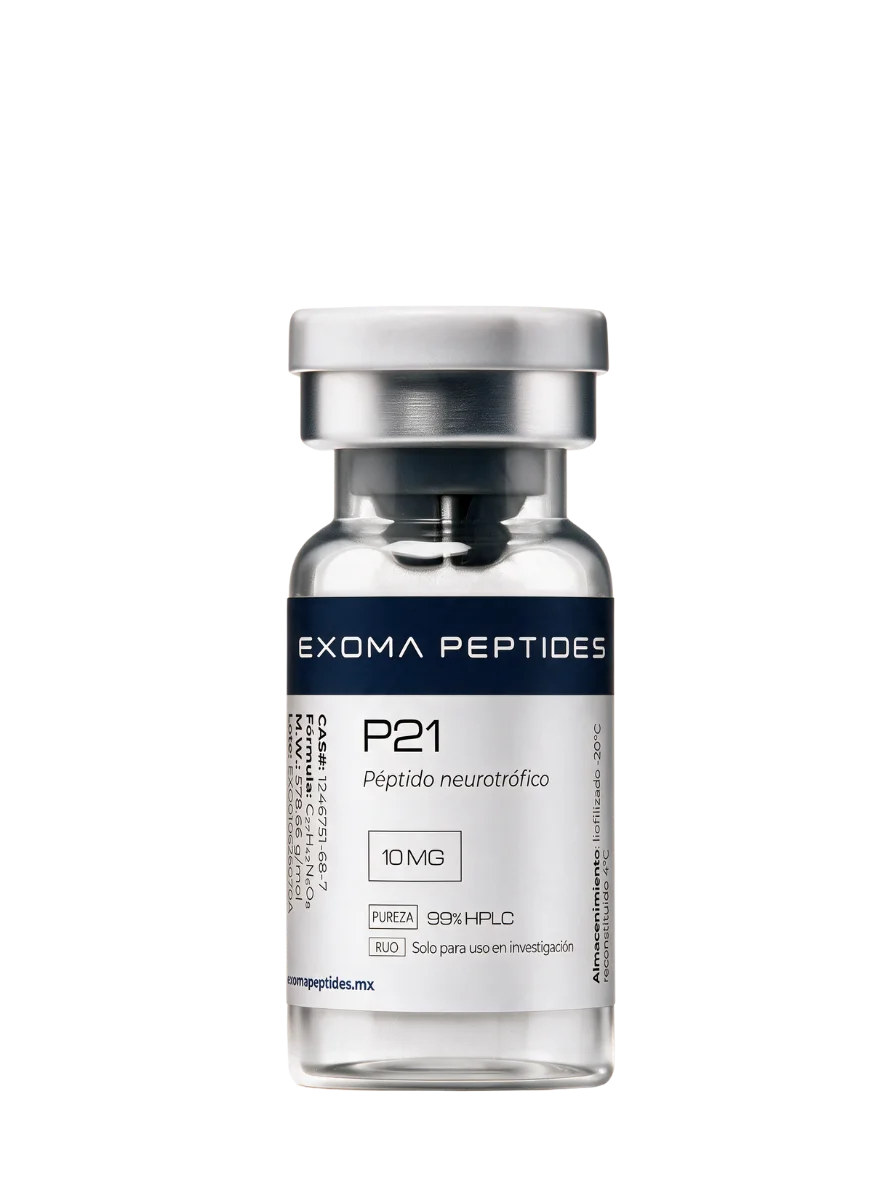
P21
P21 — research reagent (RUO).
Technical data
- Development code
- P021
- Molecular formula
- C21H35N7O9
- Molecular weight
- 529.55 g/mol
Sizes and prices: 10 mg $960 MXN ($96 MXN per mg) (out of stock).
Buy P21 in Mexico: order online with nationwide shipping in 1-4 business days depending on region, with a tracking number. Prices in Mexican pesos. Material for research use only.
P21 is also searched as: P021, Ac-DGGLAG-NH2.
Identity and composition
P21 (P021) is a low-molecular-weight peptidergic compound investigated in preclinical models for its neurotrophic and neurogenic activity. It derives from the active region of human ciliary neurotrophic factor (CNTF, residues 148-151) and is studied as a candidate disease-modifying agent in experimental neuroscience. Product for research use.
At the level of chemical identity it is an acetylated tetrapeptide with an adamantylated glycine at the C-terminus, a modification designed to increase lipophilicity and resistance to exopeptidases.
- Name / synonyms: P021, Ac-DGGLAG-NH2, Peptide 021, GLXC-21260, Ac-dggl-adamantanylglycine-NH2
- CAS: 1246751-68-7
- Molecular formula: C27H42N6O8
- Molecular weight: ~578.7 g/mol
- Sequence / structure: Ac-DGGL(A)G-NH2 (acetyl-Asp-Gly-Gly-Leu with adamantylated glycine at the C-terminus)
Mechanism of action
In preclinical models, P021 acts as a small mimetic of the biologically active region of CNTF. Its proposed mechanism involves the increase in the expression of BDNF (brain-derived neurotrophic factor), which has been associated with an increase in neurogenesis in the dentate gyrus and greater synaptic plasticity (PMID 25046994).
The described signaling includes inhibition of the pathway of LIF and a decrease in the activity of GSK3β mediated by the increase in BDNF. In the murine 3xTg-AD model, a reduction of hyperphosphorylation and abnormal accumulation of tau, with a more limited effect on Aβ (PMID 25046994).
The adamantylated glycine added at the C-terminus is described as the element that favors penetration of the blood-brain barrier and resistance to degradation by exopeptidases (PMID 39592934). These findings come from laboratory research and do not represent clinical results in humans.
Pharmacokinetics
No quantitatively verifiable pharmacokinetic parameters (half-life, bioavailability or Cmax) are available in a primary source, so only the dynamics are described here qualitatively.
Structurally, P021 was designed to cross the blood-brain barrier and resist degradation by exopeptidases thanks to the adamantylated glycine modification. In the available preclinical studies it was administered by oral route (incorporated in the diet) in murine models. Any kinetic extrapolation to other species or contexts lacks support in the reviewed evidence.
Scientific evidence
The published evidence on P021 es exclusively preclinical (in vitro studies and animal models); no completed human clinical trials or confirmed NCT registrations were identified, so it should be interpreted as preliminary.
In the 3xTg-AD model of Alzheimer's disease, chronic oral treatment has been investigated in relation to the rescue of cognition, neurogenesis, plasticity and the reduction of tau pathology (PMID 25046994). In a model of deficiency disorder of CDKL5, rescue of neuronal proliferation, survival and maturation was observed in vitro, but a limited benefit in vivo (PMID 39592934).
These results correspond to laboratory contexts and do not allow conclusions about efficacy or safety in people.
Research applications
Product for research use.
It may be suitable for (research contexts):
- In vitro and in vivo studies on neurotrophic signaling and the BDNF pathway
- Preclinical models of neurogenesis, synaptic plasticity and tau pathology
- Exploratory research in Alzheimer's disease models (e.g., 3xTg-AD) or CDKL5 deficiency
- Characterization of peptidergic compounds with adamantane modification and blood-brain barrier penetration
Not applicable for:
- clinical use, diagnostic, therapeutic or veterinary use
- Any form of self-administration
- Use as a dietary supplement or medication
The compound is intended only for research personnel and facilities with the appropriate equipment and practices.
Research protocols
In the reviewed evidence, P021 was administered via orally, incorporated into the diet, in murine models, with chronic treatment schemes (PMID 25046994). The exact mg doses used in those studies were not identified in a verifiable primary source, so no numerical dosing values are specified to avoid unsupported figures.
Any experimental design (dose, route, duration and controls) must be defined by the researcher based on the primary literature and validated internal protocols. The presentation of 10 mg corresponds to the amount in the vial and does not constitute a dose recommendation.
Reconstitution
As a general laboratory handling guide for lyophilized peptides, reconstitution is usually performed with bacteriostatic water (water with ~0.9% benzyl alcohol), which helps limit microbial growth in preparations for repeated use.
- Let the vial reach room temperature before opening.
- Add the diluent, letting it run slowly down the vial wall, not directly onto the powder.
- Do not shake; swirl gently until fully dissolved.
- The diluent volume is chosen according to the working concentration desired for the experiment.
These are standard laboratory practices and do not imply an indication for use in humans.
Stability and storage
As a general handling reference for peptides:
- Lyophilized (unreconstituted): retains its stability better when stored cold; for long-term storage, freezing is usually preferred, protected from light and moisture.
- Reconstituted: must be kept refrigerated and be used within a short period; for longer terms it may be aliquoted and frozen to avoid repeated freeze-thaw cycles.
Avoid repeated thermal cycles, which may favor degradation. These are qualitative laboratory handling guidelines; no product-specific stability data are available in the source reviewed.
Safety profile
El the safety profile in humans is not established: no clinical trials or published human safety data were identified for P021.
In murine models, chronic oral treatment was described as tolerated, with no manifest toxicity reported in the reviewed summaries; however, this comes from animal studies and cannot be extrapolated to people. No information is available on contraindications, interactions or adverse events in humans.
As it is a research material, it must be handled with personal protective equipment and good laboratory practices, avoiding any exposure or administration to people.
Comparative context
Within its class, P021 positions itself as a small CNTF-derived mimetic, designed to overcome limitations of the native peptide:
- Compared to the Complete CNTF, it is described that P021 retains neurogenic and neurotrophic activity without activating the inflammatory cascade associated with native CNTF.
- Compared to the parental peptide "Peptide 6" (Ac-VGDGGLFEKKL-NH2, of 11 residues), P021 is a compact version derived from the active 4-amino-acid fragment (residues 148-151), designed as a smaller and more stable mimetic.
- Its described class advantages are the reduced size, the stability against exopeptidases and the blood-brain barrier penetration thanks to the adamantylated glycine modification.
Consistency note: it is imprecise to describe P021 as "the 11-residue peptide of CNTF" that is the parental Peptide 6, of which P021 is the compact mimetic.
History and development
P021 arises from work on peptides derived from ciliary neurotrophic factor (CNTF). From the biologically active region of CNTF (residues 148-151), a compact mimetic of the parent peptide "Peptide 6" was designed, seeking to preserve the neurotrophic activity but with a smaller size, greater stability against exopeptidases, and the ability to cross the blood-brain barrier through modification with adamantylated glycine.
Its preclinical characterization in Alzheimer's disease was documented in the 3xTg-AD model with chronic oral treatment (PMID 25046994), and it was subsequently explored in models of CDKL5 deficiency (PMID 39592934). Its development by Phanes Biotech as a disease-modifying candidate has been reported, although a clinical phase was not confirmed in a regulatory source.
FAQ
What is P21 (P021) and what is it researched for?
It is a low-molecular-weight peptidergic compound derived from the active region of CNTF. In preclinical models it is investigated for its neurotrophic activity, the increase in BDNF, neurogenesis and the reduction of tau pathology. It is a product for research use, not for clinical use.
Are there human clinical trials with P021?
No. The available evidence is exclusively preclinical (in vitro and animal models) and no completed human clinical trials or confirmed NCT registrations were identified. The safety and efficacy profile in humans is not established.
How was P021 administered in the studies?
In the reviewed murine models it was administered orally, incorporated into the diet, in chronic treatment schemes (PMID 25046994). Numerical doses in mg are not specified because none were found supported in a verifiable primary source.
What is the chemical identity of P021?
CAS 1246751-68-7, molecular formula C27H42N6O8 and approximate molecular weight of 578.7 g/mol. Its sequence is Ac-DGGL(A)G-NH2, an acetylated tetrapeptide with an adamantylated glycine at the C-terminus.
How does P021 differ from CNTF and Peptide 6?
P021 is a compact mimetic derived from the active 4-amino-acid fragment of CNTF, not the 11-residue peptide (that is the parent Peptide 6). It is described to retain neurotrophic activity without activating the inflammatory cascade of native CNTF, with better stability and blood-brain barrier penetration.
How is P021 reconstituted and stored?
As a general laboratory guide, lyophilized peptides are usually reconstituted with bacteriostatic water, added slowly down the wall of the vial without shaking. The lyophilizate is best stored cold or frozen; once reconstituted it is kept refrigerated and used within a short period, avoiding freeze-thaw cycles.
Customer reviews
Average rating: 5.0 out of 5, based on 3 customer ratings.
Arturo G. — 5/5
Excellent product, the P21. Delivery was very fast and without any kind of setback.
Arturo G. — 5/5
The P21 is an excellent product. Very fast delivery and no setbacks.
Sofía V. — 5/5
The P21 arrived super fast and with excellent protective packaging. Very happy with the service.
Scientific references (2)
Peer-reviewed literature on P21, with its PubMed identifier when available:
- Disease modifying effect of chronic oral treatment with a neurotrophic peptidergic compound in a triple transgenic mouse model of Alzheimer's disease (Kazim, et al. · Neurobiology of Disease · 2014) PMID 25046994.
- Prevention of dendritic and synaptic deficits and cognitive impairment with a neurotrophic compound (Baazaoui, et al. · Alzheimer's Research & Therapy · 2017) PMID 28655344.
Full scientific profile: P21 in the compendium — mechanism of action, studies and technical data sheet.
See the full category catalog: Cognitive.