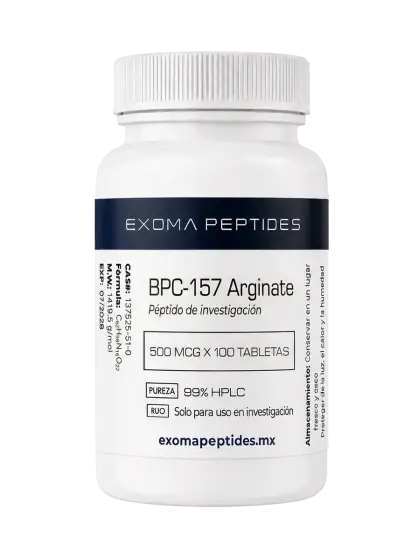
BPC-157 Arginate
BPC-157 Arginate — reagent for research use (RUO).
Sizes and prices: 500 mcg × 100 tablets $2,087 MXN.
Buy BPC-157 Arginate in Mexico: order online with nationwide shipping in 1-4 business days depending on zone and tracking number. Prices in Mexican pesos. Material for research use only.
BPC-157 Arginate is also searched as: BPC-157 arginato.
Identity and composition
BPC-157 Arginate is a synthetic pentadecapeptide (salt form with an arginine counterion) studied in preclinical models for its role in cytoprotection, wound healing and vascular regulation. It is offered as reference material in a presentation of 500 mcg × 100 tablets. Product for research use.
As for its chemical identity, it corresponds to the pentadecapeptide BPC-157, whose sequence is Gly-Glu-Pro-Pro-Pro-Gly-Lys-Pro-Ala-Asp-Asp-Ala-Gly-Leu-Val (GEPPPGKPADDAGLV). The molecular weight reported for the peptide base (free acid, PubChem CID 9941957) is approximately 1419.5 g/mol, with formula C62H98N16O22. It is important to note that these values correspond to the base peptide: the specific molecular weight and formula of the arginate salt (with the counterion) are not confirmed in a primary source. The CAS number is not included because it is not verified in an authoritative source.
"Arginate" refers only to a salt form that some suppliers use for the formulation, and it does not modify the sequence of the peptide. Among its synonyms are BPC 157, Bepecin, PL 14736, PL-10, and pentadecapeptide BPC 157.
Mechanism of action
In preclinical studies, the proposed mechanism of BPC-157 is described as pleiotropic, es decir, no atribuible a un único receptor definido (PMID:40005999). Los mecanismos mejor documentados en modelos animales y celulares incluyen:
- Modulation of the nitric oxide (NO) system: it has been observed to interact with the activity of nitric oxide synthase (NOS), which has been related to the regulation of vasodilation and blood flow.
- Promotion of angiogenesis: through the vascular endothelial growth factor pathway and its receptor VEGFR2.
- Antioxidant and cytoprotective activity: by counteracting the formation of free radicals.
Additionally, overexpression of the growth hormone receptor in tendon fibroblasts has been reported in the literature (PMID:40005999). Regarding the arginate form, there is no specific mechanistic characterization of the salt in the primary literature; the arginine counterion is used for formulation purposes and does not alter the proposed mechanism of the peptide.
Pharmacokinetics
The available pharmacokinetic data come from preclinical studies cited in a review (PMID:40005999). In those models, a half-life below ~30 minutes. Bioavailability after intramuscular administration was described in the range of ~14-19% in rats y ~45-51% in dog.
There are no robustly published human pharmacokinetic data: the oral Phase I trial that evaluated pharmacokinetics did not publish results (NCT02637284). The specific pharmacokinetics of the oral arginate salt are also not characterized in primary sources. Therefore, any extrapolation to humans should be considered unestablished.
Scientific evidence
The evidence on BPC-157 is predominantly preclinical (in vitro and in rodent and dog models) and must be interpreted as preliminary (PMID:40005999). Among the indications investigated in animals are wound healing, tendon, muscle, and ligament injuries, inflammatory bowel disease, gastrointestinal protection, alcohol-induced damage, and some neuropsychiatric disorders.
In humans the evidence is very limited: a Phase I oral trial was registered (NCT02637284, 42 healthy volunteers, oriented toward safety and pharmacokinetics) that appears as canceled and without formally published results. There are records of more recent trials, but without conclusive results. BPC-157 it is not approved or prescribed as a drug by any regulatory agency, and any efficacy claim must be considered unestablished in humans.
Research applications
Product for research use.
This material is intended for laboratory and preclinical research contexts. Qualitatively:
- It may be of interest for: in vitro and animal-model studies on mechanisms of cytoprotection, angiogenesis, nitric oxide signaling and tissue repair processes; reference analytical work and characterization.
- Not applicable for: clinical use, therapeutic use, diagnosis, prevention, or treatment of any condition. It is not an approved medicine and must not be used for clinical purposes or for self-medication.
The research framing is mandatory: safety and efficacy in humans are not established.
Research protocols
The available consulted literature does not include specific doses used in studies that can be cited with support. The evidence is described qualitatively as preclinical, with indications investigated in animal and cellular models (PMID:40005999).
For this reason, no numerical dosing schemes are indicated. The available preclinical pharmacokinetic parameters (half-life below ~30 minutes and intramuscular bioavailability in rat and dog) are detailed in the pharmacokinetics section. Any experimental protocol must be defined by the responsible researcher in accordance with their study design and applicable regulatory framework.
Reconstitution
The presentation of this product is in 500 mcg tablets (100 units), so it does not require reconstitution for its reference format.
As a general laboratory guide for lyophilized peptides (when applicable to other presentations): reconstitution is usually carried out with bacteriostatic water (water for injection with ~0.9% benzyl alcohol as a preservative). The standard technique consists of directing the solvent slowly down the wall of the vial, without injecting it directly onto the material, and letting it dissolve by gentle diffusion without vigorous agitation, swirling the vial delicately. Bacteriostatic water allows multiple withdrawals while maintaining relative sterility during the period of use.
Stability and storage
As a general laboratory handling guideline:
- Lyophilized or tablet material (not reconstituted): it is best preserved protected from moisture, light and heat. Storage under refrigeration prolongs stability, and freezing is suitable for long-term storage.
- Reconstituted product (when applicable): it must be kept refrigerated and used within a short window, since peptide solutions are less stable than the dry material.
It is recommended to avoid repeated freeze-thaw cycles and to label with the date of preparation. It should be noted that, within its class, BPC-157 is described as having a relative stability in gastric juice, a characteristic that motivates the oral formulations (PMID:40005999).
Safety profile
En preclinical studies no clear toxic dose was identified and the profile is described as well tolerated in animals (PMID:40005999). However, the safety in humans is not established: the only registered Phase I trial did not publish results (NCT02637284).
The literature notes theoretical risks derived from the proposed mechanisms themselves, in particular those associated with the stimulation of angiogenesis and with excessive nitric oxide production. BPC-157 is not an approved medication and its use is restricted to research. No information is available on long-term safety in humans, interactions, or validated clinical contraindications. It must be handled with standard laboratory precautions.
Comparative context
Within its class of cytoprotective and regulatory peptides, BPC-157 is distinguished by its relative stability in gastric juice, a feature that has motivated the development of oral formulations (PMID:40005999).
On the market there are different commercial salts of the same peptide, mainly the acetate and the arginate. These forms seek to improve aspects of stability, solubility, and formulation handling. It is important to note that there is no evidence in the primary literature that the arginate salt alters the mechanism or efficacy with respect to other forms of the same peptide; the difference lies in the counterion used for the formulation, not in the peptide sequence or in its proposed activity.
History and development
BPC-157 is a synthetic pentadecapeptide derived from a partial sequence of a gastric protein (Body Protection Compound), from which it takes its name. Its research has focused for years on preclinical models that explore cytoprotective and tissue-repair properties (PMID:40005999).
In the realm of clinical development, a Phase I oral trial was registered under the designation PCO-02 / 'Bepecin' (NCT02637284), with 42 healthy volunteers, aimed at evaluating safety and pharmacokinetics; this trial is listed as canceled and without published results. To date, BPC-157 has not been approved as a drug by any regulatory agency, and its development remains at the research stage.
FAQ
What is BPC-157 Arginate?
It is a synthetic pentadecapeptide in salt form with an arginine counterion, studied in preclinical models for its role in cytoprotection, wound healing and vascular regulation. It is offered as reference material for research (500 mcg × 100 tablets) and is not intended for clinical use.
How does the arginate form differ from other salts of BPC-157?
The arginate uses arginine as a counterion for formulation purposes (stability, solubility and handling). There is no evidence in the primary literature that the arginate salt modifies the mechanism or the efficacy relative to the acetate or other forms of the same peptide.
Is BPC-157 approved for human use?
No. BPC-157 is not approved or prescribed as a drug by any regulatory agency. The evidence is predominantly preclinical and safety and efficacy in humans are not established. Its use is exclusively for research.
What is the sequence and molecular weight of BPC-157?
The sequence is Gly-Glu-Pro-Pro-Pro-Gly-Lys-Pro-Ala-Asp-Asp-Ala-Gly-Leu-Val (GEPPPGKPADDAGLV). The molecular weight of the peptide base is approximately 1419.5 g/mol (formula C62H98N16O22); the specific value of the arginate salt is not confirmed in primary sources.
What is known about its safety?
In preclinical studies it was described as well tolerated in animals, without a clear toxic dose identified. Safety in humans is not established, since the only Phase I trial did not publish results. There are theoretical risks linked to angiogenesis and to nitric oxide.
How is the product stored?
Dry or tablet material is stored protected from humidity, light, and heat; refrigeration prolongs its stability and freezing serves for long-term preservation. It is advisable to avoid repeated freeze-thaw cycles.
Customer reviews
Average rating: 4.8 out of 5, based on 9 customer ratings.
Adrián G. — 5/5
Very good product, the BPC-157 Arginate. The purchase was extremely easy and shipping fast.
Paola M. — 4/5
Good product, the BPC-157 Arginate. I give it 4 stars only because the box arrived a bit banged up on one corner from the courier, but the bottle was intact and sealed.
Mauricio V. — 5/5
Excellent BPC-157 Arginate, it arrived within the stated time and with a very good presentation in the vials.
N. Q. — 5/5
The reconstitution of the research material is clean, allowing precise handling during titration in culture media. The clarity of the solution after mixing confirms the absence of undesired excipients or visible contaminants in the lyophilized product.
C. M. — 5/5
The integrity of the 500mcg vials was evaluated, finding a hermetic seal and a lyophilizate of uniform appearance. The results in molecular research models have been consistent across different lots, which suggests notable stability in the arginate formulation.
C. T. — 4/5
The labeling of the vial is clear and proportional to the dimensions of the 500mcg container, although the transit time to the northern region was slightly longer than anticipated. The quality of the compound remains intact, reflecting a purity consistent with the technical documentation provided by the supplier.
I. P. — 5/5
The batch received presents a purity of 99.2% verified by HPLC, consistent with the attached certificate of analysis. The solubility of the compound in sterile saline solution is immediate, resulting in a clear mixture with no solid residues in suspension for use in in vitro protocols.
V. A. — 5/5
The packaging meets the light and thermal protection standards necessary for this peptide. The delivery was carried out within the established time frame, facilitating the continuity of the scheduled assays in the laboratory without variations in the volumetric dosing.
Scientific references (8)
Peer-reviewed literature on BPC-157 Arginate, with its PubMed identifier where available:
- The promoting effect of pentadecapeptide BPC 157 on tendon healing involves tendon outgrowth, cell survival, and cell migration (Chang, et al. · Journal of Applied Physiology (1985) · 2011) PMID 21030672.
- Pharmacokinetics, distribution, metabolism, and excretion of body-protective compound 157, a potential drug for treating various wounds, in rats and dogs (He, et al. · Frontiers in Pharmacology · 2022)
- Multifunctionality and Possible Medical Application of the BPC 157 Peptide—Literature and Patent Review (Józwiak, et al. · Pharmaceuticals (Basel) · 2025)
- Multifunctionality and Possible Medical Application of the BPC 157 Peptide-Literature and Patent Review. (Józwiak M, et al. · Pharmaceuticals (Basel) · 2025) PMID 40005999.
- Emerging Use of BPC-157 in Orthopaedic Sports Medicine: A Systematic Review. (Vasireddi N, et al. · HSS J · 2025) PMID 40756949.
- Gastric pentadecapeptide body protection compound BPC 157 and its role in accelerating musculoskeletal soft tissue healing. (Gwyer D, et al. · Cell Tissue Res · 2019) PMID 30915550.
- Stable Gastric Pentadecapeptide BPC 157 and Wound Healing. (Seiwerth S, et al. · Front Pharmacol · 2021) PMID 34267654.
- Regeneration or Risk? A Narrative Review of BPC-157 for Musculoskeletal Healing. (McGuire FP, et al. · Curr Rev Musculoskelet Med · 2025) PMID 40789979.
Full scientific profile: BPC-157 Arginate Oral in the compendium — mechanism of action, studies and technical data sheet.
See the full category catalog: Orals.
Otras presentaciones de BPC-157 Arginate
Guides and articles about BPC-157 Arginate
Lecturas del blog de EXOMA que la editorial asoció a este compuesto: