Andarine (S-4)
Andarine (S-4) — reactivo for research (RUO). Contenido revisado por el Dr. Jesús Jaramillo.
Technical data
- INN name
- Andarine
- Development code
- S-4
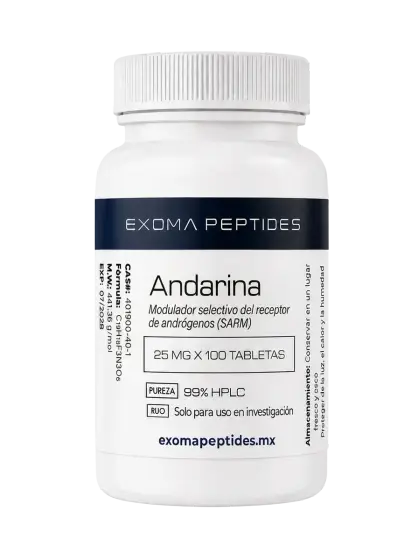
Sizes and prices: 25 mg × 100 tablets $1,626 MXN ($65 MXN per mg).
Buy Andarine (S-4) in Mexico: order online with nationwide shipping in 1-4 business days depending on zone and tracking number. Prices in Mexican pesos. Material for research use only.
Andarine (S-4) is known internationally as Andarine (English INN name). Buy Andarine in Mexico / comprar Andarine en México: reagent for research use (RUO) and nationwide shipping.
Andarine (S-4) is also searched as: S-4, GTx-007.
Identity and composition
Andarine (S-4) is a non-steroidal selective androgen receptor modulator (SARM), derived from arylpropionamide, studied in preclinical models for its anabolic activity on muscle and bone with less stimulation of androgenic tissues. It is offered in a presentation of 25 mg × 100 tablets. Product for research use.
Reference chemical identity data:
- CAS number: 401900-40-1
- Molecular formula: C19H18F3N3O6
- Molecular weight: 441.36 g/mol
- Synonyms: Andarine, S-4, GTx-007, Acetamidoxolutamide, Androxolutamide
Andarine is not a drug approved by regulators for clinical use. Its characterization comes mainly from preclinical literature.
Mechanism of action
Andarine (S-4) binds to the androgen receptor (AR) and acts as tissue-selective agonist: in the general SARM mechanism, the compound displaces the AR from heat-shock proteins, promotes its translocation to the nucleus and its binding to the androgen response elements (ARE). Subtle conformational changes of the AR alter the recruitment of coactivators and corepressors depending on the tissue, which in animal models is associated with a more selective anabolic activity than that of steroids.
In muscle and bone tissue it behaves as anabolic agonist, whereas in androgenic tissues (prostate, seminal vesicles) it acts as weak partial agonist. In models of orchidectomized rats, S-4 restored muscle mass and strength and prevented bone loss, with minimal prostatic stimulation —on the order of 16-17% relative to the control—, which illustrates its tissue selectivity relative to dihydrotestosterone (DHT) (PMC2039881).
Pharmacokinetics
No pharmacokinetic parameters (such as half-life or bioavailability) were confirmed in the reviewed sources for this compound. The available preclinical studies focused on outcomes pharmacodynamic following chronic treatment in animals, not in kinetic characterization. Therefore, any quantitative description of absorption, distribution, or elimination would fall outside the confirmed evidence and is deliberately omitted.
Scientific evidence
The published evidence on Andarine (S-4) is mostly preclinical and should be interpreted with caution. In rodent models —ovariectomized and orchidectomized rats— its effect on body composition, bone and muscle has been investigated. In preclinical studies it was observed that S-4 maintained bone mineral density and bone strength and reduced body fat in ovariectomized rats (PMID 17063395), and that it restored muscle mass and strength and prevented bone loss with minimal prostatic stimulation in orchidectomized rats (PMC2039881).
No approved advanced-phase clinical trial program was identified; characterization in humans is limited. Recent preclinical research additionally explores oncological uses of an exploratory nature. The preliminary evidence does not allow results to be extrapolated to people.
Research applications
Product for research use.
Aimed at:
- In vitro and animal model studies on the biology of the androgen receptor and the tissue selectivity of SARMs.
- Preclinical research in body composition, bone and muscle metabolism.
- Analytical and reference work, including the context of anti-doping control (S-4 is a known analyte).
Not applicable for:
- clinical use, therapeutic use, diagnostic or preventive.
- Use in sport: SARMs are prohibited by anti-doping agencies.
- Any clinical application: S-4 is not a drug approved by regulators.
Research protocols
The reported doses correspond to animal models and are not extrapolable to humans nor do they constitute a usage guideline. In preclinical studies in castrated rats, anabolic doses of S-4 of 3 mg/kg were associated with the recovery of muscle mass and strength (soleus muscle), restoring the prostate and seminal vesicles to only 16-17% of control levels, which demonstrates tissue selectivity relative to DHT (PMC2039881).
There are no validated dosing protocols for clinical use. For experimental work, dosing must be defined by the researcher according to their study design and model, under the applicable biosafety standards.
Reconstitution
The presentation of Andarine (S-4) of this product is in tablets (25 mg), so it does not require reconstitution with bacteriostatic water like injectable lyophilizates.
As a general laboratory reference: when a lyophilized powder compound does need to be reconstituted, one typically uses bacteriostatic water (water with ~0.9% benzyl alcohol as preservative), adding it slowly down the wall of the vial onto the solid, without shaking abruptly, and letting it dissolve by gentle rotation. This point does not apply to the tablet form.
Stability and storage
General laboratory handling guide:
- Solid form (tablets / powder): store in its original, tightly closed container, protected from light, moisture, and heat. For prolonged storage a cool, dry environment is usually preferred; refrigeration or freezing prolongs the stability of many compounds in solid form.
- Reconstituted solutions (when applicable): keep refrigerated, protected from light, and use them within a short period, since in solution the stability is lower than in solid form.
These are standard storage practices; they do not replace batch-specific stability data.
Safety profile
The safety data of Andarine (S-4) in humans are limited; the described profile comes from animal models and should be interpreted with caution.
- S-4 is not an approved compound by regulators for clinical use.
- It is banned in sport for belonging to the SARM class.
- It has been detected as adulterant in black market products and supplements, which raises quality and labeling risks (PMID 20355219).
Owing to its nature as a research material, it must be handled with appropriate protective equipment and under the laboratory's biosafety standards. No established clinical contraindications are available because of the lack of characterization in humans.
Comparative context
Compared with the dihydrotestosterone (DHT), the reference steroidal androgen in preclinical studies, Andarine (S-4) showed a profile of partial/tissue-selective agonist:
- Greater increase in total body bone mineral density than DHT in the models evaluated.
- Markedly lower prostatic stimulation at equivalent anabolic doses, consistent with its tissue selectivity.
- Unlike DHT, in some models S-4 did not induce the same fat loss.
This contrast illustrates the central characteristic of the SARM class: to seek anabolic activity on muscle and bone dissociated from the strong androgenic action of steroids. The comparisons come from animal models and do not predict responses in humans.
History and development
Andarine was developed by GTx Inc. as a therapeutic candidate targeting muscle atrophy and wasting, osteoporosis, and benign prostatic hyperplasia. Its development was supported by rodent models (ovariectomized and orchidectomized rats), in which the prevention of bone loss, the maintenance of bone mineral density, the improvement of muscle strength, and the reduction of body fat were investigated.
No approved advanced-phase clinical trial program was identified. Over time, S-4 came to appear in the literature mostly as a substance detected in black-market products and as analyte in anti-doping control (PMID 20355219), rather than as a drug in active development.
FAQ
What is Andarine (S-4)?
It is a non-steroidal selective androgen receptor modulator (SARM), derived from arylpropionamide (CAS 401900-40-1). In preclinical studies it has been investigated for its anabolic activity on muscle and bone with lower stimulation of androgenic tissues. It is a material for research use; not for clinical use.
Is Andarine (S-4) approved for clinical use?
No. S-4 is not a drug approved by regulators for clinical use and is banned in sport as it belongs to the SARM class. The available evidence is mostly preclinical and its characterization in humans is limited.
What is the difference between Andarine (S-4) and DHT?
In preclinical models, compared to dihydrotestosterone (DHT), S-4 showed a partial agonist/tissue-selective profile: greater increase in total bone mineral density and a markedly lower prostatic stimulation at equivalent anabolic doses. These are data from animal models, not extrapolable to people.
What doses have been used in the S-4 studies?
In castrated rats, anabolic doses of 3 mg/kg were associated with recovery of muscle mass and strength, with prostatic restoration to only 16-17% of control. These are animal-model doses, without equivalence or guideline for clinical use.
How is Andarine (S-4) stored in tablet form?
As a general laboratory reference, it is preserved in its original closed container, protected from light, humidity and heat. A cool, dry environment, or refrigeration/freezing, helps to preserve the stability of the solid. These are standard preservation practices.
Is S-4 detected in anti-doping control?
Yes. S-4 (Andarine) is a SARM banned in sport and appears as an analyte in anti-doping control. It has also been reported as an adulterant in black-market products and supplements, which raises quality and labeling risks.
Customer reviews
Average rating: 4.8 out of 5, based on 5 customer ratings.
A. R. — 4/5
The vial presents a hermetic seal and labeling with a traceable lot number. During the reconstitution tests for in vitro application, the resulting solution maintained an optimal clarity, indicating a low presence of synthesis byproducts or impurities.
H. S. — 5/5
The material presents a purity consistent with the attached certificate of analysis. The solubility in organic solvents for research protocols is immediate and no solid residues were observed after agitation, which confirms the quality of the filtration in the synthesis of the lot.
H. S. — 5/5
A relevant precision in the per-unit dosage was observed, facilitating the standardization of research protocols. The shipment arrived within the stipulated time frame and the product remains stable under cryogenic storage conditions without apparent degradation.
P. B. — 5/5
The physical integrity of the containers is excellent and the HPLC purity report provided is consistent with the results obtained in our laboratory. It is a reliable resource for the study of androgen receptors in cell culture models.
A. S. — 5/5
The delivery of the compound was punctual and the packaging guarantees the integrity of the vials. The consistency of the powder was verified by means of basic spectroscopy, showing total agreement with the standards expected for the S-4 molecule in controlled experimental settings.
Scientific references (5)
Peer-reviewed literature on Andarine (S-4), with its PubMed identifier where available:
- In vitro anti-carcinogenic effect of andarine as a selective androgen receptor modulator on MIA-PaCa-2 cells by decreased proliferation and cell-cycle arrest at G0/G1 phase (Bölük A et al. · Biochemical and biophysical research communications · 2023) PMID 37302286.
- Detection of the arylpropionamide-derived selective androgen receptor modulator (SARM) S-4 (Andarine) in a black-market product. (Thevis M, et al. · Drug Test Anal · 2009) PMID 20355219.
- Mass spectrometric characterization of urinary metabolites of the selective androgen receptor modulator andarine (S-4) for routine doping control purposes. (Thevis M, et al. · Rapid Commun Mass Spectrom · 2010) PMID 20623476.
- Selective Androgen Receptor Modulator (SARM) treatment prevents bone loss and reduces body fat in ovariectomized rats (Kearbey, et al. · Pharmaceutical Research · 2007) PMID 17063395.
- Exploring the potentials of S4, a selective androgen receptor modulator, in glioblastoma multiforme therapy (Yavuz, et al. · Toxicology and Applied Pharmacology · 2024) PMID 38997069.
Full scientific profile: Andarine (S4) in the compendium — mechanism of action, studies and technical data sheet.
See the full category catalog: Orals · SARMs.