
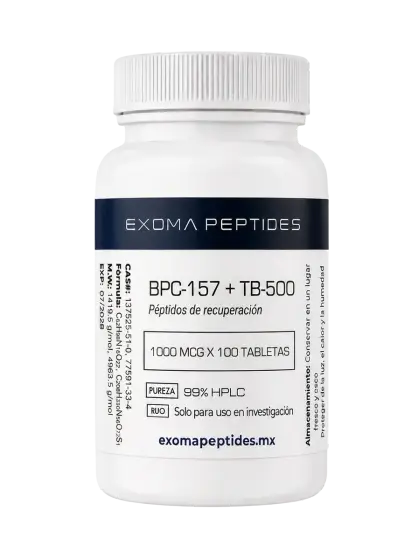
BPC-157 + TB-500 Blend
BPC-157 + TB-500 Mezcla — reactivo for research (RUO). Contenido revisado por el Dr. Jesús Jaramillo.
Technical data
- INN name
- BPC-157 + TB-500 Blend
Sizes and prices: 1000 mcg × 100 tablets (BPC 500 mcg + TB500 500 mcg) $6,035 MXN.
Buy BPC-157 + TB-500 Blend in Mexico: order online with nationwide shipping in 1-4 business days depending on zone and tracking number. Prices in Mexican pesos. Material for research use only.
BPC-157 + TB-500 Blend is known internationally as BPC-157 + TB-500 Blend (English INN name). Buy BPC-157 + TB-500 Blend in Mexico / comprar BPC-157 + TB-500 Blend en México: reagent for research use (RUO) and nationwide shipping.
BPC-157 + TB-500 Mezcla is also searched as: BPC-157 + TB-500 Oral, Mezcla oral BPC-157 / TB-500, BPC-157 y TB-500 en tabletas.
Identity and composition
La BPC-157 + TB-500 Blend is a combined research material that brings together two distinct peptides studied preclinically for their role in tissue repair and angiogenesis. It does not constitute a single chemical entity, but rather the coexistence of two independent molecules; it is offered in a presentation of 100 tablets (BPC-157 500 mcg + TB-500 500 mcg per unit).
Product for research use.
As for chemical identity, since it is a mixture there is no single CAS, molecular weight, formula, or sequence, so these fields do not apply and are omitted. At the component level there are confirmed reference data:
- BPC-157 (Body Protection Compound-157; also PL 14736): a pentadecapeptide with the sequence Gly-Glu-Pro-Pro-Pro-Gly-Lys-Pro-Ala-Asp-Asp-Ala-Gly-Leu-Val, formula C62H98N16O22, registered in PubChem with CID 9941957.
- TB-500: synthetic N-acetylated fragment of thymosin beta-4 (residues 17-23), a heptapeptide with sequence Ac-LKKTETQ.
No verified CAS or molecular weight is reported in an open authoritative source for either of the two components, so they are not included.
Mechanism of action
This material combines two peptides with documented preclinical mechanisms separately; there is no validated combined mechanism or evidence of synergy.
BPC-157 acts pleiotropically, not on a single receptor. The literature describes interaction with nitric oxide synthase with an increase in antioxidants such as heme oxygenase (HO-1), activation of VEGF receptors with vascular and angiogenic responses, modulation of dopaminergic regulation and inflammatory cascades, and overexpression of the growth hormone receptor in fibroblasts (review of literature and patents; PMID 40005999).
TB-500 derives from thymosin beta-4; its canonical described mechanism is actin sequestration and modulation of the cytoskeleton, with downstream effects on cell migration, angiogenesis and stem cell mobilization. Recent in vitro evidence suggests that the wound-healing activity could be attributed to its metabolite Ac-LKKTE rather than to the original molecule (PMID 38382158).
Critical note: the oral route is not mechanistically supported; both are peptides susceptible to gastrointestinal degradation and most of the evidence comes from parenteral or topical administration in animal models.
Pharmacokinetics
No confirmed human pharmacokinetic data (half-life, bioavailability) were found for either of the two peptides or for the mixture, and in particular none for the oral route. Oral bioavailability is not established.
The only mechanistic datum relevant to pharmacokinetics comes from an in vitro/rat study that showed TB-500 is metabolized to fragments (Ac-LKKTE, Ac-LKK, Ac-LK), with Ac-LKKTE being the fragment with wound-healing activity, which implies rapid proteolytic metabolism (PMID 38382158). Any half-life or bioavailability figure for this presentation would be speculative and is omitted.
Scientific evidence
All the relevant evidence is preclinical (in vitro and rodent models) and corresponds to the components separately, not to the commercial oral mixture. No clinical trials of a defined phase or data on efficacy or safety in humans were identified for the oral combination BPC-157 + TB-500.
- BPC-157: literature reviews and patents describe preclinical promise in tissue injury and tendon/muscle repair, but it does not have FDA approval owing to a lack of sufficient human clinical trials (PMID 40005999).
- Thymosin beta-4 / TB-500: in wound-healing studies in rats, acceleration of re-epithelialization has been observed (reported increases of 42-61%), greater contraction, collagen deposition and keratinocyte migration (PMID 10469335). The human clinical development of the synthetic fragment remains at very early stages and limited (PMID 38382158).
Preliminary evidence suggests regenerative activity in animal models, but it should not be extrapolated to humans or to this combined oral formulation.
Research applications
Product for research use.
It may be of interest for research in:
- In vitro and animal-model studies on tissue repair, angiogenesis, and cell migration.
- Comparative work between regenerative peptides (VEGF/HO-1 mechanisms versus actin sequestration).
- Analytical characterization of peptides and their metabolites (e.g., TB-500 fragments).
Not applicable for:
- Any use in humans, diagnosis, treatment, or consumption.
- Applications that assume clinical efficacy: there are no efficacy or safety data in humans for this combination.
- Regulated sports contexts: TB-500/thymosin beta-4 appear on the WADA Prohibited List, and BPC-157 had a temporary ban by WADA (2022).
Research protocols
No dosing protocols were found in humans nor validated dose data for the oral combination BPC-157 + TB-500; there are no clinical trials of the blend.
The available evidence comes from in vitro and rodent models with typically parenteral or topical administration of the components separately, and does not report a transferable oral dose regimen. For this reason, a quantitative protocol is not specified.
The reference presentation of the product is 100 tablets with 500 mcg of BPC-157 and 500 mcg of TB-500 per unit; this datum describes the composition of the research material, not a validated study regimen. Any experimental design must be defined under the researcher's laboratory criteria.
Reconstitution
This presentation is offered in tablet form, so reconstitution with liquid does not apply directly to the product as supplied.
As a general laboratory handling reference for lyophilized peptide material: reconstitution is usually carried out with bacteriostatic water (sterile water with ~0.9% benzyl alcohol), added slowly down the vial wall onto the powder, without shaking forcefully —it is left to dissolve by gentle rotation so as not to damage the peptide—. The volume is chosen according to the desired working concentration. This guidance is general laboratory knowledge and does not imply preparation for use in humans.
Stability and storage
Standard laboratory handling guide for peptide material:
- Lyophilized product / in tablets (dry): store protected from moisture, light, and heat; the dry material is considerably more stable and is usually kept refrigerated, with prolonged storage in the freezer.
- Peptide reconstituted in solution: keep refrigerated and use within a short window; for longer-term preservation, freezing in aliquots and avoiding repeated freeze-thaw cycles, which degrade peptides, is recommended.
These are general qualitative stability practices; no specific stability data are available for this blend.
Safety profile
There is no established human safety profile for this combination. None of the components is FDA-approved for clinical use, and the available safety data come almost exclusively from animal models.
- The adverse effects, interactions, and long-term profile in humans are unknown, and there are no safety data for the combined oral formulation.
- Anti-doping restrictions: TB-500/thymosin beta-4 and BPC-157 are subject to WADA restrictions (BPC-157 with a temporary ban in 2022).
- Being marketed as research material without regulatory approval, it must be handled only in laboratory settings with the usual precautions.
Due to the absence of human data, specific clinical contraindications cannot be established; the absence of information does not equate to the absence of risk.
Comparative context
Within its class —regenerative research peptides— both components share a strong preclinical basis but lack human clinical validation.
- BPC-157 is one of the most indexed peptides in PubMed, with abundant multi-organ preclinical literature and a pleiotropic mechanism (angiogenesis via VEGF, antioxidant via HO-1).
- TB-500 / thymosin beta-4: the protein of origin has hundreds of publications, but the synthetic fragment TB-500 has scarcer evidence, and it has been proposed that its real effect would depend on the metabolite Ac-LKKTE (PMID 38382158). Its mechanism centers on the sequestration of actin and cell migration.
The combination is promoted for a supposed complementary action (angiogenesis/repair versus actin sequestration/migration), but there is no evidence supporting synergy or an advantage of the oral route.
History and development
BPC-157 derives from a partial sequence of a protective protein identified in gastric juice; hence its name Body Protection Compound. It has been studied in preclinical models for its role in tissue protection and repair, and its literature and patents have been extensively reviewed, although without reaching regulatory approval owing to a lack of sufficient human clinical trials (PMID 40005999).
TB-500 is a synthetic N-acetylated fragment (residues 17-23) of thymosin beta-4, a natural peptide that regulates the cytoskeleton. Research on thymosin beta-4 in wound healing dates back to rodent studies that documented accelerated reepithelialization (PMID 10469335), whereas the study of the synthetic fragment and its metabolites is more recent (PMID 38382158).
The commercial oral mixture of both is a market combination with no clinical development of its own nor trials supporting it as a single formulation.
FAQ
What is the BPC-157 + TB-500 blend?
It is a research material that combines two distinct peptides —BPC-157 and TB-500 (a thymosin beta-4 fragment)— studied preclinically for their role in tissue repair and angiogenesis. It is not a single molecule and is intended exclusively for research, not for clinical use.
Is there clinical evidence in humans for this combination?
No. All the relevant evidence is preclinical (in vitro and in rodents) and corresponds to the components separately. No clinical trials of a defined phase or efficacy or safety data in humans were identified for the oral combination BPC-157 + TB-500.
Why is the oral route of these peptides questioned?
Both are peptides susceptible to gastrointestinal degradation, and most of the mechanistic evidence comes from parenteral or topical administration. Oral bioavailability is not established and the oral route does not have mechanistic support.
What is the chemical identity of each component?
BPC-157 is a pentadecapeptide (sequence Gly-Glu-Pro-Pro-Pro-Gly-Lys-Pro-Ala-Asp-Asp-Ala-Gly-Leu-Val, formula C62H98N16O22, PubChem CID 9941957). TB-500 is an N-acetylated heptapeptide, fragment 17-23 of thymosin beta-4 (Ac-LKKTETQ). Being a mixture, it has no unique CAS or molecular weight.
Is it permitted in sport?
Not in regulated contexts: TB-500/thymosin beta-4 appear on the WADA Prohibited List, and BPC-157 had a temporary ban by WADA in 2022.
How is the material stored?
As a general laboratory guideline, dry material is preserved protected from humidity, light and heat, refrigerated or frozen for prolonged storage. If reconstituted, it is kept refrigerated for a short time or frozen in aliquots, avoiding freeze-thaw cycles.
Customer reviews
Average rating: 4.8 out of 5, based on 5 customer ratings.
L. C. — 5/5
A clean and rapid reconstitution was observed under controlled laboratory conditions. The dosage specified on the label matches the yield obtained after lyophilization, facilitating precision in the preparation of the dilutions for the experimental model.
F. R. — 5/5
The blend presents adequate thermal stability during transport, with no signs of degradation in the pellet. The labeling includes essential technical information for the traceability of the batch within the preclinical research records, complying with the identification standards.
R. O. — 4/5
The delivery time was adequate and the packaging guarantees the protection of the vials. A slight improvement in the visibility of the lot code on the external label is suggested, although the HPLC-verified purity meets the parameters required for the in vitro study.
H. S. — 5/5
The mass spectrometry analysis results attached to the batch are consistent with the purity observed in the in vitro protocols developed. The packaging adequately protects the vials against photodegradation, maintaining the integrity of the peptide during transit to the laboratory.
M. V. — 5/5
The compound presents optimal solubility in bacteriostatic water, resulting in a clear solution with no residues in suspension. Inspection of the vial shows a uniform lyophilizate and an intact safety seal, confirming the quality in supply chain handling.
Scientific references (6)
There is no peer-reviewed literature on BPC-157 + TB-500 Blend as a combination. What follows is the literature for each component separately, with its PubMed identifier:
- About BPC-157: Protective effects of pentadecapeptide BPC 157 on gastric ulcer in rats (Xue, et al. · World Journal of Gastroenterology · 2004) PMID 15052688.
- About TB-500: Thymosin beta4 accelerates wound healing (Malinda, et al. · Journal of Investigative Dermatology · 1999) PMID 10469335.
- About BPC-157: Focus on ulcerative colitis: stable gastric pentadecapeptide BPC 157 (Sikiric, et al. · Current Medicinal Chemistry · 2012) PMID 22300085.
- About TB-500: Thymosin β4: a multi-functional regenerative peptide. Basic properties and clinical applications (Goldstein, et al. · Expert Opinion on Biological Therapy · 2012) PMID 22074294.
- About BPC-157: The promoting effect of pentadecapeptide BPC 157 on tendon healing involves tendon outgrowth, cell survival, and cell migration (Chang, et al. · Journal of Applied Physiology · 2011) PMID 21030672.
- About TB-500: Thymosin beta 4 promotes corneal wound healing and decreases inflammation in vivo following alkali injury (Sosne, et al. · Experimental Eye Research · 2002) PMID 11950239.
Full scientific profile: BPC-157 + TB-500 Oral Blend in the compendium — mechanism of action, studies and technical data sheet.
See the full category catalog: Orals.