
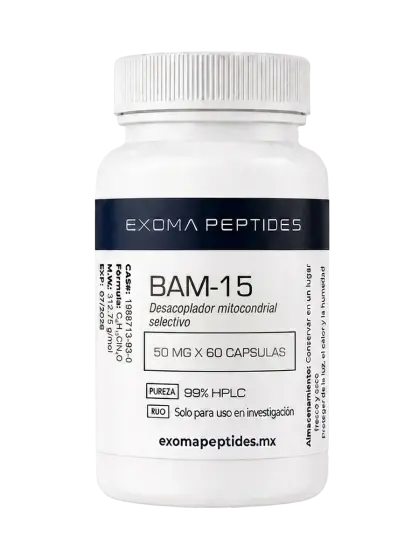
BAM-15
BAM-15 — reactivo for research (RUO). Contenido revisado por el Dr. Jesús Jaramillo.
Sizes and prices: 50 mg × 60 cápsulas $3,713 MXN ($74 MXN per mg) (out of stock).
Buy BAM-15 in Mexico: order online with nationwide shipping in 1-4 business days depending on zone and tracking number. Prices in Mexican pesos. Material for research use only.
Identity and composition
BAM-15 is a small-molecule mitochondrial uncoupler (protonophore) that is studied in preclinical research on energy metabolism, obesity and insulin resistance. It is not a peptide, but a synthetic compound of the difluorophenylated oxadiazolopyrazine type.
Reference chemical identity data:
- CAS: 210302-17-3
- Molecular formula: C16H10F2N6O
- Molecular weight: 340.29 g/mol
- PubChem CID: 565708
- IUPAC name / synonyms: 5-N,6-N-bis(2-fluorophenyl)-[1,2,5]oxadiazolo[3,4-b]pyrazine-5,6-diamine; BAM15
Being a small molecule, it does not have an amino acid sequence. Product for research use.
Mechanism of action
BAM-15 acts as mitochondrial uncoupler: it transports protons across the inner mitochondrial membrane, dissipating the electrochemical gradient and uncoupling oxidative phosphorylation from ATP synthesis. This mechanism increases oxygen consumption and nutrient oxidation by the mitochondria.
Unlike classic uncouplers such as FCCP, in in vitro studies it did not depolarize the plasma membrane and sustained a higher maximum mitochondrial respiration rate at equivalent potency. In cell models it was observed to enhance mitochondrial respiratory kinetics, improve insulin signaling, and stimulate nutrient uptake through sustained AMPK activation (EMBO Mol Med 2020; PMID 32519812).
Pharmacokinetics
The available evidence comes from rodents, where BAM-15 showed oral bioavailability. The preclinical literature describes a relatively short half-life and a low aqueous solubility as limitations, which has motivated the study of formulation strategies to improve exposure (Nat Commun 2020; PMID 32409697).
No pharmacokinetic data in humans are available.
Scientific evidence
The evidence on BAM-15 is preliminary and exclusively preclinical (rodent and cell models); no registered clinical trials in humans were identified.
In mice with diet-induced obesity, oral administration was associated with prevention and reduction of body weight gain and fat mass, with no observed changes in food intake, lean mass, or body temperature, and with improvement in insulin sensitivity assessed by hyperinsulinemic-euglycemic clamps (Nat Commun 2020; PMID 32409697). Other preclinical works reported activation of AMPK and improved glycemic control (EMBO Mol Med 2020; PMID 32519812).
These findings should not be interpreted as demonstrated efficacy in humans.
Research applications
Product for research use.
Contexts in which it has been preliminarily explored (preclinical):
- Research on energy metabolism and mitochondrial bioenergetics.
- Preclinical models of obesity and fat mass.
- Studies of insulin resistance and type 2 diabetes.
- Other exploratory lines: hepatic steatosis, ischemia-reperfusion kidney injury, sepsis, and cancer.
Not applicable for:
- Use or clinical use, nor clinical administration of any kind.
- Diagnostic, therapeutic use or as a supplement.
- Any application outside a controlled research environment.
Research protocols
In the available preclinical evidence, BAM-15 was administered via oral route in rodent models. The consulted literature does not detail specific numerical doses (mg/kg) or validated administration schemes, so they are not specified here to avoid unsupported figures.
There are no established protocols or dosing guidelines for humans. Any handling corresponds to laboratory experimental design under the responsibility of the researcher.
Reconstitution
As a general laboratory guideline: vials are usually reconstituted with a diluent compatible with the compound's solubility. It should be considered that BAM-15 presents low aqueous solubility, so that bacteriostatic water (sterile water with ~0.9% benzyl alcohol) may not be the optimal vehicle; appropriate solvents for poorly soluble small molecules are usually evaluated.
Standard technique: allow the vial to reach room temperature, add the diluent slowly down the wall of the vial avoiding vigorous agitation, and swirl gently until dissolved. This is general handling guidance, not a recommendation for use.
Stability and storage
Standard laboratory handling:
- Unreconstituted product (solid): store in a cool, dry place protected from light; for prolonged storage, freezing is usually preferred.
- Reconstituted product / in solution: keep refrigerated and use in the short term, protected from light.
- Avoid repeated freeze-thaw cycles and minimize exposure to moisture.
These are general stability guidelines; it is advisable to follow the specific conditions of the batch and the vehicle used.
Safety profile
The safety profile of BAM-15 in humans is unknown: there are no clinical safety data.
In the mouse studies, no changes were reported in biochemical/hematological markers of toxicity or an increase in body temperature at the doses studied (Nat Commun 2020; PMID 32409697). Nevertheless, as a mitochondrial uncoupler it belongs to a a class historically associated with toxicity: 2,4-dinitrophenol (DNP) has caused hyperthermia and deaths in humans. This class consideration justifies caution.
Handle with appropriate protective equipment and under laboratory practices. For research use only.
Comparative context
Compared with classic uncouplers such as FCCP and the 2,4-dinitrophenol (DNP), the preclinical literature describes a distinct profile for BAM-15:
- At potency comparable to FCCP in vitro, BAM-15 did not depolarize the plasma membrane and sustained a higher maximum rate of mitochondrial respiration.
- This behavior has been proposed as a potentially more favorable margin compared with the toxicity historically associated with DNP (hyperthermia).
This relative advantage is based on preclinical data and is not clinically validated.
History and development
BAM-15 emerged as a synthetic small-molecule mitochondrial uncoupler (a difluorophenylated oxadiazolopyrazine) developed in the context of research into mitochondrial bioenergetics and metabolism. Interest consolidated around 2020 with studies in rodent and cellular models that characterized its ability to uncouple oxidative phosphorylation with an in vitro profile distinct from that of classical uncouplers (Nat Commun 2020; PMID 32409697; EMBO Mol Med 2020; PMID 32519812). It remains in preclinical phase, with no registered human clinical trials.
FAQ
What is BAM-15?
It is a small-molecule mitochondrial uncoupler (protonophore), not a peptide. It is studied in preclinical research on energy metabolism, obesity, and insulin resistance. Product for research use; not for clinical use.
How does BAM-15 act at the mitochondrial level?
It transports protons across the inner mitochondrial membrane, dissipating the electrochemical gradient and uncoupling oxidative phosphorylation from ATP synthesis, which increases oxygen consumption and nutrient oxidation (PMID 32519812).
How does it differ from DNP and FCCP?
In in vitro studies, at potency comparable to FCCP, BAM-15 did not depolarize the plasma membrane and sustained greater mitochondrial respiration. A potentially more favorable margin relative to the historical toxicity of DNP has been proposed, although this is not clinically validated.
Are there safety data in humans?
No. There are no clinical safety data or registered trials in humans. In mice, no changes in toxicity markers or increase in body temperature were observed at the doses studied, but its clinical profile is unknown (PMID 32409697).
What are its chemical identity data?
CAS 210302-17-3, molecular formula C16H10F2N6O, molecular weight 340.29 g/mol, and PubChem CID 565708. Being a small molecule, it has no amino acid sequence.
How is it stored and reconstituted?
The solid is kept cool, dry, and protected from light, preferably frozen; in solution, refrigerated and for short-term use. It exhibits low aqueous solubility, so an appropriate solvent is usually evaluated. This is general laboratory guidance.
Customer reviews
Average rating: 4.8 out of 5, based on 5 customer ratings.
F. R. — 5/5
The product meets the technical requirements for in vitro research protocols on mitochondrial uncoupling. Reconstitution is clean and the lyophilized powder shows a uniform consistency across different vials of the same batch. Transit times were short, minimizing exposure to environmental variations.
N. E. — 5/5
The integrity of the vial and the vacuum seal ensure the stability of the compound for handling in experimental models. The accuracy of the 50mg dosing was verified by comparative weighing, validating the supplier's quality-control standards. Efficient logistics delivery and packaging with adequate thermal protection.
D. V. — 5/5
The reagent BAM-15 presents optimal solubility in DMSO following the established protocol. The clarity of the solution after reconstitution is total, with no particles in suspension, which confirms the quality of the filtration during the lyophilization process. The received batch fully matches the attached HPLC report.
R. O. — 5/5
A high thermal stability of the lyophilized compound was observed during transport. The COA data are consistent with the spectroscopy analyses performed in-house, demonstrating a purity greater than 98 percent. The vial label facilitates the traceability needed for logging in the laboratory record book.
C. M. — 4/5
The compound Bam-15 shows the chemical behavior expected according to the available technical literature. Although the delivery time suffered a slight 24-hour delay relative to the initial schedule, the quality of the material and the robustness of the vial compensate for the delay. The HPLC purity is satisfactory for the experimental purposes.
Scientific references (7)
Peer-reviewed literature on BAM-15, with its PubMed identifier when available:
- BAM 15 Exerts Molluscicidal Effects on Pomacea canaliculata Through the Induction of Oxidative Stress, Impaired Energy Metabolism, and Tissue Damage (Wang L et al. · Molecules (Basel, Switzerland) · 2026) PMID 41599409.
- Identification of a novel mitochondrial uncoupler that does not depolarize the plasma membrane (Kenwood, et al. · Molecular Metabolism · 2014) PMID 24634817.
- Mitochondrial uncoupler BAM15 reverses diet-induced obesity and insulin resistance in mice (Alexopoulos, et al. · Nature Communications · 2020) PMID 32409697.
- BAM15-mediated mitochondrial uncoupling protects against obesity and improves glycemic control (Axelrod, et al. · EMBO Molecular Medicine · 2020) PMID 32519812.
- Safety and efficacy of once-daily HU6 versus placebo in people with non-alcoholic fatty liver disease and high BMI: a randomised, double-blind, placebo-controlled, phase 2a trial. (Noureddin M, et al. · Lancet Gastroenterol Hepatol · 2023) PMID 37806314.
- BAM15 as a mitochondrial uncoupler: a promising therapeutic agent for diverse diseases. (Xiong G, et al. · Front Endocrinol (Lausanne) · 2023) PMID 37900126.
- The magic bullet: Niclosamide. (Jiang H, et al. · Front Oncol · 2022) PMID 36479072.
Full scientific profile: BAM-15 in the compendium — mechanism of action, studies and technical data sheet.
See the full category catalog: Orals.
Guides and articles about BAM-15
Lecturas del blog de EXOMA que la editorial asoció a este compuesto: