
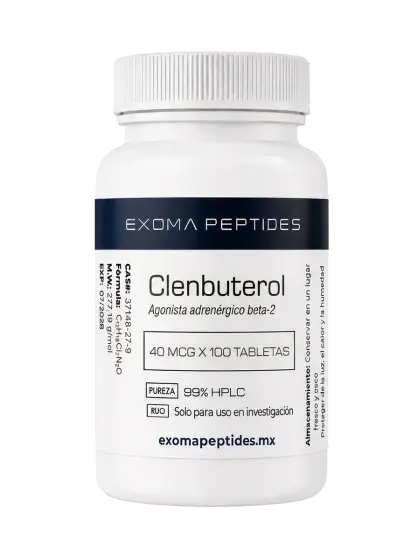
Clenbuterol
Clenbuterol — reagent for research use (RUO).
Technical data
- Development code
- NAB-365
Sizes and prices: 40 mcg × 100 tablets $696 MXN.
Buy Clenbuterol in Mexico: order online with nationwide shipping in 1-4 business days depending on zone and tracking number. Prices in Mexican pesos. Material for research use only.
Clenbuterol is also searched as: Clenbuterol hydrochloride, Clorhidrato de clenbuterol, NAB-365.
Identity and composition
El Clenbuterol is a selective agonist of the beta2-adrenergic receptors, a small-molecule sympathomimetic amine (it is not a peptide) that is studied for its thermogenic, lipolytic and anabolic signaling pathways. In prior clinical research it has been used as a bronchodilator.
Reference chemical identity data:
- CAS number: 37148-27-9
- Molecular formula: C12H18Cl2N2O
- Molecular weight: 277.19 g/mol
- PubChem CID: 2783
- Synonyms: Clenbuterol hydrochloride, NAB 365, Spiropent, Ventipulmin
Being a small molecule and not a peptide, it does not possess an amino acid sequence.
Product for research use.
Mechanism of action
Clenbuterol acts as selective beta2-adrenergic receptor agonist. Its binding to the beta2-adrenoceptor activates adenylyl cyclase, which raises intracellular cAMP and activates protein kinase A (PKA), a mechanism characteristic of sympathomimetic signaling.
In a mechanistic study in healthy young men, ingestion of a single oral dose of 80 mcg was associated with an increase in resting energy expenditure of approximately 21% and in fat oxidation of about 39% (with no changes in carbohydrate oxidation), as well as an increase in mTOR(Ser2448) phosphorylation in skeletal muscle (~121%) and in PKA substrates (~35%), suggesting involvement of both thermogenic/lipolytic and anabolic pathways (PMID 31887249).
These findings come from a small mechanistic study and should be interpreted as preliminary.
Pharmacokinetics
Clenbuterol is administered orally and is well absorbed. In healthy volunteers dosed with 20/40/80 mcg, the maximum plasma concentrations (~0.1/0.2/0.35 ng/mL, dose-dependent) were reached in approximately 2.5 h; the plasma elimination half-life was estimated at about 35 h; plasma protein binding was ~89-98%; around 20% of the dose was excreted unchanged in urine within 72 h, and with twice-daily dosing steady state was reached in about 4 days (PMID 4045696).
This prolonged half-life distinguishes it from short-acting beta2-agonists such as salbutamol.
Scientific evidence
The available evidence is limited and preliminary. Clinically, Clenbuterol has been used and studied as a bronchodilator for reversible airway obstruction (marketed in some countries as Spiropent; for veterinary use as Ventipulmin).
Human research relevant to metabolism and body composition is limited to small mechanistic studies (for example, n=6 healthy men) that examine thermogenesis, fat oxidation, and signaling in skeletal muscle (PMID 31887249), rather than large controlled efficacy trials. It does not have FDA approval for clinical use in the United States.
Claims about body composition and lipolysis should be considered preliminary and not established by phased clinical efficacy trials.
Research applications
Ideal for (research use):
- In vitro and preclinical-model studies on beta2-adrenergic signaling (cAMP/PKA).
- Mechanistic research on thermogenic, lipolytic, and mTOR/PKA phosphorylation pathways.
- Pharmacokinetic and analytical reference work (detection methods, anti-doping context).
Not applicable for:
- clinical use, self-experimentation, or therapeutic use. Product for research use.
- Use in sport: banned by WADA.
- Substituting approved products or guiding clinical decisions.
Research protocols
The described doses correspond to human studies and are cited only for research reference purposes, not as a guideline for use.
- In a pharmacokinetics study, healthy volunteers received oral doses of 20, 40 and 80 mcg, with twice-daily dosing in part of the protocol (PMID 4045696). - In a mechanistic study, a single oral dose of 80 mcg was administered (PMID 31887249).
The reported doses fall within the therapeutic range of single or short-term repeated dosing. No verified data on chronic or high-dose regimens are available in the consulted literature.
Reconstitution
This presentation corresponds to 40 mcg tablets (100 tablets), that is, an already-dosed oral solid form; therefore, does not require reconstitution with bacteriostatic water or with solvents.
As a general laboratory reference: reconstitution with bacteriostatic water (water with ~0.9% benzyl alcohol) applies to lyophilized powder compounds, not to tablet formats such as this one. For analytical preparations from solid material, follow standard laboratory procedures according to the solvent appropriate for the compound.
Stability and storage
As a standard laboratory handling reference for a solid form:
- Store the tablets in their original, closed container, protected from moisture and direct light.
- Store in a cool, dry place; refrigeration can prolong stability according to laboratory practices.
- Avoid temperature cycling and prolonged exposure to heat.
As it is a solid format and not a reconstituted solution, the post-reconstitution stability considerations characteristic of lyophilizates do not apply. Handle the material with the usual precautions of a research reagent.
Safety profile
The documented sympathomimetic effects include tachycardia, palpitations, tremor, headache and elevations of glucose, lactate, insulin and free fatty acids after dosing (PMID 31887249).
Additional considerations:
- It is banned in sport by WADA. - It is not a therapeutic product approved for clinical use in the United States. - The doses and exposure in the cited human studies corresponded to single or short-term oral doses in the therapeutic range; the safety of higher, chronic, or non-medical dosing is not established by the verified sources of this literature consulted.
Always handle as a research reagent, with appropriate protective equipment.
Comparative context
Within the class of beta2-agonists, Clenbuterol is distinguished by a markedly longer plasma half-life (~35 h) compared with short-acting agents such as salbutamol/albuterol (~4-6 h), owing to slower clearance.
In practical research terms:
- Greater prolonged systemic exposure per dose.
- Wider detection window, relevant in anti-doping contexts.
- Reaches steady state within a few days with repeated dosing.
This prolonged kinetics is the feature that most distinguishes it from the short-acting beta2-agonists of the same family.
History and development
Clenbuterol was developed as a beta2-adrenergic bronchodilator and has been marketed in some countries under names such as Spiropent (clinical use) and Ventipulmin (veterinary use); it also appears under the development designation NAB 365. Its documented original indication corresponds to reversible airway obstruction.
It subsequently attracted research interest for its metabolic effects observed in small mechanistic studies. It does not have FDA approval for clinical use in the United States. The available consulted literature does not include dates or additional details about its initial discovery, so these are not specified here.
FAQ
What is the half-life of Clenbuterol?
In healthy volunteers, the plasma elimination half-life was estimated at approximately 35 h, with peak concentrations reached at about 2.5 h (PMID 4045696). This prolonged half-life distinguishes it from short-acting beta2-agonists.
How does it differ from salbutamol?
Both are beta2-agonists, but Clenbuterol has a much longer half-life (~35 h) relative to salbutamol/albuterol (~4-6 h), due to a slower clearance. This generates a more prolonged systemic exposure and a wider detection window.
Is it approved for clinical use?
It does not have FDA approval for clinical use in the United States. It has been marketed as a bronchodilator in some countries (for example, Spiropent) and in veterinary use (Ventipulmin). This product is exclusively for research use; not for clinical use.
What effects have been observed in human studies?
In a mechanistic study with a single oral dose of 80 mcg, an increase in resting energy expenditure (~21%) and in fat oxidation (~39%) was observed, along with greater phosphorylation of mTOR and PKA in skeletal muscle. Sympathomimetic effects such as tachycardia and tremor were also documented (PMID 31887249). The evidence is preliminary.
Is it banned in sport?
Yes. Clenbuterol is banned in sport by WADA. Its prolonged half-life contributes to a wide detection window, relevant in anti-doping contexts.
Do the tablets need reconstitution?
No. The 40 mcg presentation (100 tablets) is an already-dosed solid oral form and does not require reconstitution with bacteriostatic water or solvents. Reconstitution applies to lyophilized powder compounds, not to tablets.
Customer reviews
Average rating: 4.7 out of 5, based on 9 customer ratings.
Valeria C. — 4/5
The Clenbuterol arrived well sealed. The outer packaging is very discreet, which is appreciated.
M. V. — 5/5
The compound presented immediate solubility in buffer solution, maintaining absolute transparency without sediments. The labeling of the vial is clear and the lot received fully matches the values reported in the HPLC analysis. The transit time was efficient.
N. E. — 5/5
Product received in optimal conditions of passive refrigeration and discreet packaging. The reconstitution is clean, which is indicative of a high-quality lyophilization process. The material behaves predictably in study models of beta-adrenergic receptors.
E. G. — 4/5
The consistency of the lyophilized powder is adequate, although a slight initial resistance to dissolution in polar solvents was observed, which was resolved with gentle mechanical agitation. The attached technical documentation is complete and the shipment met the standard logistics timelines.
Bruno C. — 5/5
The Clenbuterol arrived extremely fast and in perfect condition. I will certainly place my orders here again, highly recommended.
E. G. — 5/5
The purity of the material was verified by comparison with the provided certificate of analysis, confirming the absence of volatile contaminants. The vial is robust and the vacuum remained intact, facilitating safe handling within the controlled laboratory environment.
Mariana L. — 5/5
I loved the speed. The Clenbuterol arrived well packed and with its tracking number active from the very first moment.
M. C. — 5/5
The integrity of the sealing and packaging guarantees protection against photodegradation of the reagent. In the quantification tests, the 40mcg dosing showed rigorous accuracy, essential for experimental protocols requiring exact microdosing. No detectable variations.
Scientific references (7)
Peer-reviewed literature on Clenbuterol, with its PubMed identifier where available:
- Adverse events of clenbuterol among athletes: a systematic review of case reports and case series (Kumari S et al. · International journal of legal medicine · 2023) PMID 37062796.
- Clenbuterol Hydrochloride (Al-Majed AA et al. · Profiles of drug substances, excipients, and related methodology · 2017) PMID 28431781.
- Clenbuterol and the horse revisited (Kearns CF et al. · Veterinary journal (London, England: 1997) · 2009) PMID 18926742.
- Clenbuterol: a substitute for anabolic steroids? (Prather, et al. · Medicine & Science in Sports & Exercise · 1995) PMID 7476054.
- Anabolic effects of clenbuterol on skeletal muscle are mediated by beta 2-adrenoceptor activation (Choo, et al. · American Journal of Physiology · 1992) PMID 1322047.
- Clenbuterol, a beta-adrenoceptor agonist, increases relative muscle strength in orthopaedic patients (Maltin, et al. · Clinical Science (London) · 1993) PMID 8334811.
- Randomized, Double-Blind, and Placebo-Controlled Trial of Clenbuterol in Denervated Muscle Atrophy (Jiang, et al. · ISRN Pharmaceutics · 2011)
Full scientific profile: Clenbuterol in the compendium — mechanism of action, studies and technical data sheet.
See the full category catalog: Orals.
Guides and articles about Clenbuterol
Lecturas del blog de EXOMA que la editorial asoció a este compuesto: