
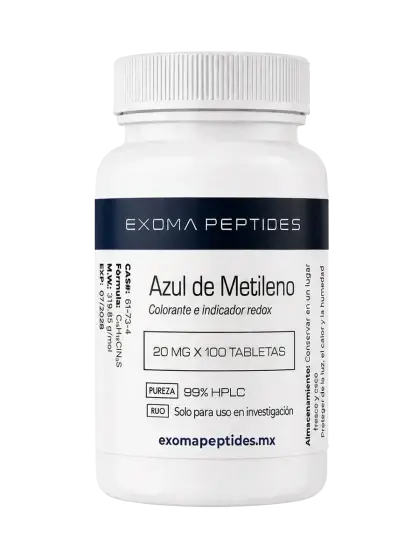
Methylene Blue
Methylene Blue — research reagent (RUO).
Technical data
- INN name
- Methylene blue
Sizes and prices: 20 mg × 100 tablets $931 MXN ($47 MXN per mg).
Buy Methylene Blue in Mexico: order online with nationwide shipping in 1-4 business days depending on zone and tracking number. Prices in Mexican pesos. Material for research use only.
Methylene Blue is known internationally as Methylene blue (INN name in English). Buy Methylene blue in Mexico / buy Methylene blue in Mexico: research reagent (RUO) and nationwide shipping.
Azul de Metileno is also searched as: Methylthioninium chloride, Cloruro de metiltioninio.
Identity and composition
El methylene blue (methylthioninium chloride) is a cationic phenothiazine dye with redox activity, studied in research for its role in mitochondrial bioenergetics and as a reference agent in redox chemistry. Product for research use.
Chemical identity data:
- CAS number: 61-73-4
- Molecular formula: C16H18ClN3S
- Molecular weight: ~319.85 g/mol (approx. 319.9; corresponds to anhydrous methylthioninium chloride; the exact value varies according to the salt form or hydration)
- Synonyms: methylthioninium chloride, methylthioninium chloride, Basic Blue 9, tetramethylthionine chloride, Swiss blue, CI 52015
It is not a peptide, so an amino acid sequence does not apply. Reference presentation: 20 mg × 100 tablets.
Mechanism of action
Methylene blue is a compound thiazine with redox activity which cycles reversibly between its oxidized form (blue) and its reduced form, leucomethylene (colorless), acting as an electron acceptor and donor.
Studies have described that, at low doses, it may function as electron recycler in the mitochondrial transport chain, interacting with cytochrome c oxidase and allowing electrons to be shunted around points of blockade of electron flow, which in models has been associated with the preservation of oxygen consumption and ATP production (PMID 22067440).
In addition, it has been experimentally characterized as a potent inhibitor of monoamine oxidase A (MAO-A) and partial of MAO-B, acting as an oxidizing substrate and one-electron reductant. This MAO-A inhibition is the described basis of the risk of serotonergic toxicity (PMID 17721552).
Pharmacokinetics
The pharmacokinetic parameters should be interpreted with caution, since they come from secondary syntheses and were not directly confirmed in an open primary source.
- It describes a good oral absorption, with bioavailability reported approximately and varying according to the formulation.
- The plasma peak is typically located within the first few minutes after the oral dose, according to secondary sources.
- La terminal half-life is reported on the order of several hours, with estimates that vary according to route and formulation.
- Metabolism is mainly hepatic (reduction to leucomethylene; conjugation by UGT and participation of CYP1A2/2C19/2D6), with partial urinary excretion.
As these are values not verified in a primary source, they are presented qualitatively and for guidance only.
Scientific evidence
Methylene blue is a compound with long clinical history. In the research setting it has been studied, mostly in preclinical models and early-phase or exploratory trials, in topics such as mitochondrial bioenergetics, memory performance and neuroprotection in models of mitochondrial dysfunction (for example, cardiac arrest or neurotoxins such as rotenone) (PMID 22067440).
Derivatives and formulations have been explored in the context of neurodegenerative diseases (for example, related to the tau protein), but the evidence of robust clinical efficacy remains limited and must be interpreted with caution. The available evidence is largely preliminary and does not allow definitive conclusions to be drawn about outcomes in humans.
Research applications
Product for research use.
Ideal for:
- In vitro and preclinical model studies on redox chemistry and reversible electron cycling.
- Research in mitochondrial bioenergetics and function of cytochrome c oxidase.
- Experimental work as MAO-A inhibitor reference.
- Use as a reference dye in laboratory applications.
Not applicable for:
- Any form of clinical use, self-administration or clinical/therapeutic use.
- Use as a supplement, medication or diagnostic product in people.
- Applications where pharmaceutical grade or clinical sterility is required.
Research protocols
The literature reviewed does not include specific dose figures validated by citation for experimental protocols, so numerical doses are not listed.
Qualitatively, the reference literature describes that many of the bioenergetic and neurometabolic effects studied are observed at low doses, in contrast to high doses where the compound's behavioral profile may change (PMID 22067440).
The exact dosing parameters must be taken directly from the primary source corresponding to each experimental design. It is not recommended to infer doses from this data sheet.
Reconstitution
The methylene blue in this presentation is offered in tablet format (20 mg × 100), so it does not require reconstitution for handling as a solid material.
As a general laboratory guide, when a compound of this type is prepared in solution for experimental work:
- A compatible aqueous vehicle is usually used; the bacteriostatic water (water with approximately 0.9% benzyl alcohol as preservative) is a standard option when a multi-use solution is sought.
- The diluent is added slowly down the wall of the vial, without vigorous shaking, letting it dissolve gently.
- Due to its intense coloring power, it is advisable to work with dedicated material and protected surfaces, since it stains easily.
These indications are for general laboratory handling and do not constitute instructions for use in people.
Stability and storage
As a standard laboratory handling guideline:
- The material solid (tablets) it must be kept in a dry place, protected from light and moisture, in its closed container. Reference solids are usually kept stable for prolonged periods under controlled conditions.
- All prepared solution tends to be less stable than the solid: it is recommended to keep it refrigerated, protected from light and labeled with the preparation date.
- For prolonged storage of aliquots, one may consider freezing, avoiding repeated freeze-thaw cycles.
- The compound is photosensitive and a colorant; it is advisable to use amber or light-protected vials.
These ranges are general laboratory practices and should be adjusted to the specific protocol of each study.
Safety profile
Documented safety profile (for research handling; not for clinical use):
- Risk of serotonergic toxicity / serotonin syndrome when combined with SSRIs, SNRIs, clomipramine or other serotonergic agents, due to its inhibition of MAO-A (PMID 17721552).
- Must be handled with caution in the context of G6PD deficiency, due to the risk of hemolysis described in the literature.
- At high doses it can, paradoxically, be associated with methemoglobinemia.
- Produces a characteristic coloring effect (blue-green discoloration of urine and skin in exposure contexts) and it can interfere with pulse oximetry readings.
These points reflect documented risks and reinforce that the product is intended exclusively for research use under controlled laboratory conditions.
Comparative context
Within the family of phenothiazines, methylene blue occupies a particular place:
- It is distinguished by its redox reversibility and a favorable redox potential for mitochondrial electron recycling. This contrasts with antipsychotic phenothiazines such as chlorpromazine, whose main action is the antagonism of dopaminergic receptors.
- As MAO-A inhibitor, it shares part of the serotonergic interaction profile with the classic MAOIs; however, its main described role is that of redox / reference agent, and not that of an antidepressant.
In summary, it is a redox compound of the thiazine class whose electrochemical behavior functionally distinguishes it from other receptor-oriented phenothiazines.
History and development
Methylene blue is a thiazine-type dye with a long track record of use and study. Historically it has been used as a dye (under names such as Basic Blue 9 and CI 52015) and has been extensively characterized in chemistry and biology for its reversible redox cycling between the blue (oxidized) and colorless (reduced leucomethylene) forms.
In the field of biomedical research, its development has been directed toward exploring its interaction with the mitochondrial transport chain and cytochrome c oxidase (PMID 22067440), as well as its characterization as MAO-A inhibitor (PMID 17721552). Building on these findings, derivatives and formulations have been investigated in models of mitochondrial dysfunction and neurodegeneration, although robust clinical evidence remains limited.
FAQ
What is methylene blue and what is it studied for?
It is a phenothiazine dye (methylthioninium chloride, CAS 61-73-4) with reversible redox activity. In research its role in mitochondrial bioenergetics and as an inhibitor of MAO-A is studied mainly. It is a product for research use; not for clinical use.
What is its formula and molecular weight?
Its molecular formula is C16H18ClN3S and its approximate molecular weight is 319.85 g/mol (corresponding to anhydrous methylthioninium chloride). The exact value may vary depending on the salt form or degree of hydration.
How does it act at the cellular level?
Studies have described that it cycles reversibly between its oxidized and colorless forms, acting as an electron recycler in the mitochondrial transport chain via cytochrome c oxidase (PMID 22067440). It also inhibits MAO-A (PMID 17721552).
What interaction risks have been documented?
A risk of serotonergic toxicity has been documented when combining it with SSRIs, SNRIs, clomipramine or other serotonergic agents, due to its inhibition of MAO-A (PMID 17721552). Caution in G6PD deficiency is also described. It is research material, not for use in people.
How should it be stored?
As a general laboratory guideline, solid material is preserved dry, protected from light and humidity. Prepared solutions are kept refrigerated and protected from light, or frozen in aliquots for long periods, avoiding repeated freeze cycles.
Is the clinical evidence conclusive?
No. Much of the evidence on memory, neuroprotection, and bioenergetics comes from preclinical models and early-phase trials. Robust clinical efficacy evidence remains limited and must be interpreted with caution.
Customer reviews
Average rating: 4.5 out of 5, based on 12 customer ratings.
Eduardo B. — 4/5
The Methylene Blue arrived well sealed. Good service from the support team.
Valeria M. — 5/5
The bottle of Methylene Blue comes excellent, well sealed and with the dropper intact. Shipping took only two days. Thank you very much!
Mariana C. — 4/5
The Methylene Blue vial arrived well sealed. Shipping was standard but it arrived earlier than expected.
Mariana C. — 4/5
The Methylene Blue arrived in good condition.
Mariana C. — 4/5
The bottle of Methylene Blue arrived well protected. Shipping met the estimate.
N. Q. — 4/5
The delivery of the product was made within the expected parameters, although the outer packaging showed slight wear that did not affect the integrity of the inner vial. The chemical purity is outstanding and the solubility in distilled water is immediate, meeting the requirements of the project.
B. S. — 5/5
The material was received in hermetic packaging that guarantees the integrity of the compound against photodegradation. Reconstitution in aqueous medium resulted in a solution of absolute clarity, validating the absence of particulate contaminants according to the technical standards established for research protocols.
P. A. — 5/5
A notable consistency between different batches was observed, which is critical for the reproducibility of the experimental models. The labeling includes all the technical information necessary for safe handling in the laboratory and the delivery time was in line with what the supplier stipulated.
N. Q. — 5/5
The purity reported in the attached COA fully matches the results obtained in the spectrophotometry tests. The powder presents a fine and uniform particle size, facilitating complete dissolution in saline solution without leaving insoluble residues or the formation of aggregates at the bottom of the vial.
Jorge C. — 5/5
Everything in order with the Methylene Blue. The package came very well protected and the tracking number arrived the day after making the payment. I will definitely buy again.
P. A. — 5/5
The compound presents a high controlled hygroscopicity within the vacuum-sealed vial, keeping its physical properties intact. Internal HPLC analyses confirm the declared concentration of 20mg, allowing precise dosing in the in vitro protocols designed for this study.
Scientific references (7)
Peer-reviewed literature on Methylene Blue, with its PubMed identifier where available:
- [Methylene blue] (Kiyota K · Chudoku kenkyu: Chudoku Kenkyukai jun kikanshi = The Japanese journal of toxicology · 2008) PMID 19069129.
- Methylene-blue-associated encephalopathy (Sweet G et al. · Journal of the American College of Surgeons · 2007) PMID 17324781.
- Methylene blue (Clifton J 2nd et al. · American journal of therapeutics · 2003) PMID 12845393.
- Molecular Mechanisms of the Neuroprotective Effect of Methylene Blue (Gureev, et al. · Biochemistry (Moscow) · 2022) PMID 36180986.
- Multimodal Randomized Functional MR Imaging of the Effects of Methylene Blue in the Human Brain (Rodriguez, et al. · Radiology · 2016) PMID 27351678.
- Methylene Blue in Septic Shock: A Systematic Review and Meta-Analysis. (Fernando SM, et al. · Crit Care Explor · 2024) PMID 38904978.
- Early adjunctive methylene blue in patients with septic shock: a randomized controlled trial. (Ibarra-Estrada M, et al. · Crit Care · 2023) PMID 36915146.
Full scientific profile: Methylene Blue in the compendium — mechanism of action, studies and technical data sheet.
See the full category catalog: Orals · Nootrópicos Orals.