
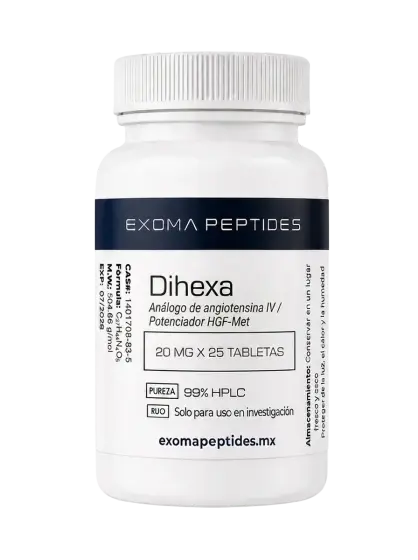
Dihexa
Dihexa — reagent for research use (RUO).
Technical data
- Development code
- PNB-0408
Sizes and prices: 20 mg × 25 tablets $5,104 MXN ($255 MXN per mg).
Buy Dihexa in Mexico: order online with nationwide shipping in 1-4 business days depending on zone and tracking number. Prices in Mexican pesos. Material for research use only.
Dihexa is also searched as: PNB-0408.
Identity and composition
Dihexa it is a synthetic oligopeptide derived from angiotensin IV, studied exclusively in preclinical research on neuroplasticity and cognitive decline. It is not approved for clinical use. Its confirmed molecular formula is C27H44N4O5 (PubChem CID 129010512), corresponding to a modified Tyr-Ile dipeptide.
Structurally it is described as N-hexanoyl-L-Tyr-L-Ile-(6)-aminohexanoamide, with a hexanoyl N-terminus and an aminohexanoamide C-terminus. Its IUPAC/PubChem name is N-(1-Oxohexyl)-L-tyrosyl-N-(6-amino-6-oxohexyl)-L-isoleucinamide. It is also identified by the synonyms PNB-0408, N-hexanoic-Tyr-Ile-(6)-aminohexanoic amide y N-hexanoyl-Tyr-Ile-(6)aminohexanoamide.
- Molecular weight: approximately 504.66 g/mol, a value calculated from the formula C27H44N4O5 (a derived datum, not read directly from the consulted PubChem page).
- CAS: no CAS number confirmed in verified reference sources is available, so it is omitted.
This presentation corresponds to a format of 20 mg × 25 tablets intended for research purposes.
Mechanism of action
The proposed mechanism for Dihexa part of its origin as an analog of angiotensin IV (AngIV: Val-Tyr-Ile-His-Pro-Phe) and of its derivative Nle1-AngIV. According to the original description by Benoist et al. (2014; PMID 25187433), Dihexa would bind with high affinity to the hepatocyte growth factor (HGF) and would enhance the phosphorylation of its receptor c-Met in the presence of subthreshold concentrations of HGF, promoting spinogenesis and synaptogenesis in the hippocampus. In that work, the procognitive effects were blocked with an HGF antagonist and with shRNA directed at c-Met.
Critical warning: that foundational study was retracted in April 2025 (PMID 40312093) following an investigation by Washington State University that concluded that figures and data were falsified in co-authored works. Therefore, the primary evidence that underpins the HGF/c-Met mechanism of Dihexa is seriously compromised and must be treated as unreliable until independent replications exist. The above is offered for educational purposes regarding the mechanistic hypothesis, not as evidence of activity.
Pharmacokinetics
There are no pharmacokinetic parameters confirmed by independent sources. In the publication by Benoist et al. (2014; PMID 25187433) —subsequently retracted for data falsification (PMID 40312093)— Dihexa was described qualitatively as orally active and permeable to the blood-brain barrier. Given the retracted origin of those data, the oral bioavailability, the CNS penetration and the half-life of Dihexa must be considered unverified and unknown. It is not possible to provide half-life or bioavailability values supported by reliable evidence.
Scientific evidence
The available evidence on Dihexa is scarce, preliminary and exclusively preclinical (rodents and neuronal cultures), focused on models of cognitive impairment of the Alzheimer's disease type and of neuroplasticity. There are no registered clinical trials of Dihexa (PNB-0408) in humans. The central body of evidence came from the Harding group at Washington State University, but its key publication was retracted for data falsification (PMID 40312093; original PMID 25187433), which strongly reduces the robustness of the research context.
No evidence of efficacy or safety in humans should be inferred. Any research interest is framed within a compound of uncertain profile whose main experimental basis is compromised.
Research applications
Product for research use.
- It may be of interest for: in vitro and preclinical studies in animal models or neuronal cultures; analytical characterization of chemical identity; exploratory research on the HGF/c-Met pathway and peptides derived from angiotensin IV, always under institutional protocols and appropriate controls.
- Not applicable for: clinical use, clinical use, diagnosis, treatment of any condition, or any application in people or companion animals. It is not a food product, supplement or medication.
Given that the compound's primary evidence was retracted, all use must be considered exploratory in nature and without expectation of results.
Research protocols
There are no validated dosing protocols. The only quantitative reference comes from Benoist et al. (2014; PMID 25187433), which described a dose oral 2 mg/kg in rats with alleged reach to the CNS; however, that publication was retracted for data falsification (PMID 40312093), so that value does not constitute a reliable or reproducible guide.
Consequently, there are no available dose ranges, routes of administration or experimental regimens supported by independent evidence. The design of any research protocol remains at the discretion of the investigator and the review of their corresponding committee.
Reconstitution
This presentation is in 20 mg tablets, a solid format that, unlike injectable lyophilized peptides, does not require reconstitution with bacteriostatic water for its usual handling.
As a general laboratory reference: when a peptide is supplied lyophilized and a solution is needed for in vitro work, it is usually reconstituted with bacteriostatic water (water with ~0.9% benzyl alcohol) or with a compatible solvent, adding the liquid slowly down the wall of the vial and letting it dissolve without vigorous shaking. For a tablet format, any analytical solution preparation will depend on the solvent and concentration required by the specific assay.
Stability and storage
As a general laboratory handling guide, a solid tablet format is best stored in a cool, dry and protected from light and humidity, in its closed container. Many peptides benefit from storage at refrigeration (2-8 °C) for prolonged periods and of freezing for long-term storage of the unopened material.
Once any solution for analytical use is prepared, stability decreases relative to the solid material; it is advisable to keep it cold, aliquot it to avoid repeated freeze-thaw cycles and use it within short windows. These are standard handling criteria, not specific stability parameters measured for Dihexa.
Safety profile
The safety profile of Dihexa is essentially unknown. There are no safety or toxicology data in humans, and there are no registered clinical trials. The main preclinical publication did not report formal adverse event or toxicity data and, moreover, was retracted for data falsification (PMID 40312093).
A concern has been noted theoretical associated with its class: by enhancing the HGF/c-Met pathway —involved in cell proliferation and oncogenesis— it could pose a theoretical proliferative/oncological risk. This risk is not experimentally characterized for Dihexa. In the absence of data, it must be handled with strict laboratory precaution and under the assumption that its toxicity is not defined.
Comparative context
Dihexa falls within the peptides derived from angiotensin IV and of its analog Nle1-AngIV. Unlike native AngIV peptides, it was designed to seek greater metabolic stability, oral activity, and penetration into the central nervous system, properties that those original peptides do not possess.
It is important not to confuse it with fosgonimeton (ATH-1017, Athira Pharma), another modulator of the HGF/c-Met system that did advance to clinical trials. Fosgonimeton is not Dihexa: they are distinct compounds. While the former reached clinical phase, Dihexa remains in a purely preclinical phase, and its foundational mechanistic evidence was retracted.
History and development
Dihexa (development code PNB-0408) was designed as a synthetic oligopeptide based on angiotensin IV and its analog Nle1-AngIV, with the objective of obtaining greater metabolic stability, oral activity and penetration into the CNS. The central body of its research came from the group of Harding at Washington State University, oriented toward Alzheimer's-type cognitive decline models and neuroplasticity.
En April 2025, the foundational article by Benoist et al. (2014) was retracted (PMID 40312093) after an institutional investigation concluded that co-author Leen Kawas falsified figures and data in her thesis and in several co-authored articles (2011-2014). This fact marks the current status of the compound: a molecule of historical interest whose main experimental basis was compromised and without reliable independent replication.
FAQ
What is Dihexa and what is it investigated for?
It is a synthetic oligopeptide derived from angiotensin IV (code PNB-0408), studied only in preclinical research on neuroplasticity and cognitive decline. It is a product for research use; not for clinical use.
Does Dihexa have clinical trials in humans?
No. There are no registered clinical trials of Dihexa (PNB-0408) in humans on ClinicalTrials.gov. All available literature is preclinical and limited.
Why is it mentioned that its main evidence was retracted?
The foundational study of its mechanism (Benoist et al., 2014; PMID 25187433) was retracted in April 2025 for data falsification (PMID 40312093). For this reason, its mechanistic evidence must be treated as unreliable until independent replications exist.
What is the molecular formula of Dihexa?
Its confirmed molecular formula is C27H44N4O5, with a calculated molecular weight of approximately 504.66 g/mol and a PubChem CID 129010512 registry. No confirmed CAS number is available in verified sources.
How is this presentation handled and stored?
It is presented as 20 mg tablets, a solid format that does not require reconstitution. As a general laboratory guideline, it is kept in a cool, dry place protected from light and moisture, in its closed container.
Is the safety profile of Dihexa known?
No. There are no human safety or toxicology data. An only theoretical oncological risk has been noted through its HGF/c-Met pathway, not experimentally characterized. Its safety profile is essentially unknown.
Customer reviews
Average rating: 4.8 out of 5, based on 5 customer ratings.
J. H. — 5/5
The Dihexa 20 mg compound exhibits optimal solubility in controlled experimental environments. After chemical reconstitution, the solution maintains absolute clarity without the presence of sediment, which is consistent with the certificate of analysis provided by the supplier. Shipping was punctual and the vial has a fully airtight seal.
R. O. — 5/5
The integrity of the vial and the bromobutyl stopper ensure the sterility of the compound for use in research models. Internal quality-control testing matches the 99% purity standards detailed in the product's technical documentation. It is a reliable material for experimental pharmacokinetic studies.
A. S. — 5/5
Product received with robust secondary packaging to prevent fractures during logistics. The lyophilized Dihexa powder exhibits a uniform structure, indicating a rigorous synthesis process. No insoluble particles or significant weight variations were detected between units of the same research batch.
S. D. — 5/5
The consistency of the received lot shows precise agreement with the reported HPLC results. The transport packaging guarantees the thermal stability necessary for this type of research peptide, arriving in optimal conditions for handling in the scheduled in vitro protocols. The detected purity facilitates precision in dosing.
S. D. — 4/5
A professional presentation is observed in the labeling, which includes technical information relevant to the laboratory inventory. The lyophilization process is uniform across all vials purchased, allowing clean and rapid reconstitution. Domestic delivery was carried out within the initially stipulated timeframe.
Scientific references (5)
Peer-reviewed literature on Dihexa, with its PubMed identifier when available:
- Stem cell, Granulocyte-Colony Stimulating Factor and/or Dihexa to promote limb function recovery in a rat sciatic nerve damage-repair model: Experimental animal studies (Weiss JB et al. · Annals of medicine and surgery (2012) · 2021) PMID 34703584.
- AngIV-Analog Dihexa Rescues Cognitive Impairment and Recovers Memory in the APP/PS1 Mouse via the PI3K/AKT Signaling Pathway (Sun X et al. · Brain sciences · 2021) PMID 34827486.
- Evaluation of metabolically stabilized angiotensin IV analogs as procognitive/antidementia agents (McCoy, et al. · Journal of Pharmacology and Experimental Therapeutics · 2013) PMID 23055539. [Con expresion de preocupacion editorial vigente. Interpretar con cautela.]
- The procognitive and synaptogenic effects of angiotensin IV-derived peptides are dependent on activation of the hepatocyte growth factor/c-Met system (Benoist, et al. · Journal of Pharmacology and Experimental Therapeutics · 2014) PMID 25187433. [RETRACTED in April 2025 for falsification of figures and data (notice: PMID 40312093). It does not constitute evidence.]
- The development of small molecule angiotensin IV analogs to treat Alzheimer's and Parkinson's diseases. (Wright JW, et al. · Prog Neurobiol · 2015) PMID 25455861.
Full scientific profile: Dihexa in the compendium — mechanism of action, studies and technical data sheet.
See the full category catalog: Orals · Nootrópicos Orals.
Guides and articles about Dihexa
Lecturas del blog de EXOMA que la editorial asoció a este compuesto: