Stenabolic
Stenabolic — research reagent (RUO).
Technical data
- INN name
- Stenabolic
- Development code
- SR9009
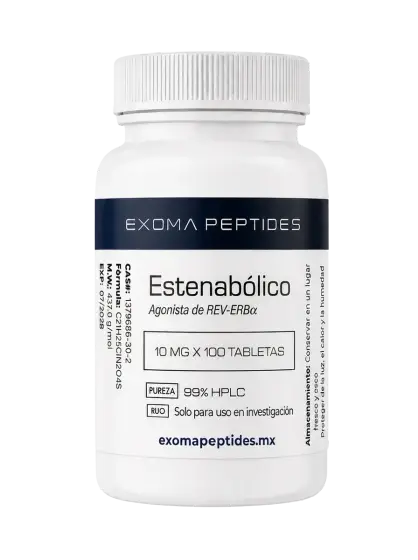
Sizes and prices: 10 mg × 100 tablets $2,322 MXN ($232 MXN per mg).
Buy Stenabolic in Mexico: order online with nationwide shipping in 1-4 business days depending on zone and tracking number. Prices in Mexican pesos. Material for research use only.
Stenabolic is known internationally as Stenabolic (INN name in English). Buy Stenabolic in Mexico / buy Stenabolic in Mexico: research reagent (RUO) and nationwide shipping.
Stenabolic is also searched as: SR9009.
Identity and composition
Stenabolic is the common name for SR9009 (Stenabolic), a synthetic small molecule that acts as an agonist of the nuclear receptors REV-ERB. It is not a peptide: it is an organic compound of the pyrrolidine-carboxylate type, studied only at the preclinical and research level.
Its chemical identity is confirmed in PubChem (CID 57394020):
- CAS: 1379686-30-2
- Molecular formula: C20H24ClN3O4S
- Molecular weight: 437.9 g/mol
- IUPAC name: ethyl 3-[[(4-chlorophenyl)methyl-[(5-nitrothiophen-2-yl)methyl]amino]methyl]pyrrolidine-1-carboxylate
- Synonyms: SR9009, SR-9009, Stenabolic
As it is a small molecule and not a peptide, it has no amino acid sequence. Presentation of this sheet: 10 mg × 100 tablets.
Product for research use.
Mechanism of action
Stenabolic (SR9009) is described in the literature as a synthetic agonist of the REV-ERB nuclear receptors (REV-ERBα/NR1D1 and REV-ERBβ/NR1D2). These receptors are transcriptional repressors of the circadian clock; their pharmacological activation suppresses the expression of Bmal1 and other clock genes and remodels the circadian expression of metabolic genes in the liver, skeletal muscle, and adipose tissue. In the foundational mouse study, following the administration of SR9009, an increase in oxygen consumption and energy expenditure was observed (Solt LA et al., Nature 2012; PMID 22460951).
An important nuance for interpreting its mechanism: later literature showed that SR9009 produces effects independent of REV-ERB on cell viability, metabolism, and transcription, even in cells with deletion of both REV-ERBα/β. Therefore, its effects should not be attributed exclusively to REV-ERB activity (Dierickx P et al., PNAS 2019; PMID 31127047).
Pharmacokinetics
The specific pharmacokinetic parameters are not confirmed in open primary sources for this listing. The literature describes a extensive hepatic metabolism, with multiple metabolites identified in hepatic microsomes by means of LC-HRMS, but concrete values of half-life (t½) or oral bioavailability were not verified here. A relevant point for the tablet form: the preclinical efficacy studies used parenteral administration (intraperitoneal), and in the general literature a low oral bioavailability is reported for SR9009, although this datum was not confirmed in an open primary source in this research.
Scientific evidence
The available evidence on Stenabolic is preliminary, exclusively preclinical and limited. It comes from animal (mouse) and in vitro models; no human clinical trials were identified for SR9009 as a therapeutic. In exploratory preclinical studies it has been investigated in contexts of obesity and diet-induced metabolic disease, insulin resistance, weight gain from circadian disruption, and in oncology cell lines in vitro (e.g., T98G glioblastoma).
In the foundational work in mice, an increase in oxygen consumption and energy expenditure was observed, along with remodeling of circadian metabolic genes (Solt LA et al., Nature 2012; PMID 22460951). There is also a considerable body of anti-doping literature (in vitro metabolism, reference materials, detection in urine/plasma), which reflects its status as a substance prohibited in sport rather than an approved therapeutic indication. No regulatory authority has approved it for clinical use.
Research applications
Product for research use.
Suitable for:
- In vitro and animal-model studies on the biology of REV-ERB receptors and the circadian clock.
- Exploratory research in energy metabolism, circadian signaling and preclinical metabolic models.
- Analytical and forensic work (detection methods, metabolite characterization, anti-doping control).
Not applicable for:
- clinical use, clinical use, diagnostic or therapeutic use of any kind.
- Sports use: it is a substance subject to anti-doping control and prohibited in sport.
- Any application that assumes results in humans: there are no clinical trials supporting efficacy or safety in people.
Research protocols
In the consulted literature no verified numerical doses are available used in studies, so no specific milligram figures or quantitative regimens are reported.
What is qualitatively documented: the preclinical efficacy studies used parenteral route (intraperitoneal) in mouse models, not oral administration (Solt LA et al., Nature 2012; PMID 22460951). This contrasts with the commercial tablet presentation. Any research protocol design must be defined according to the experimental model, the route of administration and the corresponding primary literature, without extrapolating to humans.
Reconstitution
This presentation corresponds to 10 mg oral tablets of a small molecule, not a lyophilized powder. Therefore, does not require reconstitution with bacteriostatic water or with other diluents: the tablets are used as is in the research context.
As a general laboratory reference: reconstitution with bacteriostatic water (water with ~0.9% benzyl alcohol as a preservative) applies to lyophilized vials, not to oral solid forms such as this one. To prepare working solutions from solid material for analytical purposes, one resorts to the standard solvents and procedures of the corresponding experimental method.
Stability and storage
As a standard laboratory-handling guide for a small molecule in solid form (tablets):
- Store in its original packaging, closed, protected from light and humidity.
- Keep in a cool, dry place; refrigerated storage can prolong the stability of the solid material.
- Avoid repeated humidity/temperature cycles and prolonged exposure to air.
Note: SR9009 possesses a nitrothiophene group and presents extensive metabolization described in the literature, so it is advisable to minimize exposure to light and heat. These indications are for general laboratory handling; they do not substitute the stability validation specific to each protocol.
Safety profile
The safety profile of Stenabolic is not characterized in humans: there are no safety data from clinical trials, and no regulatory authority has approved it for clinical use.
Considerations documented at the preclinical and in vitro level:
- Off-target effects: SR9009 reduces cell viability and alters metabolism and transcription independently of REV-ERB, which complicates the interpretation of both its mechanism and its safety (Dierickx P et al., PNAS 2019; PMID 31127047).
- Anti-doping control: is a substance prohibited in sport, with abundant forensic work dedicated to its detection.
As it is a research compound, it must be handled with standard laboratory precautions (personal protective equipment, avoid inhalation and ingestion). It is not intended for clinical use.
Comparative context
Stenabolic (SR9009) is usually studied together with SR9011, a structural analog that also acts as a REV-ERB agonist and whose pharmacokinetic profile is reported in the literature as more favorable.
A frequent point of commercial confusion: SR9009 is sometimes grouped with the SARMs (selective androgen receptor modulators), but does not share its mechanism. SR9009 does not act on the androgen receptor; its target is the nuclear receptors REV-ERB, linked to the circadian clock and metabolism. It is, therefore, a distinct pharmacological class.
Another relevant difference: its marketing as an oral tablet contrasts with the parenteral route (intraperitoneal) used in the preclinical efficacy studies.
History and development
Stenabolic emerges as SR9009 (Stenabolic), a small synthetic molecule developed as an agonist of the REV-ERB nuclear receptors to investigate the role of these receptors in the circadian clock and metabolism. Its foundational characterization was published in the mouse study by Solt and colleagues, where it was described as a synthetic REV-ERB agonist and its effects on bioenergetics and on the circadian expression of metabolic genes were documented (Solt LA et al., Nature 2012; PMID 22460951).
Subsequently, research expanded and nuanced its profile by demonstrating REV-ERB-independent effects (Dierickx P et al., PNAS 2019; PMID 31127047). In parallel, an extensive body of anti-doping literature focused on its metabolism and detection was developed. To date it remains an exclusively preclinical, research-use compound, without regulatory approval for clinical use.
FAQ
What is Stenabolic (SR9009) and what is it studied for?
It is a synthetic small molecule that acts as an agonist of the nuclear receptors REV-ERB, linked to the circadian clock and metabolism. It is investigated exclusively at the preclinical level (animal models and in vitro) in metabolic and circadian biology contexts. Product for research use; not for clinical use.
Is SR9009 a SARM?
No. Although it is sometimes commercially grouped with SARMs, SR9009 does not act on the androgen receptor. Its target is the nuclear receptors REV-ERB, so it belongs to a distinct pharmacological class.
Are there studies in humans with Stenabolic?
No human clinical trials for SR9009 as a therapeutic were identified. All available evidence is preclinical (mouse) and in vitro, and no regulatory authority has approved it for clinical use.
What is the half-life of SR9009?
Concrete values for half-life and oral bioavailability are not confirmed in open primary sources. The literature describes extensive hepatic metabolization, but no specific unverified figures are reported.
Do SR9009 tablets need reconstitution?
No. This presentation consists of 10 mg oral tablets of a small molecule, not a lyophilized powder, so they do not require reconstitution with bacteriostatic water. They are stored in a cool, dry place protected from light.
Is SR9009 banned in sport?
Yes. It is a substance subject to anti-doping control and prohibited in sport, with abundant forensic literature dedicated to its detection. It is not a therapeutic indication and it is not intended for clinical use.
Customer reviews
Average rating: 4.8 out of 5, based on 5 customer ratings.
E. G. — 5/5
The lot was verified by means of external HPLC analysis, fully matching the purity values of the certificate. The transport packaging guarantees the integrity of the safety seal and prevents any type of cross-contamination during logistical handling.
M. C. — 5/5
The supplied material presents optimal solubility in the vehicle selected for the in vitro protocol. The clarity of the solution after reconstitution is total, without formation of sediments or particles in suspension, which confirms the purity reported by the manufacturer.
C. M. — 4/5
Product collected for stability evaluation. The lyophilization is uniform throughout the lot, showing a solid structure that allows precise handling. The transit time was adequate, although the outer packaging presented a slight transport dent.
R. C. — 5/5
Excellent response of the compound in cell culture models. The absence of visible impurities and the rapid dissolution allow maintaining the sterility of the medium according to the established protocol. The 10mg vial maintains the factory vacuum impeccably.
K. M. — 5/5
The precision in the gram weight of the compound within the vial is consistent across the units received. The technical labeling facilitates traceability within the laboratory inventory and the delivery times meet the standards of preclinical research.
Scientific references (2)
Peer-reviewed literature on Stenabolic, with its PubMed identifier where available:
- Regulation of circadian behaviour and metabolism by synthetic REV-ERB agonists (Solt, et al. · Nature · 2012) PMID 22460951.
- SR9009 induces a REV-ERB dependent anti-small-cell lung cancer effect through inhibition of autophagy (Shen, et al. · Theranostics · 2020) PMID 32292508.
Full scientific profile: SR9009 (Stenabolic) in the compendium — mechanism of action, studies and technical data sheet.
See the full category catalog: Orals · SARMs.