Ligandrol (LGD-4033)
Ligandrol (LGD-4033) — research reagent (RUO).
Technical data
- INN name
- Ligandrol
- Development code
- LGD-4033
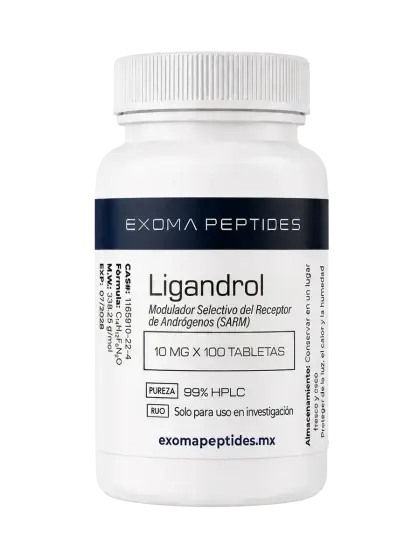
Sizes and prices: 10 mg × 100 tablets $1,626 MXN ($163 MXN per mg).
Buy Ligandrol (LGD-4033) in Mexico: order online with nationwide shipping in 1-4 business days depending on zone and tracking number. Prices in Mexican pesos. Material for research use only.
Ligandrol (LGD-4033) is known internationally as Ligandrol (INN name in English). Buy Ligandrol in Mexico / buy Ligandrol in Mexico: research reagent (RUO) and nationwide shipping.
Ligandrol (LGD-4033) is also searched as: LGD-4033, VK5211.
Identity and composition
Ligandrol (LGD-4033) is an orally administered non-steroidal selective androgen receptor modulator (SARM), investigated for its tissue-selective interaction with the androgen receptor (AR), with the design premise of favoring an anabolic effect in muscle and bone with lower androgenic activity in other tissues. Product for research use.
Unlike peptides, LGD-4033 is not a chain of amino acids, but a small molecule; therefore it has no peptide sequence. Its reference chemical identity constants are:
- Name / synonyms: Ligandrol, LGD-4033, VK5211 / VK-5211
- CAS: 1165910-22-4
- Molecular formula: C14H12F6N2O
- Molecular weight: ~338.25 g/mol
- PubChem CID: 44137686
- IUPAC name: 4-[(2R)-2-[(1R)-2,2,2-trifluoro-1-hydroxyethyl]pyrrolidin-1-yl]-2-(trifluoromethyl)benzonitrile
This presentation corresponds to 10 mg per tablet, 100 tablets per package.
Mechanism of action
LGD-4033 acts as androgen receptor (AR) ligand with activity described as tissue-selective: the SARM class hypothesis is to achieve preferential anabolic signaling in muscle and bone with lower prostatic androgenic activity. It is a non-steroidal small molecule, not a peptide.
In the early-phase clinical trial, administration was associated with dose-dependent suppression of total testosterone, SHBG, HDL cholesterol, and triglycerides, with suppression of FSH and free testosterone only at the highest dose; these findings are consistent with modulation of the androgenic axis (Basaria et al., 2013; PMID 22459616).
These descriptions are of an educational nature about the investigated mechanism and do not constitute a claim of clinical efficacy.
Pharmacokinetics
In the phase 1 trial, LGD-4033 showed linear / dose-proportional pharmacokinetics in the studied range (0.1-1 mg/day). A ... was described long elimination half-life, with dose-proportional accumulation after repeated administration (levels approximately 3 times higher on day 21 versus day 1) (Basaria et al., 2013; PMID 22459616).
Transparency note: the specific numerical half-life value that circulates in secondary sources was not extracted from the peer-reviewed abstract, so here it is described qualitatively as "long" without assigning an exact figure.
Scientific evidence
La peer-reviewed clinical evidence is limited and early-phase. The main study (Basaria et al., 2013, J Gerontol A Biol Sci Med Sci; PMID 22459616) was a trial of phase 1, randomized, placebo-controlled, and dose-escalation in 76 healthy young men (21-50 years), with doses of 0.1, 0.3 and 1.0 mg/day for 21 days, whose stated objective was to evaluate safety, pharmacokinetics and effects on body composition.
The SARM class has been investigated as a possible approach for lean mass loss conditions, but LGD-4033 has no regulatory approval and its documented clinical development is early-stage. The data on long-term efficacy and in clinical populations are scarce; the available evidence should be interpreted as preliminary.
Research applications
Product for research use.
Ideal for:
- Research in vitro and laboratory studies on selective androgen receptor modulators (SARMs).
- Chemical-analytical reference work and characterization of the SARM class.
- Educational research on androgen receptor pharmacology.
Not applicable for:
- clinical, dietary, therapeutic, or supplementation use.
- Sport use: LGD-4033 is banned in sport by WADA.
- Any application involving administration to people or animals outside an authorized research framework.
Research protocols
In the only available peer-reviewed clinical trial (phase 1), the doses investigated were 0.1, 0.3, and 1.0 mg/day for 21 days in healthy young men (Basaria et al., 2013; PMID 22459616). These values correspond to the study design and do not constitute a recommendation for use nor a dosing regimen for people.
In the open peer-reviewed literature, there are no validated protocols beyond phase 1 or efficacy schemes in clinical populations. Any handling must be restricted to the researcher's laboratory experimental design.
Reconstitution
This presentation is a small molecule in tablet format (10 mg), so does not require reconstitution like lyophilized peptides: it does not dissolve with bacteriostatic water for its intended use.
As a general laboratory reference: bacteriostatic water (water with ~0.9% benzyl alcohol) is the standard diluent for reconstituting lyophilized peptide vials, which does not apply to this product in tablet form. If a research protocol requires preparing a solution of LGD-4033, the appropriate solvents should be used according to the laboratory's technique, not bacteriostatic water.
Stability and storage
As a general laboratory-handling standard, the tablets should be stored in a place cool, dry and protected from light, in its closed container and away from moisture. Unlike reconstituted peptides, a solid in tablet form does not require immediate refrigeration after opening, although a cool, stable environment favors preservation.
If a working solution for research is prepared, it is usually less stable than the solid and should be kept refrigerated or frozen according to the protocol, minimizing freeze-thaw cycles. These are qualitative handling guidelines, not validated stability specifications for this product.
Safety profile
In the 21-day phase 1 trial, LGD-4033 was well tolerated, with no serious adverse events related to the drug and no significant changes in hemoglobin, PSA, liver enzymes, or cardiac markers during the studied period (Basaria et al., 2013; PMID 22459616). There was observed dose-dependent suppression of the hormonal axis (total testosterone, SHBG) and of lipids (HDL, triglycerides); these parameters returned to baseline values after discontinuation.
Important considerations:
- La long-term safety is not established in peer-reviewed literature.
- Outside the study context there are independent reports (case reports) of hepatotoxicity associated with commercial products containing SARMs, although they were not part of the cited controlled trial.
- Reinforcing the framing: product for research use.
Comparative context
LGD-4033 belongs to the class of Non-steroidal SARMs, along with compounds such as ostarine (MK-2866 / enobosarm) y RAD-140 (testolone).
Compared with anabolic androgenic steroids, the design premise of SARMs is a greater tissue anabolic selectivity (muscle and bone) with lower prostatic androgenic activity. It is important to emphasize that the direct head-to-head comparison with other SARMs in the peer-reviewed clinical literature is limited; these notes are at the class level and do not imply demonstrated superiority of one compound over another.
History and development
LGD-4033, also known as Ligandrol and under the development code VK5211 / VK-5211, was developed as an oral non-steroidal selective androgen receptor modulator. Its published clinical characterization corresponds to a phase 1 trial in healthy young men (Basaria et al., 2013; PMID 22459616), focused on safety, pharmacokinetics and body composition.
Its class (SARMs) has been investigated as a possible approach for muscle/lean mass loss conditions, but LGD-4033 has not reached regulatory approval for clinical use and its documented clinical development remains in an early phase. It is banned in sport by WADA.
FAQ
What is Ligandrol (LGD-4033)?
It is a non-steroidal selective androgen receptor modulator (SARM) of oral administration, investigated for its tissue-selective interaction with the androgen receptor. It is a small molecule, not a peptide. Product for research use; not for clinical use.
Is LGD-4033 a peptide? Does it need reconstitution with bacteriostatic water?
No. LGD-4033 is a small molecule, not a peptide, and this presentation comes in 10 mg tablets. It does not require reconstitution with bacteriostatic water like the lyophilized peptide vials.
What doses of LGD-4033 have been used in studies?
In the only peer-reviewed phase 1 trial, doses of 0.1, 0.3 and 1.0 mg/day were investigated over 21 days in healthy young men (Basaria et al., 2013; PMID 22459616). These are values from the study design, not a dosing recommendation.
What is known about its safety?
In the 21-day phase 1 trial it was well tolerated, with no serious drug-related adverse events, with dose-dependent suppression of hormones and lipids that returned to baseline values after discontinuation. Long-term safety is not established, and there are independent reports of hepatotoxicity with products containing SARMs.
Is it banned in sport?
Yes. LGD-4033 is prohibited in sport by WADA and does not have regulatory approval for clinical use.
How does it differ from RAD-140 or ostarine?
All three belong to the class of non-steroidal SARMs. The design premise of the class is greater anabolic tissue selectivity with lower prostatic androgenic activity, but the direct head-to-head comparison in the clinical literature is limited and does not imply demonstrated superiority of one over another.
Customer reviews
Average rating: 4.8 out of 5, based on 5 customer ratings.
C. M. — 5/5
It has been confirmed that the net mass contained in the vial is consistent between batches, allowing precise dosing in working solutions. The presentation of the labeling facilitates the traceability needed for data logging in the laboratory. Punctual delivery time within the national territory.
E. N. — 4/5
Although the delivery time suffered a slight 24-hour delay, the quality of the Ligandrol supplied is unquestionable. The analytical purity detected allows its use in receptor-binding assays without significant interference. The packaging is robust and adequately protects the fragile material.
R. O. — 5/5
The material received shows optimal solubility in standard contrast media. HPLC analyses confirm the purity of the batch, which is essential for maintaining the integrity of internal protocols without the risk of cross-contamination. The packaging arrived properly sealed.
G. E. — 5/5
The product strictly complies with the technical specifications detailed in the technical data sheet. The physical integrity of the vial seals guarantees a sterile environment for handling samples in research models. The supporting documentation is complete and pertinent for academic purposes.
S. D. — 5/5
Reconstitution of the compound results in a clear solution free of particles in suspension, which indicates a high-quality lyophilization process. The thermal packaging protected the vials from thermal variations during transit. The attached COA matches the spectrometry results.
Scientific references (4)
Peer-reviewed literature on Ligandrol (LGD-4033), with its PubMed identifier where available:
- Variation of Sequential Ligandrol (LGD-4033) Metabolite Levels in Routine Anti-Doping Urine Samples Detected with or without Other Xenobiotics (Kwiatkowska D et al. · Molecules (Basel, Switzerland) · 2023) PMID 37764261.
- LGD-4033 and MK-677 use impacts body composition, circulating biomarkers, and skeletal muscle androgenic hormone and receptor content: A case report (Cardaci TD et al. · Experimental physiology · 2022) PMID 36303408.
- Ligandrol (LGD-4033)-Induced Liver Injury (Barbara M et al. · ACG case reports journal · 2020) PMID 32637435.
- The safety, pharmacokinetics, and effects of LGD-4033, a novel nonsteroidal oral, selective androgen receptor modulator, in healthy young men. (Basaria S, et al. · J Gerontol A Biol Sci Med Sci · 2013) PMID 22459616.
Full scientific profile: LGD-4033 (Ligandrol) in the compendium — mechanism of action, studies and technical data sheet.
See the full category catalog: Orals · SARMs.