
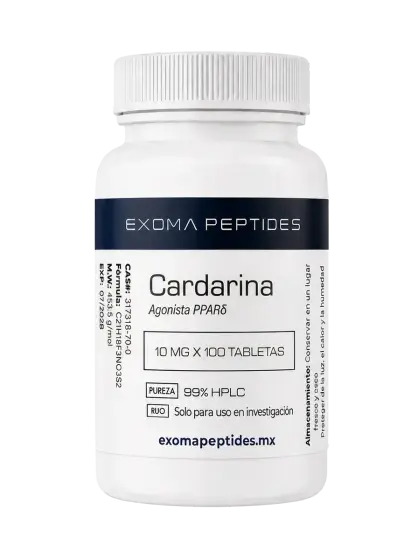
Cardarine (GW-501516)
Cardarine (GW-501516) — research reagent (RUO).
Technical data
- INN name
- Cardarine
- Development code
- GW-501516
Sizes and prices: 10 mg × 100 tablets $1,626 MXN ($163 MXN per mg).
Buy Cardarine (GW-501516) in Mexico: order online with nationwide shipping in 1-4 business days depending on zone and tracking number. Prices in Mexican pesos. Material for research use only.
Cardarine (GW-501516) is known internationally as Cardarine (INN name in English). Buy Cardarine in Mexico / buy Cardarine in Mexico: research reagent (RUO) and nationwide shipping.
Cardarine (GW-501516) is also searched as: GW-501516, GW1516, Endurobol.
Identity and composition
Cardarine (GW-501516) is a research compound —a synthetic small molecule, not a peptide or a steroid— that acts as a selective agonist of the nuclear receptor PPAR-δ and is studied for its role in lipid metabolism and the oxidation of fatty acids. Presentation: 10 mg × 100 tablets. Product for research use.
Reference chemical identity data:
- CAS number: 317318-70-0
- Molecular weight: 453.5 g/mol
- Molecular formula: C21H18F3NO3S2
- PubChem CID: 9803963
- Synonyms: GW501516, GW-501516, GW 501516, Cardarine, Endurobol; IUPAC name: 2-[2-methyl-4-[[4-methyl-2-[4-(trifluoromethyl)phenyl]-1,3-thiazol-5-yl]methylsulfanyl]phenoxy]acetic acid.
As it is a small molecule, it has no amino-acid sequence. Although the catalog groups it among peptides, chemically it corresponds to a low-molecular-weight organic compound, not a peptide or a SARM.
Mechanism of action
GW-501516 is a synthetic, potent and selective agonist of the peroxisome proliferator-activated receptor delta (PPAR-δ, also called PPAR-β/δ), with selectivity over the PPAR-α and PPAR-γ subtypes. Its target is a nuclear receptor involved in lipid metabolism, not an anabolic steroidal pathway.
In cellular studies it has been observed that, upon activating PPAR-δ, it induces the expression of genes linked to preferential lipid utilization, fatty acid β-oxidation, cholesterol efflux, and energy uncoupling in skeletal muscle (for example PDK4 and CPT-1/CPT1b) (Mol Endocrinol 2003; PMID 14525954). In cellular and animal models, the preliminary evidence suggests that this is associated with an increase in fatty acid oxidation.
Pharmacokinetics
The pharmacokinetic parameters in humans —including the half-life— could not be verified in open sources for this sheet, so they are left unspecified. Half-life or elimination-dynamics figures are not reported here in order to avoid providing unconfirmed data. Any PK characterization should be established independently within the corresponding research protocol.
Scientific evidence
The available evidence is limited and mostly preclinical. Most of the literature corresponds to cellular and rodent studies on oxidative metabolism, muscle fiber type and aerobic capacity; the observations on aerobic endurance come mainly from rodent models and not from efficacy trials in humans.
As for human data, there is at least one short-duration controlled study in moderately obese men, in which reductions in triglycerides, apoB, LDL, fasting insulin, and hepatic fat were observed, along with an increase in fatty acid oxidation and no increase in oxidative stress (Diabetes 2008; PMID 18024853). This is preliminary and limited-scope evidence: the compound did not achieve regulatory approval and its development was halted.
Research applications
Product for research use.
Ideal for:
- In vitro and animal-model studies on the PPAR-δ pathway and the regulation of lipid catabolism genes.
- Research on oxidative metabolism, fatty acid β-oxidation and muscle fiber type in preclinical models.
- Use as a reference PPAR-δ agonist in comparative work within its class.
Not applicable for:
- Any form of clinical use, sports supplementation or clinical use.
- Use in sports competition contexts: it is prohibited by the anti-doping agencies.
- Diagnostic or therapeutic use: it is not a drug approved for humans.
Research protocols
The literature reviewed does not include specific numerical doses from studies (in mg or in concentration) that can be cited with direct support, so no dosing figures are indicated to avoid unverified data.
At a qualitative level, the available literature spans cellular and rodent models to characterize the activation of PPAR-δ, and a short-duration study in moderately obese humans (PMID 18024853). The parameters of dose, route, and duration must be defined within the laboratory's experimental design, in accordance with the corresponding protocol guidelines, and are not presented here as a recommendation.
Reconstitution
This presentation is in tablet format (10 mg × 100), so does not require reconstitution: it is not a lyophilizate intended to be dissolved with bacteriostatic water.
As a general laboratory reference, reconstitution with bacteriostatic water (sterile water with approximately 0.9% benzyl alcohol as a preservative) is the standard technique for lyophilized vials, not for solid oral forms such as this one. To prepare working solutions from tablets in a research protocol, dissolution must follow the analytical method defined by the laboratory and the solvent appropriate for the compound.
Stability and storage
As a general laboratory handling guideline for a solid form:
- Store the tablets in their original container, closed, in a cool, dry place, protected from light and moisture.
- Avoid prolonged exposure to heat and temperature cycling.
- If the protocol requires preparing a working solution, this is usually less stable than the solid: it is handled refrigerated, in aliquots, and protected from light, and used within the window defined by the laboratory.
Always label with the preparation date and conditions. These are standard storage criteria; specific stability must be confirmed in the experimental context.
Safety profile
Safety profile to consider when handling as research material, with reservations due to evidence not verified in detail in this session:
- There is a widely documented regulatory safety note: the development programs were abandoned after long-term carcinogenicity studies in rodents that showed tumor induction in multiple organs at high doses. This information is marked as not verified against a primary source in this datasheet.
- The anti-doping agencies (WADA) issued alerts and were banned in sport.
- It is not a drug approved for clinical use; its use is exclusively for research.
Handle with appropriate personal protective equipment and under the laboratory's biosafety practices. These notes do not constitute a complete toxicological evaluation.
Comparative context
Within its class of PPAR-δ agonists, GW-501516 is comparable to GW0742, another selective PPAR-δ agonist used in research; both share the target of the nuclear receptor of lipid metabolism.
Compared with the PPAR-α agonists (fibrates), in the study in moderately obese humans the PPAR-α comparator showed minimal effects beyond the reduction of triglycerides, which suggests that the metabolic effects observed would be specific to the PPAR-δ pathway (PMID 18024853). Unlike anabolic steroids and SARMs, GW-501516 does not act on the androgen receptor: its mechanism centers on the regulation of lipid-metabolism genes.
History and development
GW-501516 was originally developed by GlaxoSmithKline in collaboration with Ligand as a candidate compound for dyslipidemia and metabolic syndrome. Research characterized its action as a selective PPAR-δ agonist on lipid metabolism.
Its clinical development did not reach regulatory approval and was halted, in the context of long-term carcinogenicity findings in rodents (information flagged as not verified against a primary source in this datasheet). Subsequently, anti-doping agencies added it to their lists of substances prohibited in sport. Today it remains a reference compound in preclinical research on the PPAR-δ pathway.
FAQ
What is Cardarine (GW-501516)?
It is a research compound: a synthetic small molecule that acts as a selective agonist of the PPAR-δ receptor, studied for its role in lipid metabolism and fatty acid oxidation. It is not a steroid, a SARM or a peptide. Product for research use; not for clinical use.
Is Cardarine a SARM or a steroid?
No. Although it is sometimes grouped with those compounds, chemically it is a small-molecule agonist of the nuclear receptor PPAR-δ. It does not act on the androgen receptor, so its mechanism differs from that of SARMs and anabolic steroids.
What does the evidence say about GW-501516?
The evidence is limited and mostly preclinical (cell and rodent studies). In humans there is at least one short-duration study in moderately obese males that observed changes in lipid markers and greater fatty acid oxidation (PMID 18024853). It did not reach regulatory approval.
Why was its development halted?
The development programs were abandoned after long-term carcinogenicity studies in rodents that showed tumor induction at high doses (information not verified with a primary source in this data sheet). In addition, anti-doping agencies prohibited it in sport.
How is this tablet presentation stored?
As a solid form, it is kept in its closed original container, in a cool, dry place, protected from light and moisture. It does not require reconstitution with bacteriostatic water, as it is not a lyophilizate.
Can it be used in humans or in sport?
No. It is not an approved drug for clinical use and it is banned by anti-doping agencies. This product is for research use only; not for clinical use.
Customer reviews
Average rating: 4.8 out of 5, based on 5 customer ratings.
C. T. — 5/5
Batch integrity was verified by spectroscopy, confirming correspondence with the provided certificate of analysis. The 10mg per vial dosing shows 99% accuracy, facilitating standardization in preclinical metabolic research models. Efficient logistics delivery under controlled thermal conditions.
O. C. — 5/5
The product arrived within the stipulated time with the security seal intact. In thermal-resistance tests, the lyophilizate maintained its structural stability, which is critical for long-duration experiments. The consistency between the batch number and the purity report facilitates institutional traceability.
J. H. — 5/5
The lyophilized material presents a uniform structure and immediate solubility in aqueous medium after reconstitution. The data from the attached HPLC analysis align with the stability observed in the in vitro protocol, maintaining the integrity of the compound without formation of visible aggregates. The packaging adequately protects against photodegradation.
C. M. — 5/5
Presentation in borosilicate vials ensures the purity of the reagent during prolonged storage. A clean reconstitution and absolute transparency in the final solution were observed, which validates the absence of undeclared excipients. The labeling meets the technical requirements for laboratory inventory.
A. R. — 4/5
The compound shows good affinity in solution, although a slight initial resistance to dispersion was detected that resolves with gentle mechanical agitation. The purity reported by HPLC is consistent with the behavior observed in the experimental model. The outer packaging is robust, although the storage manual could be more detailed.
Scientific references (7)
Peer-reviewed literature on Cardarine (GW-501516), with its PubMed identifier where available:
- Testing for GW501516 (cardarine) in human hair using LC/MS-MS and confirmation by LC/HRMS (Kintz P et al. · Drug testing and analysis · 2020) PMID 32298044.
- PPARdelta activator GW-501516 has no acute effect on glucose transport in skeletal muscle (Terada S et al. · American journal of physiology. Endocrinology and metabolism · 2006) PMID 16278250.
- GW-501516 GlaxoSmithKline/Ligand (Pelton P · Current opinion in investigational drugs (London, England: 2000) · 2006) PMID 16625823.
- Activation of Nuclear Hormone Receptor Peroxisome Proliferator-Activated Receptor-Delta Accelerates Intestinal Adenoma Growth (Gupta, et al. · Nature Medicine · 2004) PMID 14758356.
- The PPARdelta Agonist, GW501516, Promotes Fatty Acid Oxidation but Has No Direct Effect on Glucose Utilisation or Insulin Sensitivity in Rat L6 Skeletal Muscle Cells (Dimopoulos, et al. · FEBS Letters · 2007) PMID 17869249.
- Lipid Effects of Peroxisome Proliferator-Activated Receptor-Delta Agonist GW501516 in Subjects with Low High-Density Lipoprotein Cholesterol: Characteristics of Metabolic Syndrome (Olson, et al. · Arteriosclerosis, Thrombosis, and Vascular Biology · 2012) PMID 22814748.
- Effects of the Peroxisome Proliferator-Activated Receptor (PPAR)-delta Agonist GW501516 on Bone and Muscle in Ovariectomized Rats (Mosti, et al. · Endocrinology · 2014) PMID 24708238.
Full scientific profile: Cardarine (GW-501516) in the compendium — mechanism of action, studies and technical data sheet.
See the full category catalog: Orals · SARMs.