Ostarine
Ostarine — reagent for research use (RUO).
Technical data
- INN name
- Ostarine
- Development code
- MK-2866
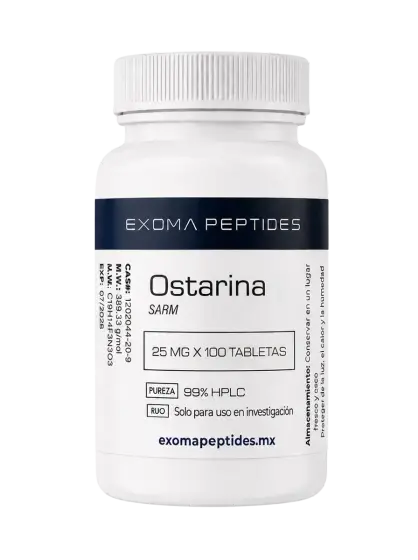
Sizes and prices: 25 mg × 100 tablets $1,626 MXN ($65 MXN per mg).
Buy Ostarine in Mexico: order online with nationwide shipping in 1-4 business days depending on zone and tracking number. Prices in Mexican pesos. Material for research use only.
Ostarine is known internationally as Ostarine (English INN name). Buy Ostarine in Mexico / comprar Ostarine en México: reagent for research use (RUO) and nationwide shipping.
Ostarine is also searched as: MK-2866, Enobosarm, GTx-024.
Identity and composition
Ostarine (also known as Ostarine, Enobosarm, MK-2866, GTx-024 o S-22) is a non-steroidal orally administered selective androgen receptor modulator (SARM), studied in research as a tissue-selective anabolic agent. It is not a peptide, but a synthetic small molecule. This is a product for research use.
Reference chemical identity data:
- Molecular formula: C19H14F3N3O3
- Molecular weight: 389.3 g/mol
- PubChem CID: 11326715
- IUPAC name: (2S)-3-(4-cyanophenoxy)-N-[4-cyano-3-(trifluoromethyl)phenyl]-2-hydroxy-2-methylpropanamide
As it is a small molecule and not a peptide, an amino acid sequence does not apply. The catalog presentation corresponds to 25 mg × 100 tablets.
Mechanism of action
Ostarine acts as androgen receptor (AR) ligand, producing tissue-selective anabolic activity. In the clinical trials reviewed, its documented measurable effect is the increase in lean body mass (lean body mass) (PMID 23499390).
The mechanistic premise of the SARM class is to achieve AR activation with a greater effect on muscle and bone tissue and less classic androgenic activity; however, that tissue selectivity separation has not been conclusively demonstrated in humans in the sources gathered. What direct clinical evidence documents is the effect on lean mass, not a fully established tissue separation.
In simple terms: it is a small synthetic molecule that binds to the androgen receptor and, in the available studies, was measurably associated with changes in lean mass.
Pharmacokinetics
Ostarine is a oral administration. In the open primary sources reviewed, no confirmed value was found for half-life; the phase 2 and phase 3 abstracts consulted do not report a half-life. Therefore, this datum is considered not verified and no numerical figure is offered to avoid unsupported information.
Scientific evidence
The available evidence is limited and of an investigational nature; ostarine (enobosarm) was never approved by the FDA or the EMA. The most advanced indication studied was the prevention/treatment of muscle wasting (cachexia) cancer-associated.
- In a phase 2 trial double-blind and randomized in cancer patients; in studies, increases were observed modest but statistically significant of lean mass with oral doses of 1 mg and 3 mg/day (PMID 23499390).
- El phase 3 program (POWER 1 and 2 trials, enobosarm 3 mg/day versus placebo in non-small-cell lung cancer) was designed with co-primary endpoints of lean mass and functional power (PMID 27138015; NCT01355484). According to the secondary literature, both phase 3 trials did not fully meet their co-primary endpoints; the exact result was not verified in the primary abstract.
The preliminary evidence suggests an effect on lean mass in oncology populations, but without conclusive clinical results that support an established therapeutic use.
Research applications
Product for research use.
Ideal for:
- Laboratory and research studies in vitro or preclinical on selective androgen receptor modulators (SARM).
- Chemical characterization and analytical reference work on the non-steroidal SARM class.
- Comparative research within the class (versus andarine, ligandrol, RAD-140).
Not applicable for:
- clinical use, supplementation, clinical use, or self-administration.
- Use in sport: ostarine is banned by WADA in the sports context.
- Any application that assumes clinical support for catalog doses (e.g. 25 mg), far higher than the studied doses (1-3 mg/day) and without clinical support at that order of magnitude.
Research protocols
The doses studied in clinical trials were administered oral, at 1 mg and 3 mg/day in phase 2 in oncology patients (PMID 23499390), and of 3 mg/day in the phase 3 POWER program in non-small-cell lung cancer (PMID 27138015; NCT01355484).
It is important to note that supplier catalog doses (e.g. 25 mg) are much higher at the clinical doses studied and do not have clinical support to that order of magnitude. No dosing protocol for clinical use is offered here, since the product is exclusively for research.
Reconstitution
The catalog ostarine is presented in 25 mg tablets, so it does not require reconstitution like an injectable lyophilizate.
As a general laboratory handling reference for compounds that are indeed supplied lyophilized: the usual reconstitution is carried out with bacteriostatic water (sterile water with approximately 0.9% benzyl alcohol as a preservative). The standard technique consists of letting the diluent run slowly down the wall of the vial onto the powder, without injecting directly onto the solid, and gently swirling the vial (without shaking forcefully) until complete dissolution. This guide is qualitative and standard laboratory practice; it does not apply directly to the tablet presentation.
Stability and storage
General standard laboratory handling guide:
- Solid product (tablets/powder): store in a cool, dry place protected from light. For prolonged storage, cold (refrigeration or freezing) favors stability; avoid moisture and temperature cycles.
- Reconstituted product (when applicable to lyophilizates): keep refrigerated and use within a brief window, protected from light.
These indications are for general laboratory handling and do not replace the specific conditions indicated by the batch certificate of analysis.
Safety profile
Ostarine is not approved for clinical use and its safety profile should be interpreted with caution.
- In the phase 2 trial in oncology patients, the most frequent serious adverse events were progression of the neoplasm (9-15%), pneumonia (4-6%) and febrile neutropenia (0-6%); the authors attributed them to the underlying disease and did not consider them related to the drug (PMID 23499390).
- Class safety note (general for SARMs, not specific to these abstracts): in unsupervised use, SARMs are generally associated with hepatotoxicity y suppression of endogenous testosterone.
- Ostarine is banned in sport by WADA.
As a research compound without regulatory approval, it must not be used in clinical use.
Comparative context
Ostarine belongs to the class of non-steroidal SARM, together with the andarine (S-4), the LGD-4033 (ligandrol) and the RAD-140.
The shared premise of the class is to seek muscle and bone anabolism with lower androgenic activity prostatic or virilizing than the classic anabolic-androgenic steroids. Within this group, enobosarm (ostarine) stands out as one of the SARMs most clinically advanced, since it reached phase 3, unlike most of the other compounds of the class, whose clinical development was more limited.
History and development
Ostarine (enobosarm / MK-2866 / GTx-024) is a research compound developed by GTx. Was never approved by the FDA or the EMA.
Its most advanced development line was oriented toward prevention and treatment of muscle wasting (cachexia) associated with cancer. After a phase 2 trial in oncology patients (PMID 23499390), it advanced to the phase 3 program POWER 1 and 2 in non-small-cell lung cancer (PMID 27138015; NCT01355484). It has also been investigated in AR-positive breast cancer. According to the secondary literature, the phase 3 trials did not fully meet their co-primary endpoints, which set the course of its subsequent clinical development.
FAQ
What is ostarine and what is it researched for?
It is a non-steroidal, oral selective androgen receptor modulator (SARM) (enobosarm / MK-2866). It was investigated mainly for cancer-associated muscle wasting; in studies an increase in lean mass was observed. It is a product for research use, not for clinical use.
Is ostarine approved by the FDA?
No. Ostarine (enobosarm) was never approved by the FDA or the EMA. It is a research compound developed by GTx that reached phase 3, but according to the literature it did not fully meet its co-primary endpoints.
What doses were used in the clinical studies?
In the reviewed trials, oral doses of 1 mg and 3 mg/day were studied in phase 2 and 3 mg/day in the phase 3 POWER program (PMID 23499390; PMID 27138015). Catalog doses, such as 25 mg, are much higher and have no clinical support.
What is the half-life of ostarine?
In the open primary sources reviewed, no confirmed half-life value was located; the phase 2 and phase 3 abstracts do not report it. It is therefore considered an unverified datum and no numerical figure is offered.
What sets ostarine apart from other SARMs?
It belongs to the class of non-steroidal SARMs along with andarine (S-4), LGD-4033 (ligandrol), and RAD-140. It is distinguished by being one of the most clinically advanced, as it reached phase 3, unlike most of the class.
Is ostarine banned in sport?
Yes. Ostarine is banned in sport by WADA. In addition, it is not approved for clinical use, and as a class note SARMs are generally associated with hepatotoxicity and testosterone suppression in unsupervised use.
Customer reviews
Average rating: 4.8 out of 5, based on 5 customer ratings.
N. E. — 5/5
The integrity of the packaging and the accuracy of the dosing in this 25mg batch have been verified. The reconstituted solution maintains absolute transparency, indicative of correct synthesis and absence of contaminants. Delivery times were adequate for the established research schedule.
B. S. — 5/5
The analytical purity of the Ostarine compound shows full consistency with the provided COA certificate. The vial arrived in optimal sealing conditions and the lyophilizate presents immediate solubility with no particles in suspension after reconstitution in aqueous medium. Handling in the experimental model has been stable.
K. M. — 5/5
Research material with an independently verified HPLC purity rate that matches the technical data sheet. The structure of the lyophilizate facilitates precise handling during weighing and the preparation of serial dilutions. Logistics support was efficient throughout the procurement process.
A. R. — 4/5
The product presents adequate stability for long-duration protocols in preclinical models. Although the vial showed a slight variation in the internal vacuum pressure, the solubility of the compound was not compromised and the purity follows the standards declared in the original chromatographic analysis.
L. C. — 5/5
The labeling is professional and meets the laboratory identification standards required for in vitro protocols. A notable homogeneity between vials of the same batch is observed, confirming rigorous quality control in the production of the research material. The shipment was punctual and well protected.
Scientific references (5)
Peer-reviewed literature on Ostarine, with its PubMed identifier when available:
- Ostarine blunts the effect of endurance training on submaximal endurance in rats (Vasilev V et al. · Naunyn-Schmiedeberg's archives of pharmacology · 2024) PMID 38451281.
- Sex-specific cytotoxicity of ostarine in cardiomyocytes (Leciejewska N et al. · Molecular and cellular endocrinology · 2023) PMID 37543162.
- Ostarine-Induced Myogenic Differentiation in C2C12, L6, and Rat Muscles (Leciejewska N et al. · International journal of molecular sciences · 2022) PMID 35457222.
- The selective androgen receptor modulator GTx-024 (enobosarm) improves lean body mass and physical function in healthy elderly men and postmenopausal women: results of a double-blind, placebo-controlled phase II trial (Dalton, et al. · Journal of Cachexia, Sarcopenia and Muscle · 2011) PMID 22031847.
- Effects of enobosarm on muscle wasting and physical function in patients with cancer: a double-blind, randomised controlled phase 2 trial (Dobs, et al. · The Lancet Oncology · 2013) PMID 23499390.
Full scientific profile: Ostarine (MK-2866) in the compendium — mechanism of action, studies and technical data sheet.
See the full category catalog: Orals · SARMs.