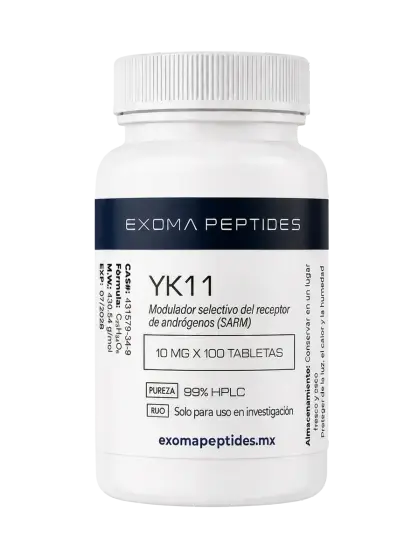
YK11
YK11 — reagent for research use (RUO).
Technical data
- Development code
- YK-11
Sizes and prices: 10 mg × 100 tablets $3,253 MXN ($325 MXN per mg).
Buy YK11 in Mexico: order online with nationwide shipping in 1-4 business days depending on region, with a tracking number. Prices in Mexican pesos. Material for research use only.
Identity and composition
YK11 is a synthetic steroidal research compound, derived from dihydrotestosterone (DHT) and classified as a SARM with myostatin-inhibiting properties. It is studied in preclinical models for its relationship with muscle differentiation and growth. Product for research use.
Chemical identity data confirmed in the reference block:
- Name: YK11 (synonyms: YK-11, YK 11)
- CAS number: 1370003-76-1
- Molecular formula: C25H34O6
- Molecular weight: 430.5 g/mol
- IUPAC name/extended synonym: (17alpha,20E)-17,20-[(1-methoxyethylidene)bis(oxy)]-3-oxo-19-norpregna-4,20-diene-21-carboxylic acid methyl ester
It is presented in the form of 10 mg × 100 tablets. Unlike peptides, YK11 is a small steroidal molecule, not an amino-acid sequence, so a peptide sequence does not apply.
Mechanism of action
YK11 is a synthetic steroid derived from DHT that acts as partial agonist of the androgen receptor (AR). Its distinctive feature compared with other SARMs is that, in experimental models, it induces the expression of follistatin in muscle cells, which in turn antagonizes the signaling of myostatin, a negative regulator of muscle growth. This combination —partial agonism of the AR plus the follistatin/myostatin pathway— is the basis of its description as a 'myostatin inhibitor' and has been associated in preclinical studies with myogenic differentiation (PMID 33588136).
The reported activity comes mainly from in vitro studies in myoblasts (the C2C12 line) and from animal models. It is important to note that the the magnitude of myostatin inhibition in humans is not established, and the mechanistic description must be interpreted in the context of preclinical research.
Pharmacokinetics
There are no formal published pharmacokinetic parameters of YK11 in humans: there are no data on plasma half-life, oral bioavailability, or Cmax.
The available human data are limited to an excretion study using deuterated YK11 aimed at anti-doping control. In that work, intact YK11 was not detected in urine, and multiple urinary metabolites were identified in unconjugated, glucuronidated, and sulfoconjugated forms; the unconjugated metabolites ceased to be detectable within less than 24 hours after administration, whereas the conjugated forms remained detectable for more than 48 hours (PMID 30379415).
Given the limited, non-clinical nature of these data, any pharmacokinetic interpretation should be considered preliminary.
Scientific evidence
The evidence on YK11 is preliminary and preclinical in nature. It is an exclusively research compound: there are no registered clinical trials nor regulatory approval as a drug, and the evidence is restricted to in vitro studies and animal models.
Among the indications explored, in a murine model of bacterial sepsis its role in the prevention of the associated muscle wasting and inflammation has been investigated; in that model, a reduction of proinflammatory cytokines and of mortality was observed (PMID 33588136). Likewise, it has been the object of metabolism and anti-doping control studies that classify it as a SARM with myostatin-inhibiting properties (PMID 30379415).
These findings should not be interpreted as evidence of safety or efficacy in humans.
Research applications
Product for research use.
Suitable for:
- In vitro studies of differentiation and muscle biology (e.g., myoblast models).
- Preclinical research in animal models on the follistatin/myostatin pathways and androgen receptor agonism.
- Studies of metabolism, excretion, and development of analytical/anti-doping methods.
- Chemical characterization and reference work in the laboratory.
Not applicable for:
- clinical use, clinical use, diagnostic or therapeutic.
- Sport use: it is a substance banned in sport, classified as a SARM by anti-doping agencies.
- Any application involving administration to people.
Research protocols
The literature reviewed does not include specific numerical doses used in the preclinical studies, so no quantitative schemes are reported here to avoid unsupported figures.
What is documented at a qualitative level is that the described activity comes from in vitro studies (C2C12 myoblasts) and animal models, including a murine model of sepsis (PMID 33588136), and from an elimination study with deuterated YK11 for anti-doping control (PMID 30379415). Any protocol must be defined according to each laboratory's experimental design and the corresponding primary literature.
Reconstitution
YK11 is supplied as tablets (10 mg × 100), that is, in solid, already-dosed form; it is not a peptide lyophilate, so reconstitution with bacteriostatic water —a technique specific to powdered peptides— not applicable to this presentation.
As a general laboratory-handling reference: bacteriostatic water is sterile water with approximately 0.9% benzyl alcohol and is used to reconstitute lyophilized powders, not solid oral forms. For in vitro work with synthetic steroids poorly soluble in water, standard laboratory practice is to prepare stock solutions in organic solvents compatible with the assay; each laboratory must follow its validated procedure and the corresponding data sheets.
Stability and storage
As a general laboratory-handling guide for a solid steroidal compound in tablets:
- Store in its original container, sealed, in a cool, dry place protected from light and from humidity. - Avoid exposure to heat and to repeated temperature cycles. - Once any working solution is prepared, handle it according to the laboratory procedure and protect it from light and temperature; solutions are usually less stable than the solid and should be prepared fresh.
The consulted literature does not include formal stability data for YK11, so these recommendations are standard handling practices and not specific parameters of the compound.
Safety profile
There are no human safety data from clinical trials for YK11. As a steroidal derivative with androgen receptor agonism, theoretical and anecdotal concerns of toxicity -including hepatotoxicity- common to SARMs have been raised; however, there are no controlled studies that specifically quantify them for YK11.
Additional considerations:
- It is a substance banned in sport, classified as a SARM by anti-doping agencies.
- It is not approved for clinical use and has no recognized clinical use.
- Strictly for research use, with the protective measures appropriate to handling laboratory compounds.
In the absence of controlled human data, any risk assessment should be considered incomplete.
Comparative context
Compared to SARMs non-steroidal —such as ostarine/enobosarm or LGD-4033—, YK11 is distinguished by its steroid structure, being a derivative of DHT.
In addition to the partial androgen receptor agonism that it conceptually shares with its class, the proposed mechanism of YK11 adds the induction of follistatin and inhibition of myostatin, which supports its promotion as a 'myostatin inhibitor'. This characteristic is what most differentiates it within the group.
It is important to emphasize that this combination is not clinically validated and that potency comparisons against other SARMs lack controlled human data, so any contrast should be taken as indicative and at a research level.
History and development
YK11 is a synthetic steroid developed as a derivative of dihydrotestosterone, with a modified steroid-type structure (conceptually related to gestrinone / 4-aza-steroids). It arose and has been studied in the field of preclinical research on compounds that act on the androgen receptor.
Its profile has been characterized mainly through in vitro studies (C2C12 myoblasts) and animal models, as well as in metabolism and anti-doping studies that classify it as a SARM with myostatin-inhibitory properties (PMID 30379415). It has not reached clinical development or regulatory approval as a drug.
FAQ
What is YK11 and what is it researched for?
YK11 is a synthetic steroidal compound derived from DHT, classified as a SARM with myostatin-inhibitory properties. It is investigated in preclinical models (in vitro and animal) for its relationship with muscle differentiation and growth. It is a product for research use, not for clinical use.
Is YK11 a peptide or a steroid?
It is a synthetic steroid, not a peptide. It is a small molecule derived from dihydrotestosterone (formula C25H34O6, molecular weight 430.5 g/mol), not an amino acid sequence.
How does YK11 act according to the preclinical literature?
It acts as a partial agonist of the androgen receptor and, in experimental models, induces follistatin, which antagonizes myostatin signaling, favoring myogenic differentiation (PMID 33588136). The magnitude of this inhibition in humans is not established.
Are there safety data for YK11 in humans?
No. There are no safety data from clinical trials. Theoretical and anecdotal concerns of toxicity have been raised, including hepatotoxicity, common to SARMs, but there are no controlled studies that quantify them for YK11. It is a substance prohibited in sport.
Does YK11 require reconstitution with bacteriostatic water?
No. It is supplied as solid tablets (10 mg × 100), not as a peptide lyophilizate, so reconstitution with bacteriostatic water does not apply to this presentation. Any in vitro preparation must follow the laboratory's validated procedure.
Does YK11 have clinical approval or registered trials?
No registered clinical trials or regulatory approval as a drug have been found. The evidence is limited to in vitro and animal-model studies, so it is a compound exclusively for preclinical research.
Customer reviews
Average rating: 4.8 out of 5, based on 5 customer ratings.
J. H. — 5/5
The compound presents optimal solubility in compatible assay media. The transparency of the product after reconstitution indicates a high purity, consistent with the internal HPLC reports. The shipment was punctual and the packaging guarantees the necessary thermal integrity.
I. P. — 5/5
Excellent presentation of the reagent for in vitro use. The transit time was reduced and the material arrived protected against light degradation. The results obtained in the study model are consistent with the purity declared by the supplier.
N. Q. — 5/5
Product received with detailed technical labeling and visible lot numbering. The lyophilization is uniform, without the presence of particles in suspension after dilution. A rigorous precision is observed in the weighing of the contents for experimental purposes.
K. M. — 5/5
The verification by means of the attached COA fully agrees with the mass spectrometry analysis carried out in our laboratory. The vial has a superior hermetic seal, preventing any risk of cross-contamination during handling in the research protocol.
M. V. — 4/5
The vial presents a solid structure and an adequate vacuum for reconstitution. Although the delivery time suffered a minor delay, the quality of the peptide and its stability at room temperature during the preparation process compensate for the initial logistical delay.
Scientific references (5)
Peer-reviewed literature on YK11, with its PubMed identifier when available:
- YK11 promotes osteogenic differentiation of BMSCs and repair of bone defects (Wang R et al. · Journal of molecular endocrinology · 2025) PMID 39660819.
- YK11 induces oxidative stress and mitochondrial dysfunction in hippocampus: The interplay between a selective androgen receptor modulator (SARM) and exercise (Dahleh MMM et al. · The Journal of steroid biochemistry and molecular biology · 2023) PMID 37468001.
- Myostatin inhibitor YK11 as a preventative health supplement for bacterial sepsis (Lee SJ et al. · Biochemical and biophysical research communications · 2021) PMID 33588136.
- (17alpha,20E)-17,20-[(1-methoxyethylidene)bis(oxy)]-3-oxo-19-norpregna-4,20-diene-21-carboxylic acid methyl ester (YK11) is a partial agonist of the androgen receptor (Kanno, et al. · Biological & Pharmaceutical Bulletin · 2011) PMID 21372378.
- Selective androgen receptor modulator, YK11, regulates myogenic differentiation of C2C12 myoblasts by follistatin expression (Kanno, et al. · Biological & Pharmaceutical Bulletin · 2013) PMID 23995658.
Full scientific profile: YK11 in the compendium — mechanism of action, studies and technical data sheet.
See the full category catalog: Orals · SARMs.