
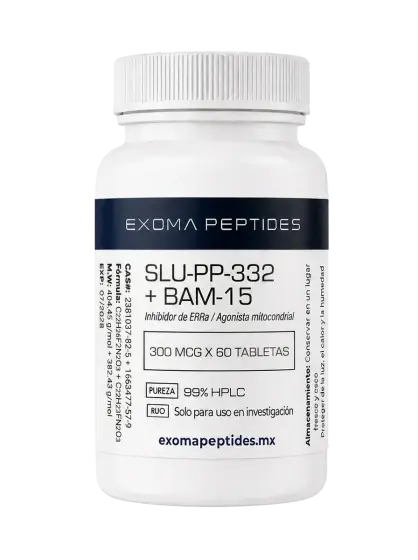
SLU-PP-332 + BAM-15 Capsule Blend
SLU-PP-332 + BAM-15 Capsule Blend — research reagent (RUO).
Technical data
- INN name
- SLU-PP-332 + BAM15 Capsule Blend
Sizes and prices: 300 mcg × 60 cápsulas (SLU 250 mcg + BAM15 50 mcg) $1,626 MXN (out of stock).
Buy SLU-PP-332 + BAM-15 Blend in Capsule in Mexico: order online with nationwide shipping in 1-4 business days depending on zone and tracking number. Prices in Mexican pesos. Material exclusively for research.
SLU-PP-332 + BAM-15 Capsule Blend is known internationally as SLU-PP-332 + BAM15 Capsule Blend (INN name in English). Buy SLU-PP-332 + BAM15 Capsule Blend in Mexico / buy SLU-PP-332 + BAM15 Capsule Blend in Mexico: research reagent (RUO) and nationwide shipping.
Identity and composition
El SLU-PP-332 + BAM-15 Capsule Blend is a research reagent that combines two distinct experimental compounds, not a single chemical entity, oriented to the study of mitochondrial energy metabolism and of the so-called "exercise mimetics". Each capsule in the catalog provides 250 mcg of SLU-PP-332 and 50 mcg of BAM15. Product for research use.
Because it is a mixture, there is no single CAS, molecular weight or formula: each component retains its own reference chemical identity.
- SLU-PP-332 — synthetic pan-ERR agonist (estrogen-related receptor). CAS 303760-60-3; formula C18H14N2O2; molecular weight 290.3; PubChem CID 5338394. IUPAC name: 4-hydroxy-N-[(E)-naphthalen-2-ylmethylideneamino]benzamide.
- BAM15 (BAM-15) - mitochondrial protonophore/uncoupler. CAS 210302-17-3; formula C16H10F2N6O; molecular weight 340.29; PubChem CID 565708. IUPAC name: 5-N,6-N-bis(2-fluorophenyl)-[1,2,5]oxadiazolo[3,4-b]pyrazine-5,6-diamine.
These identity constants are reference data verifiable in PubChem for each molecule separately.
Mechanism of action
The mixture combines two independent and complementary mechanisms which act at different points of energy metabolism. There is no peer-reviewed literature on the combination as such; what follows describes each component separately.
- SLU-PP-332 ("upstream" activation): it is a synthetic pan-ERR agonist that, in preclinical models, activates transcriptional programs associated with aerobic exercise in skeletal muscle, increasing the expression of metabolic genes such as PDK4 y PGC1alpha y favoreciendo la oxidación de ácidos grasos y el gasto energético en modelos murinos, por lo que se le describe como "mimético del ejercicio" (PMID 41850449).
- BAM15 ("downstream" action): it is a selective mitochondrial protonophore/uncoupler that transports protons to the mitochondrial matrix independently of ATP synthase, uncoupling nutrient oxidation from ATP production; a distinguishing feature is that it does not depolarize the plasma membrane (PMID 32409697).
On the whole, SLU-PP-332 would act by transcriptionally stimulating mitochondrial function via ERR, while BAM15 would uncouple the already existing oxidative phosphorylation. This complementarity is a mechanistic hypothesis, not a demonstrated combined effect.
Pharmacokinetics
The available pharmacokinetic data are per component and come solely from murine models; no verified human PK parameters were identified for either of the two compounds, and the exact half-life in humans is not available.
- BAM15: in mice it showed oral bioavailability, with measurable plasma exposure after administration by gavage and incorporated into the diet, increasing nutrient oxidation without raising body temperature (PMID 32409697).
- SLU-PP-332: in preclinical studies it was administered parenterally (intraperitoneally), with a short half-life described as a pharmacokinetic limitation that prompted the development of analogs with greater metabolic stability (PMID 41850449).
It is not possible to extrapolate these data to humans or to the capsule mixture.
Scientific evidence
The evidence is strictly preclinical (in vitro and rodent models) and limited to each component separately. No registered clinical trials in humans were identified for SLU-PP-332, BAM15, or the blend; the capsule combination does not have published studies.
- In preclinical studies, SLU-PP-332 it has been investigated as an exercise mimetic in contexts of metabolic syndrome, obesity, insulin sensitivity, and cardiac protection in mice (PMID 41850449).
- In murine models, BAM15 it has been investigated for diet-induced obesity, insulin resistance, hepatic steatosis and glycemic control (PMID 32409697).
The preliminary evidence must be interpreted with caution: findings in animals do not automatically translate to humans, and there are no data on the combination. Regulatory note: the World Anti-Doping Agency (WADA) prohibits exercise mimetics and metabolic modulators in sport.
Research applications
Product for research use.
Ideal for:
- In vitro and animal-model studies on energy metabolism, nutrient oxidation and mitochondrial biology.
- Exploratory research on ERR signaling (SLU-PP-332) and mitochondrial uncoupling (BAM15) as independent mechanisms.
- Work on characterization and development of analytical methods.
Not applicable for:
- Any form of human consumption, ingestion or administration.
- Diagnostic, therapeutic use or as a supplement.
- Sports contexts: exercise mimetics and metabolic modulators are prohibited by WADA.
The catalog doses (250 mcg SLU-PP-332 + 50 mcg BAM15 per capsule) do not correspond to any dose validated in the literature and must not be interpreted as a usage guideline.
Research protocols
There are no validated dosing protocols for the blend nor established human doses for any of the components. The available preclinical studies were carried out in animal models with schedules expressed in mg/kg (oral/dietary for BAM15 and parenteral for SLU-PP-332), which cannot be extrapolated to the catalog amounts (250 mcg SLU-PP-332 + 50 mcg BAM15 per capsule) (PMID 32409697; PMID 41850449).
The catalog doses do not correspond to any dose validated in the literature. The design of any experimental protocol is the responsibility of the qualified investigator and must start from primary sources and from the biosafety standards of their institution.
Reconstitution
This product is presented in solid oral capsule, so it does not require reconstitution for its handling as a reagent. Unlike lyophilized peptides, it is not dissolved with bacteriostatic water for its storage.
If an experimental protocol requires preparing solutions from the material, the choice of solvent depends on the solubility of each compound (SLU-PP-332 and BAM15 are small organic molecules, typically handled in organic solvents such as DMSO in in vitro work). This preparation must be carried out by qualified personnel following laboratory procedures and the corresponding safety data sheets.
Stability and storage
As a general laboratory handling guide for compounds of this type:
- Unopened capsules: store them in their original, closed container, protected from light, moisture, and heat. Cold (refrigerated) storage prolongs stability; consult the batch data sheet.
- Prepared solutions (if the protocol requires them): they are less stable than the solid material; aliquots are handled to minimize freeze-thaw cycles and are kept frozen.
- Label the aliquots with date and contents, and avoid repeated exposure to room temperature.
These are standard handling practices; the exact stability parameters for this mixture are not documented in the literature.
Safety profile
The safety data are limited to animal models and by component; there is no human safety profile or data on the combination. Not suitable for clinical use.
- BAM15: in the mouse study, food intake, lean mass, and body temperature were not altered, and the biochemical/hematological markers of toxicity (ALT, AST, creatinine, BUN) were comparable to control (PMID 32409697).
- SLU-PP-332: no formal toxicology studies were identified.
Class warning: mitochondrial uncouplers (historically 2,4-dinitrophenol, DNP) have a narrow therapeutic window and a risk of hyperthermia and toxicity at high doses. BAM15 was designed to mitigate that risk through its mitochondrial selectivity, but it lacks clinical validation.
Handle the product with personal protective equipment and in accordance with your institution's biosafety standards.
Comparative context
This is a two-component product with complementary but distinct mechanisms:
- SLU-PP-332 acts "upstream", transcriptionally activating mitochondrial biogenesis and function via ERR receptors. It is the reference compound (benchmark) of its class of synthetic ERR agonists, from which analogs with better ligand efficiency, solubility and metabolic stability have been developed (PMID 41850449).
- BAM15 acts "downstream", uncoupling the already existing oxidative phosphorylation. Compared with other uncouplers, it is distinguished from 2,4-dinitrophenol (DNP) by its mitochondrial selectivity, without depolarizing the plasma membrane (PMID 32409697).
In summary, one stimulates the mitochondrial machinery and the other modulates its energy efficiency. The combination of both in a capsule is a catalog formulation without support in published studies.
History and development
SLU-PP-332 emerged as one of the first synthetic pan-ERR agonists and has become established as the reference compound of its class in research on "exercise mimetics." Its short half-life in preclinical models motivated a chemical optimization effort that gave rise to analogs with greater ligand efficiency, solubility, and metabolic stability (PMID 41850449).
BAM15 was developed as a selective mitochondrial uncoupler intended to overcome the safety limitations of classical uncouplers such as DNP; in 2020 its oral bioavailability and its effect on nutrient oxidation were reported in models of diet-induced obesity in mice (PMID 32409697).
Both remain in a strictly preclinical phase, with no identified human clinical trials; their combination in a capsule is a research-reagent format, not a clinical development.
FAQ
What is the SLU-PP-332 + BAM-15 blend and what is it studied for?
It is a research reagent that combines two distinct experimental compounds: SLU-PP-332, a pan-ERR agonist or "exercise mimetic", and BAM15, a mitochondrial uncoupler. They are studied preclinically in the context of energy metabolism. Product for research use; not for clinical use.
Are there human studies of this combination?
No. No registered human clinical trials were identified for SLU-PP-332, BAM15, or the mixture. All the available evidence is preclinical (in vitro and rodent models) and is limited to each component separately.
Does it have a single CAS or molecular weight?
No, because it is a mixture of two compounds. Each retains its identity: SLU-PP-332 (CAS 303760-60-3; C18H14N2O2; MW 290.3) and BAM15 (CAS 210302-17-3; C16H10F2N6O; MW 340.29), both registered in PubChem.
Do the 250 mcg and 50 mcg doses correspond to any validated regimen?
No. The catalog quantities do not correspond to any dose validated in the literature and cannot be extrapolated to the mg/kg doses used in murine studies. They do not represent a recommendation for use.
How is the product stored?
As a general guideline, keep the capsules in their original closed container, protected from light, humidity and heat, preferably refrigerated. Any solution prepared for a protocol is handled in aliquots and frozen to minimize thaw cycles.
Is it relevant to competitive sport?
It is not suitable for clinical use and, in addition, the World Anti-Doping Agency (WADA) prohibits exercise mimetics and metabolic modulators in sport. Its use is exclusively as a research reagent.
Customer reviews
Average rating: 4.8 out of 5, based on 5 customer ratings.
I. P. — 5/5
Excellent product presentation with clear technical labeling that includes lot number and re-analysis date. The disintegration kinetics observed in controlled acidic media agree with what is expected for this research formulation. The high-density packaging adequately protected the samples during logistics transport.
O. C. — 5/5
The integrity of the lot was verified by means of the attached certificate of analysis, which is consistent with the results obtained in our mass spectrum. Capsule dosing facilitates handling in complex experimental protocols, avoiding accidental dispersion during weighing in the fume hood. The reported purity is greater than 98 percent.
S. D. — 5/5
The mixture of SLU-PP-332 and BAM-15 presented adequate content uniformity in the liquid chromatography analysis. The material was received perfectly sealed, with packaging that guarantees protection against photodegradation of the active components. Domestic delivery was carried out within the anticipated 48-hour window.
A. S. — 4/5
The combination of compounds showed acceptable solubility within the parameters of the in vitro protocol, although a slight deviation was observed in the total dissolution time of the excipient. Nonetheless, the potency measured by HPLC remains within the error margins accepted for analytical-grade reagents. The shipment was secure.
F. R. — 5/5
The product arrived in optimal thermal storage conditions. After physical inspection, no visible impurities or caking were observed in the powder contained in the units. The batch traceability allowed rapid integration into our database for follow-up of the metabolic research model.
Scientific references (6)
There is no peer-reviewed literature on SLU-PP-332 + BAM-15 Capsule Blend as a combination. What follows is the literature on each component separately, with its PubMed identifier:
- About SLU-PP-332: Synthetic ERRα/β/γ Agonist Induces an ERRα-Dependent Acute Aerobic Exercise Response and Enhances Exercise Capacity (Billon, et al. · ACS Chemical Biology · 2023) PMID 36988910.
- About BAM-15: Identification of a novel mitochondrial uncoupler that does not depolarize the plasma membrane (Kenwood, et al. · Molecular Metabolism · 2014) PMID 24634817.
- About SLU-PP-332: A Synthetic ERR Agonist Alleviates Metabolic Syndrome (Billon, et al. · Journal of Pharmacology and Experimental Therapeutics · 2024) PMID 37739806.
- About BAM-15: Mitochondrial uncoupler BAM15 reverses diet-induced obesity and insulin resistance in mice (Alexopoulos, et al. · Nature Communications · 2020) PMID 32409697.
- About SLU-PP-332: Novel Pan-ERR Agonists Ameliorate Heart Failure Through Enhancing Cardiac Fatty Acid Metabolism and Mitochondrial Function (Xu, et al. · Circulation · 2024) PMID 37961903.
- About BAM-15: BAM15-mediated mitochondrial uncoupling protects against obesity and improves glycemic control (Axelrod, et al. · EMBO Molecular Medicine · 2020) PMID 32519812.
Full scientific profile: SLU-PP-332 + BAM-15 Capsule Blend in the compendium — mechanism of action, studies and technical data sheet.
See the full category catalog: Orals.