Testolone (RAD-140)
Testolone (RAD-140) — reagent for research use (RUO).
Technical data
- INN name
- Testolone
- Development code
- RAD-140
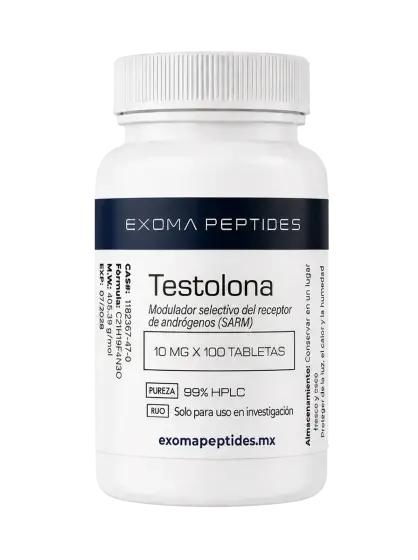
Sizes and prices: 10 mg × 100 tablets $2,322 MXN ($232 MXN per mg).
Buy Testolone (RAD-140) in Mexico: order online with nationwide shipping in 1-4 business days depending on zone and tracking number. Prices in Mexican pesos. Material for research use only.
Testolone (RAD-140) is known internationally as Testolone (English INN name). Buy Testolone in Mexico / comprar Testolone en México: reagent for research use (RUO) and nationwide shipping.
Testolona (RAD-140) is also searched as: RAD-140.
Identity and composition
La Testolone (RAD-140) is a non-steroidal selective androgen receptor modulator (SARM), a small molecule (it is not a peptide) studied in preclinical models and in early clinical research for its affinity to the androgen receptor. This product is presented as 10 mg per tablet, 100 tablets.
Chemical identity (reference data):
- CAS number: 1182367-47-0
- Molecular formula: C20H16ClN5O2
- Molecular weight: 393.8 g/mol
- PubChem CID: 44200882
- Synonyms: RAD140, RAD-140, Testolone, Vosilasarm (INN)
Its structure contains an oxadiazole/benzonitrile core. Being a small molecule, an amino acid sequence does not apply.
Product for research use.
Mechanism of action
RAD-140 binds to the androgen receptor (AR) with high affinity and specificity, behaving as AR agonist. In preclinical models it has been observed tissue selectivity: anabolic activation in tissues such as skeletal muscle with lower relative androgenic activity in the prostate.
In AR+/ER+ breast cancer cell lines it acts as an AR agonist and has been described as suppressing growth through a mechanism that includes the AR-mediated repression of ESR1; in the preclinical evidence it activates the AR in breast cancer cells but not in prostate cancer cells (Clin Cancer Res 2017; PMID 28974548).
This mechanism is under study and should not be interpreted as an established clinical effect in humans.
Pharmacokinetics
The pharmacokinetic parameters of RAD-140 were not verified in open primary sources. It is documented to be of oral administration (capsule formulation used in trial NCT03088527). The numerical values of half-life, AUC, and Cmax are not confirmed in a primary source and are listed as unverifiable.
Scientific evidence
The available evidence is preliminary and mostly preclinical. The most advanced documented clinical study is a Phase 1 trial, first in humans (NCT03088527) in postmenopausal women with hormone-receptor-positive breast cancer, which is listed as completed.
The mechanistic signal of antitumor activity comes mainly from preclinical models (AR/ER+ cell lines and xenografts), including its combination with the CDK4/6 inhibitor palbociclib (Clin Cancer Res 2017; PMID 28974548). The oncological indication studied should be considered early research, without confirmatory results from advanced phases verified here. RAD-140 is not approved by regulators for any clinical use.
Research applications
Ideal for (research context):
- In vitro and in vivo studies on the androgen receptor and its selective modulation.
- Preclinical research in AR+/ER+ breast cancer models.
- Analytical reference work and characterization of non-steroidal SARMs.
Not applicable for:
- clinical use of any kind.
- Use in bodybuilding or performance enhancement (not authorized; it appears on WADA's lists of substances prohibited in sport).
- Clinical or therapeutic use, given that it does not have regulatory approval.
Product for research use.
Research protocols
The documented clinical trial (NCT03088527) used a oral formulation; however, the literature consulted provides no milligram doses or verified dosing schedules from studies, so no dosing figures are specified.
Any experimental design must be based on reviewed protocols, primary literature, and appropriate laboratory controls. No dose recommendations for use in humans are offered because the product is not for clinical use.
Reconstitution
Unlike lyophilized peptides, the Testolone (RAD-140) is a small molecule presented in tablets, so does not require reconstitution with bacteriostatic water.
As a general laboratory reference, bacteriostatic water (water with ~0.9% benzyl alcohol) is used to reconstitute lyophilized compounds, which does not correspond to this tablet format. For analytical preparations (for example, dissolution in compatible solvents), follow the standard laboratory techniques and the guide of the corresponding method.
Stability and storage
As a standard laboratory handling guide: store the tablets in their the original closed container, protected from light, moisture, and heat, in a cool, dry place. For prolonged storage, it is usually preferred refrigeration or freezing, avoiding repeated temperature cycles.
Handle with clean and dry material to prevent degradation by moisture. These are general handling practices; they do not replace the specific conditions determined by the analytical protocol.
Safety profile
The safety profile must be interpreted with caution. In the literature there have been documented multiple case reports of drug-induced liver injury (DILI) associated with the use of RAD-140, typically in a bodybuilding context. A verified case describes severe liver injury with hyperbilirubinemia (Aust Prescr 2024; PMID 38444893); the published patterns include injury cholestatic or hepatocellular and jaundice, and in the reported cases the injury resolved after discontinuing the compound.
RAD-140 is listed as SARM on the list of substances prohibited in sport (WADA). This summary reflects documented reports and does not constitute a complete safety profile or a recommendation for use. We reiterate: product for research use.
Comparative context
As Non-steroidal SARM, RAD-140 differs from steroidal androgens (such as testosterone) by its theoretical tissue selectivity: in preclinical models it shows a relatively greater anabolic effect versus the androgenic one.
Compared to most research SARMs oriented toward muscle mass, RAD-140 stands out for having been studied specifically as AR agonist with antitumor activity in AR/ER+ breast cancer, a mechanism distinct from the rest of its class. It should be emphasized that, despite the catalog classification, is not a peptide, but rather a small molecule.
History and development
RAD-140 was originally developed by Radius Health as an oral-administration candidate. Its most advanced documented clinical trajectory is the Phase 1 trial, first in humans (NCT03088527) in postmenopausal women with hormone-receptor-positive breast cancer, which is listed as completed with a small number of patients enrolled.
Most of the efficacy evidence comes from preclinical models (AR/ER+ cell lines and xenografts). It is assigned the international nonproprietary name Vosilasarm (INN), although this status was not confirmed in an open primary regulatory source. To date has no regulatory approval for clinical use.
FAQ
Is Testolone (RAD-140) a steroid or a peptide?
Neither. It is a non-steroidal selective androgen receptor modulator (SARM), that is, a small molecule. It is not a peptide and does not share the structure of steroidal androgens such as testosterone.
What has RAD-140 been researched for?
It has been studied mostly in preclinical models as an androgen receptor agonist, including its activity in AR+/ER+ breast cancer. Its most advanced documented clinical trial is a Phase 1 (NCT03088527). The evidence is preliminary and it is not approved for clinical use.
Can RAD-140 be consumed?
No. This product is exclusively for research use and not for clinical use. It is not authorized for therapeutic use or for bodybuilding, and it appears on the WADA list of prohibited substances.
What safety risks have been documented?
The literature reports cases of drug-induced liver injury (DILI), including severe liver injury (Aust Prescr 2024; PMID 38444893), typically in a bodybuilding context. The patterns include cholestatic or hepatocellular injury and jaundice.
What is its reference chemical identity?
Its CAS number is 1182367-47-0, its molecular formula C20H16ClN5O2 and its molecular weight 393.8 g/mol (PubChem CID 44200882). As it is a small molecule, it has no amino acid sequence.
Does RAD-140 need reconstitution with bacteriostatic water?
No. It comes in 10 mg tablets and, being a small molecule, does not require reconstitution. Bacteriostatic water is used for lyophilized peptides, a format distinct from this product.
Customer reviews
Average rating: 4.8 out of 5, based on 5 customer ratings.
I. P. — 5/5
The reagent was received in packaging designed to minimize degradation from light exposure. The labeling meets the required technical standards, clearly detailing the lot and concentration. The consistency of the lyophilized powder facilitates precise handling in a laboratory setting. It faithfully matches the specifications.
E. N. — 4/5
The material presents acceptable purity consistent with the sector's technical standards. Although the vial seal is adequate, a slight difficulty was observed in removing the vial cap compared with previous lots; however, this did not affect the integrity of the contents or the stability of the reagent in the experimental phase.
I. P. — 5/5
The reconstitution of the reagent was clean and residue-free, allowing homogeneous dosing for use in preclinical research. Delivery was punctual and the secondary packaging provided the mechanical protection necessary to keep the molecular structure of the peptide/compound stable during transit. No inconsistencies detected.
J. R. — 5/5
The RAD-140 sample presented complete solubility and optimal transparency after reconstitution in the designated medium. The vial's security seal was intact, guaranteeing the compound's integrity for its analysis in controlled experimental models. Shipped on time and in proper form according to the established deadlines.
H. S. — 5/5
In-house HPLC analysis confirms consistency with the Certificate of Analysis (COA) provided by the manufacturer. No visible impurities or particles in suspension were detected after mixing, which validates the quality of this 10mg batch for in vitro protocols. The per-unit dosing is precise.
Scientific references (7)
Peer-reviewed literature on Testolone (RAD-140), with its PubMed identifier where available:
- Selective androgen receptor modulator abuse-induced heart failure: catastrophic effects of RAD-140 (Testolone) (Skorupski WJ et al. · Polish archives of internal medicine · 2024) PMID 38864168.
- RAD-140 Drug-Induced Liver Injury (Leung K et al. · Ochsner Journal · 2022) PMID 36561105.
- Acute Myocarditis From the Use of Selective Androgen Receptor Modulator (SARM) RAD-140 (Testolone) (Padappayil RP et al. · Cureus · 2022) PMID 35233331.
- Selective Androgen Receptor Modulator RAD140 Inhibits the Growth of Androgen/Estrogen Receptor-Positive Breast Cancer Models with a Distinct Mechanism of Action (Yu, Z, et al. · Clinical Cancer Research · 2017) PMID 28974548.
- Selective androgen receptor modulator RAD140 is neuroprotective in cultured neurons and kainate-lesioned male rats (Jayaraman, A, et al. · Endocrinology · 2014) PMID 24428527.
- A First-in-Human Phase 1 Study of a Novel Selective Androgen Receptor Modulator (SARM), RAD140, in ER+/HER2- Metastatic Breast Cancer (LoRusso, P, et al. · Clinical Breast Cancer · 2022) PMID 34565686.
- Preclinical assessment of the selective androgen receptor modulator RAD140 to increase muscle mass and bone mineral density (Puskas, J, et al. · Physiological Reports · 2025) PMID 40680216.
Full scientific profile: RAD-140 (Testolone) in the compendium — mechanism of action, studies and technical data sheet.
See the full category catalog: Orals · SARMs.