5-Amino-1MQ Oral
5-Amino-1MQ Oral — research reagent (RUO).
Technical data
- INN name
- 5-Amino-1MQ
- CAS
- 685079-15-6
- Molecular formula
- C10H11N2+
- Molecular weight
- 159.21 g/mol
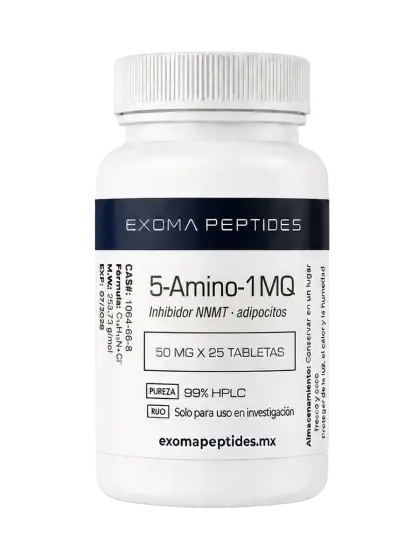
Sizes and prices: 50 mg × 25 tablets $1,699 MXN ($34 MXN per mg).
Buy 5-Amino-1MQ Oral in Mexico: order online with nationwide shipping in 1-4 business days depending on zone and tracking number. Prices in Mexican pesos. Material for research use only.
5-Amino-1MQ Oral is known internationally as 5-Amino-1MQ (INN name in English). Buy 5-Amino-1MQ in Mexico / buy 5-Amino-1MQ in Mexico: research reagent (RUO) and nationwide shipping.
5-Amino-1MQ Oral is also searched as: 5-amino-1-methylquinolinium, 5-amino-1-metilquinolinio, 5-amino-1-methylquinolin-1-ium.
Identity and composition
El 5-Amino-1MQ is the cation 5-amino-1-methylquinolinium, a small heteroaromatic molecule that is commonly marketed as salt, frequently the iodide. It is not a peptide or a peptide derivative. Synonyms and nomenclature variants in use: 5-amino-1MQ, 5A1MQ, 5-amino-1-methylquinolinium, 5-amino-1-methylquinolinium iodide. It has no assigned INN name or industrial pharmaceutical development code; it comes from academic medicinal chemistry, so in the literature it appears by its chemical name.
Molecular mass of the cation ≈ 159 g/mol; as the iodide salt, ≈ 286 g/mol. The number CAS differs according to the declared salt by each supplier, so a single value is not reproduced here: it must be verified against the identity and salt indicated on the Batch COA.
Pharmacological class: inhibitor of nicotinamide N-methyltransferase (NNMT), aromatic quaternary ammonium cation with a permanent positive charge.
Regulatory status: is not approved as a medication by COFEPRIS, the FDA, or the EMA, it has no authorized indication in any jurisdiction and is not a recognized pharmaceutical ingredient. It is supplied as material exclusively for research.
Mechanism of action
La NNMT occupies a node between two pathways: one-carbon metabolism and that of NAD+. It methylates the nicotinamide using SAM as a donor, generating MNA and S-adenosyl-L-homocysteine. Each turn of the cycle removes nicotinamide from the NAD+ salvage mediated by NAMPT and consumes one methyl equivalent. In tissues with elevated NNMT, that subtraction ceases to be marginal and begins to shape the local redox state and methyl balance.
5-Amino-1MQ is a small-molecule inhibitor of this enzyme. Structurally it mimics the methylated product at the nicotinamide site, and its interest as a reagent derived from the fact that, unlike the more potent bisubstrate inhibitors, crosses cell membranes well enough to be used in whole cell and in animal.
What is not established: selectivity relative to other SAM-dependent methyltransferases is not exhaustively characterized; the exact mechanism of cellular entry of a permanently charged cation is not resolved and mediated transport has been invoked without conclusive demonstration; it is not known whether sustained inhibition shifts the SAM/homocysteine equilibrium in a relevant way; and the MNA is not an inert metabolite —has described vascular signaling activity—, so suppressing its production does not automatically equate to a benefit. None of these points is resolved in humans.
Pharmacokinetics
Qualitatively, 5-Amino-1MQ is a quaternary ammonium cation with a permanent positive charge. That trait predicts, from the outset, low passive diffusion across lipid membranes and, by extension, limited intestinal absorption; however, preclinical works describe it as sufficiently permeable in whole cells, which suggests the involvement of transport mechanisms that are not identified with certainty. Its salt character makes it appreciably water-soluble.
In the open primary sources reviewed, no confirmed value for half-life, oral bioavailability, Cmax, Tmax or AUC was found for 5-Amino-1MQ, neither in humans nor with reproducibility between studies in rodents. The figures that circulate in commercial material differ between sources and no specific value is reproduced here.
Nor were published studies of metabolism or specific elimination pathways for this compound found. For quaternary cations in general, predominantly renal elimination is described, but extrapolating that behavior to this specific molecule would be an assumption, not a fact. There are no oral pharmacokinetic studies in humans or bioequivalence studies of commercial tablets.
Scientific evidence
The level of evidence for 5-Amino-1MQ is preclinical. What has been published consists of enzymatic assays with NNMT, cell cultures (adipocytes, myoblasts, tumor lines) and in vivo studies in rodents, mainly models of diet-induced obesity. In those models reductions in fat mass and changes in metabolic markers have been described, but are findings in animals, with small cohorts and short periods, and they do not automatically translate to human physiology.
No published clinical trials of 5-Amino-1MQ in humans were located, nor phase I. Nor was an open-access regulatory toxicology dossier located. The compound is not approved as a medication by COFEPRIS, the FDA, or the EMA, and its presence on the market as an over-the-counter product does not constitute an assessment of safety or efficacy by any authority.
La the oral route has even less support than the parenteral route: much of the in vivo rodent data comes from intraperitoneal administration, and no published studies of oral pharmacokinetics in humans or of the bioequivalence of the commercial tablets were found. Any conclusion about the performance of an oral tablet in a human organism is, today, unverified extrapolation.
Research applications
Product for research use. 5-Amino-1MQ is used as pharmacological tool to interrogate the NNMT pathway in experimental systems. Applications described in the preclinical literature and in laboratory work:
- Biochemistry of methylation: study of the consumption of nicotinamide and of S-adenosyl-L-methionine in cell extracts and in enzymatic assays with recombinant NNMT.
- NAD+ metabolism: in vitro models comparing the inhibition of nicotinamide catabolism versus the supply of precursors.
- Adipocyte biology: differentiation, lipogenesis, and gene expression in murine preadipocytes and adipocytes.
- Skeletal muscle: proliferation and differentiation of myoblasts and satellite cells in culture.
- Experimental oncology: tumor lines with NNMT overexpression.
- Analytical chemistry: comparison standard in identification by HPLC or mass spectrometry.
All these uses are for the laboratory. Material exclusively for research; it is not a medicine or a supplement.
Research protocols
In the preclinical literature, in vitro studies with 5-Amino-1MQ usually work in the micromolar range on cell cultures, with incubations of hours to days depending on the endpoint measured (enzymatic activity, NAD+ content, cell differentiation). In the in vivo studies, administration to rodents has been carried out primarily via the intraperitoneal route, and to a lesser extent orally, with doses expressed in mg per kg of body weight per day over weeks. The specific figures differ between publications and are not reproduced here, nor is any administration regimen offered.
This information is documented solely as bibliographic context for experimental design. It does not constitute a dosage regimen, it is not transferable to people, and this material is not intended for human or veterinary administration under any circumstances. There are no published clinical trials that would allow a human range to be derived, and the absence of oral pharmacokinetic data in humans makes any animal-to-human dose conversion speculative. All work must be carried out in appropriate facilities, by trained personnel and under the applicable institutional protocols.
Reconstitution
This product is a oral solid in tablet (50 mg per tablet, 25 tablets per presentation) y does not require reconstitution: it is not supplied with bacteriostatic water or with a solvent, and should not be treated as a lyophilized vial.
If a laboratory protocol requires a stock solution, two points must be taken into account. First, the tablet contains compression excipients (binders, fillers, lubricants) that do not dissolve completely and that can interfere in enzymatic, cell viability, or quantification assays; for demanding in vitro work it is preferable to start from reference-grade solid material instead of a finished pharmaceutical form. Second, as a quaternary salt the compound is appreciably water-soluble, and also supports DMSO when the experimental system tolerates it; in cell culture it is advisable to keep the organic solvent at the usual minimum fraction and to compare against a vehicle control.
All preparation must be done by gravimetric weighing with batch record, be filtered if the assay requires it, and be labeled with concentration, solvent, and date. Material exclusively for research; do not prepare for human administration.
Stability and storage
El solid is the most stable form of this material. As a low-molecular-weight salt, it does not share the fragility of lyophilized peptides, but it is sensitive to humidity and light. It is stored in its original sealed packaging, protected from light, in a dry environment and at a controlled temperature; the refrigeration (2-8 °C) or freezing in an airtight container prolong shelf life in long-term storage, always allowing the container to reach room temperature before opening it to avoid condensation on the solid.
The stock solutions are less stable than the solid. Preparing them fresh is recommended when the assay allows; if they must be stored, aliquot them in single-use volumes, protect them from light, and keep them frozen, avoiding repeated freeze-thaw cycles. Aqueous solutions exposed to room temperature for prolonged periods should be discarded rather than reused. Any turbidity, color change or precipitate invalidates the preparation.
The identity and purity correspond to the certificate of analysis (COA) of the lot, which is the valid reference for this specific material; it is issued per lot and must be consulted together with the receiving documentation.
Safety profile
There are no safety data in humans. No published clinical trials, formal tolerability reports, or open-access regulatory toxicological dossier were located for 5-Amino-1MQ. This does not mean it is safe: it means that has not been studied.
In murine models, the available studies describe administration over weeks with no manifest toxicity reported, but this is small, short studies not designed as toxicology: they did not evaluate chronic exposure, genotoxicity, reproduction, or carcinogenicity, and their absence of findings does not equate to an established safety profile.
There are also open mechanistic considerations that should not be minimized. NNMT participates in the methyl group metabolism, so that its sustained inhibition could shift the balance of SAM and homocysteine with uncharacterized consequences. The 1-methylnicotinamide whose level it aims to reduce has described signaling activity, including vascular signaling. And NNMT expression varies between tissues and between tumors, so the effects are context-dependent and not necessarily favorable.
Material for research use exclusively. Handle with personal protective equipment and consult the batch's safety data sheet.
Comparative context
Compared with the NAD+ precursors (nicotinamide, nicotinamide riboside, nicotinamide mononucleotide), 5-Amino-1MQ acts on the opposite side of the equation: instead of providing substrate, it seeks slow its consumption via methylation. They are complementary, non-equivalent approaches, and the direct comparison between them is not experimentally resolved.
Compared to others NNMT inhibitors described in the literature (bisubstrate analogs and quinolinium derivatives more potent in enzymatic assay), 5-Amino-1MQ became popular not for potency but for its cellular permeability in simple formats, which made it a reference compound for whole-cell work.
Compared to the metabolic compounds in the EXOMA catalog with real human clinical evidence -the incretin agonists, for example-, the difference in level of evidence is categorical: those have published randomized trials and regulatory approvals; 5-Amino-1MQ has neither of the two things. Its situation more closely resembles that of other purely preclinical oral compounds in the catalog, such as SLU-PP-332: attractive targets, rodent data, zero published human validation. All of them are material exclusively for research.
History and development
Interest in NNMT as a metabolic target consolidated around 2014, when it was published that silencing the enzyme with antisense oligonucleotides protected mice against diet-induced obesity. That result opened a line of academic medicinal chemistry aimed at small-molecule inhibitors of NNMT.
From that effort two families emerged: bisubstrate analogs of high potency in enzymatic assay but with poor passage across membranes, and simple quinolinium derivatives, among them 5-Amino-1MQ, described around 2017-2018 as cell-permeable inhibitors usable in animals. Their value was that of tool compound: enough to ask what happens when NNMT is inhibited in a living organism.
Unlike a conventional pharmaceutical candidate, 5-Amino-1MQ did not publicly advance to a clinical program: no record of a clinical research application or human trials was found. Its diffusion occurred through the channel of research compounds and the over-the-counter gray market, that is, before any formal clinical evaluation and in its absence. Its current status remains that of an experimental reagent without regulatory approval in any jurisdiction.
FAQ
Are there published human clinical trials of 5-Amino-1MQ?
No. In the open primary sources reviewed, no published clinical trial, not even phase I, was located with 5-Amino-1MQ. All the available evidence is preclinical: enzymology, cell culture and rodent models. The compound is not approved as a medicine by COFEPRIS, the FDA or the EMA.
Does it really increase NAD+?
It is the central hypothesis of the compound, not an established fact in humans. By inhibiting NNMT, the methylation of nicotinamide is reduced, and it has been proposed that more substrate remains available for the NAD+ salvage pathway. Increases in NAD+ have been observed in experimental cellular and tissue systems, with magnitude varying by model. It has not been demonstrated in humans.
Does it require reconstitution?
No. The product is supplied as a solid 50 mg tablet and does not include bacteriostatic water or a solvent. If the laboratory protocol requires a stock solution, it is prepared by weighing reference-grade solid material, since the tablet contains excipients that interfere in in vitro assays.
What is its half-life?
In the open primary sources reviewed, no confirmed value for half-life, oral bioavailability, Cmax or Tmax was located. The figures circulating in commercial material differ between sources and no specific value is reproduced here. Any number presented as a firm human datum should be considered unverified.
Why is it said that the oral route has less support?
Because most in vivo studies in rodents used intraperitoneal administration, not oral. In addition, 5-Amino-1MQ is a quaternary ammonium cation with permanent charge, a trait that tends to limit passive intestinal absorption. No published studies of oral pharmacokinetics in humans or of bioequivalence of commercial tablets were located.
Is it a peptide?
No. It is a small molecule, a low-molecular-weight quinolinium cation, chemically very distinct from the peptides in the catalog. This makes it more robust against hydrolysis and temperature cycles, but it does not change its framing: it is material exclusively for research.
Customer reviews
Average rating: 4.8 out of 5, based on 5 customer ratings.
E. N. — 5/5
The morphology of the lyophilizate is consistent across different units of the same order. After reconstitution, the solution maintains an optimal optical clarity for in vitro assays. The labeling includes technical information essential for safe handling in the laboratory.
R. C. — 5/5
The material presents a purity consistent with the attached certificate of analysis. The solubility of the compound in aqueous media is immediate, without the presence of suspended residues or turbidity. The packaging adequately protects the structural integrity of the vial during transit.
S. B. — 4/5
The compound exhibits the physicochemical properties expected for 5-Amino-1MQ. Although the delivery time suffered a slight delay of 24 hours, the quality of the thermal packaging preserved the integrity of the material. The solubility in organic solvents is complete.
S. B. — 5/5
Product received with intact safety seals and complete technical documentation. The internal analyses ratify a purity greater than 98%, aligned with the supplier's COA. The compound demonstrates adequate thermal stability under controlled storage conditions.
E. G. — 5/5
The homogeneity of the lot was verified by means of spectroscopy tests, confirming the chemical identity of 5-Amino-1MQ. The presentation in 50mg vials facilitates precise dosing in preclinical research protocols. Delivery time within the stipulated margins.
Scientific references (8)
Peer-reviewed literature on 5-Amino-1MQ Oral, with its PubMed identifier where available:
- Selective and membrane-permeable small molecule inhibitors of nicotinamide N-methyltransferase reverse high fat diet-induced obesity in mice (Neelakantan, et al. · Biochemical Pharmacology · 2018) PMID 29155147.
- Reduced calorie diet combined with NNMT inhibition establishes a distinct microbiome in DIO mice (Dimet-Wiley, et al. · Scientific Reports · 2022) PMID 35013352.
- Nicotinamide N-methyltransferase inhibition mitigates obesity-related metabolic dysfunction. (Babula JJ, et al. · Diabetes Obes Metab · 2024) PMID 39161060.
- Development & validation of LC-MS/MS assay for 5-amino-1-methyl quinolinium in rat plasma: Application to pharmacokinetic and oral bioavailability studies. (Awosemo O, et al. · J Pharm Biomed Anal · 2021) PMID 34304009.
- NAD(+) metabolism enzyme NNMT in cancer-associated fibroblasts drives tumor progression and resistance to immunotherapy by modulating macrophages in urothelial bladder cancer. (Yang M, et al. · J Immunother Cancer · 2024) PMID 39067875.
- Small Molecule Inhibitors of Nicotinamide N-Methyltransferase Enzyme for the Treatment of Osteosarcoma and Merkel Cell Carcinoma: Potential for the Development of a Targeted Therapeutic Strategy. (Pompei V, et al. · Biomolecules · 2025) PMID 41301471.
- Small molecule inhibitor of nicotinamide N-methyltransferase shows anti-proliferative activity in HeLa cells. (Akar S, et al. · J Obstet Gynaecol · 2021) PMID 33645410.
- Nicotinamide N-methyltransferase in endothelium protects against oxidant stress-induced endothelial injury. (Campagna R, et al. · Biochim Biophys Acta Mol Cell Res · 2021) PMID 34153425.
Full scientific profile: 5-Amino-1MQ Oral in the compendium — mechanism of action, studies and technical data sheet.
See the full category catalog: Orals.
Otras presentaciones de 5-Amino-1MQ Oral
Guides and articles about 5-Amino-1MQ Oral
Lecturas del blog de EXOMA que la editorial asoció a este compuesto: